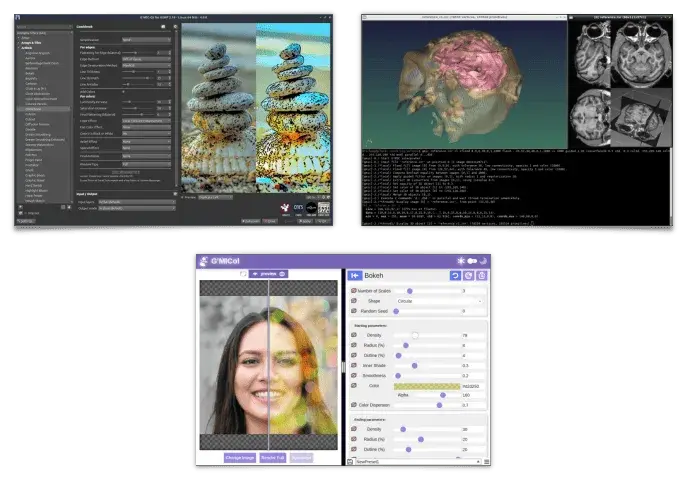
G’MIC can feel less like one application and more like a drawer where somebody has stored seventeen years of pixel experiments while refusing to throw away the weird ones.
Version 4.0 of the open-source image-processing framework keeps that approach intact. The GREYC team highlights new G’MIC-Qt filters including Pixel Stretch, Marker Drawing and Heightfield Warp, alongside new language commands, creative-coding scripts and a repository of interactive demonstrations.1
The useful part is not the size of the feature list. It is that these operations remain composable. G’MIC exists as a command-line tool, a library and a graphical interface used alongside image applications. A filter can therefore be a one-click effect or one stage inside a much more deliberate processing chain.
Version 4.0 also highlights guided color transfer. Regular color transfer attempts to move the statistical colour characteristics of one image toward another. The guided mode adds correspondences that give the user more control over that transfer.1 It is the kind of feature that can produce a loud visual effect or quietly solve one narrow production problem.
The release also showcases creative-coding scripts. Again, the value is not that G’MIC has discovered the one correct filter. It exposes enough primitives for people to construct behaviour the interface did not anticipate.
That philosophy runs against a common direction in creative software. Many tools try to hide decisions and reduce visible complexity. G’MIC keeps accumulating operations and lets users wire them together. It is messier. It is also why the project can become more than the sum of its menus.