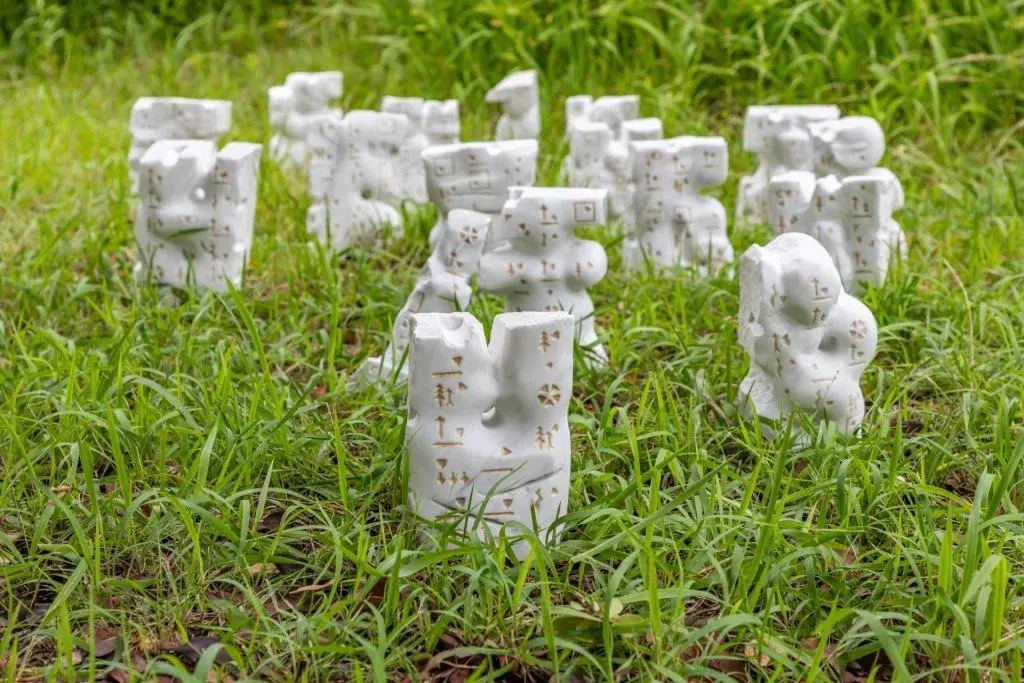
Repairing a piece of furniture normally requires knowing what it looked like before it broke. For Fumiaki Aono, that part is optional.
The Japanese artist has worked around the idea of “mending” since the 1990s. From 1996, he began salvaging fragments and discarded objects, then completing their missing sections. The goal, however, was not to faithfully recover their previous form or function.1
His Mending, Extension works instead follow whatever the fragment suggests. A shape, angle or pattern becomes an instruction. Aono extends it with plaster, paper, paint or another object. In other works, two fragments are joined because they share some formal affinity: a surface, a corner or a box-like geometry.1
That method helps explain his later assemblages of secondhand furniture. Drawers, shelves and domestic objects stop being units waiting for restoration. They become material already loaded with wear, use and memory. LOKO Gallery documents works combining furniture, books and collected objects into new structures.2
It is a useful definition of repair beyond art. The normal question is: how do I put this back the way it was? Aono asks something closer to: what does the break make possible now?
Damage stops being only information about what is missing. It becomes a design constraint. A crack gives a direction. An incomplete fragment provides geometry. Two incompatible objects may find a shared edge or dimension.
Reuse is often discussed as a material problem: keep wood, plastic or metal out of the waste stream. Aono’s work suggests another layer. Reuse can preserve the visible history of an object and build from it instead of sanding that history away.