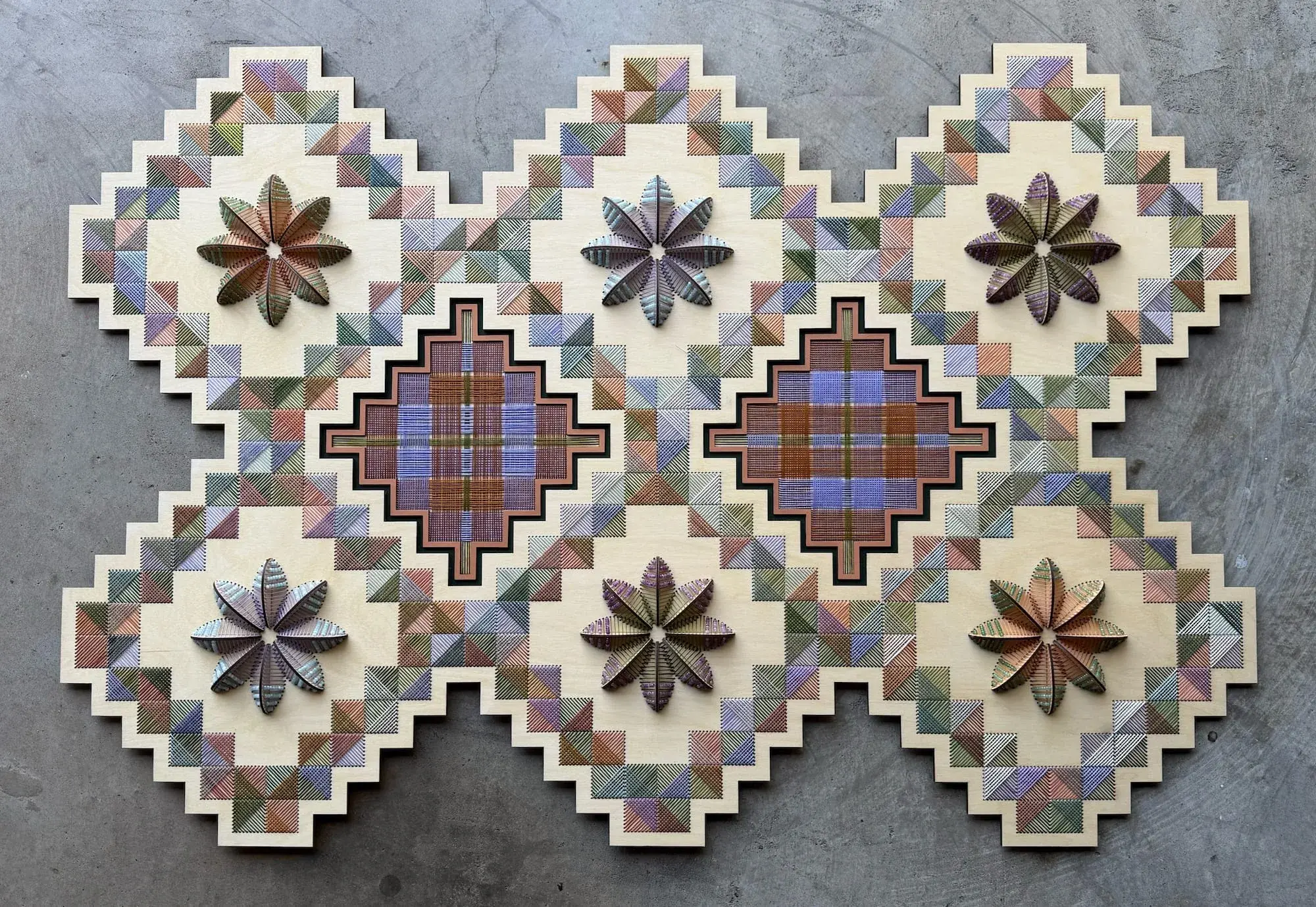
In "Repeat Rahnuma," one of Nosheen Iqbal's recent wood-and-thread reliefs, the pattern reads like pixel art from across the room: stepped diamonds, checkerboard fields, six sculptural flowers standing off the panel. Come closer and the pixels turn out to be stitches, pulled through cut birch with cotton thread and cordage, edged with semi-precious beads.1
It hangs in Inherited Forms, her solo show at MAINSITE Contemporary Art in Norman, Oklahoma, through September 11. Most of these reliefs follow the same recipe: wood, cotton fiber, beads, at the scale of a door panel. "Convergence" measures 60 by 48 inches. What separates them from every embroidered thing you have seen is the ground. Fabric stretches, forgives, lets you unpick a mistake and tighten the weave again. Wood does none of that. Iqbal has stitched through paper and dried leaves before; wood is where she settled, precisely because it resists.25
From dials to birch
Iqbal was born in Surrey, England, and moved to Texas in her teens. She trained in communication design at the University of North Texas, then spent more than a decade at Fossil, the watch brand, moving from design to art direction to lead watch designer, with work for DKNY, Armani Exchange and an Opening Ceremony collaboration along the way.62
The sewing came much earlier. Her grandmother and her mother taught her around age ten, on fabric. The move to rigid surfaces happened while she was still working in design: first paper, then dried leaves, then wood. "Wood offered resistance, permanence and structure," she told Embroidery Magazine earlier this year, "qualities that contrasted beautifully with the softness of thread."5 The studio only became a full-time job in the last couple of years.9
The watch years left a mark she names herself. "When you're designing watches or jewelry, you're constantly thinking about scale, precision, and materiality," she told American Craft. "I've carried that same meticulousness into my embroidery through wood: every stitch, bead, and surface choice matters."4
Color comes first
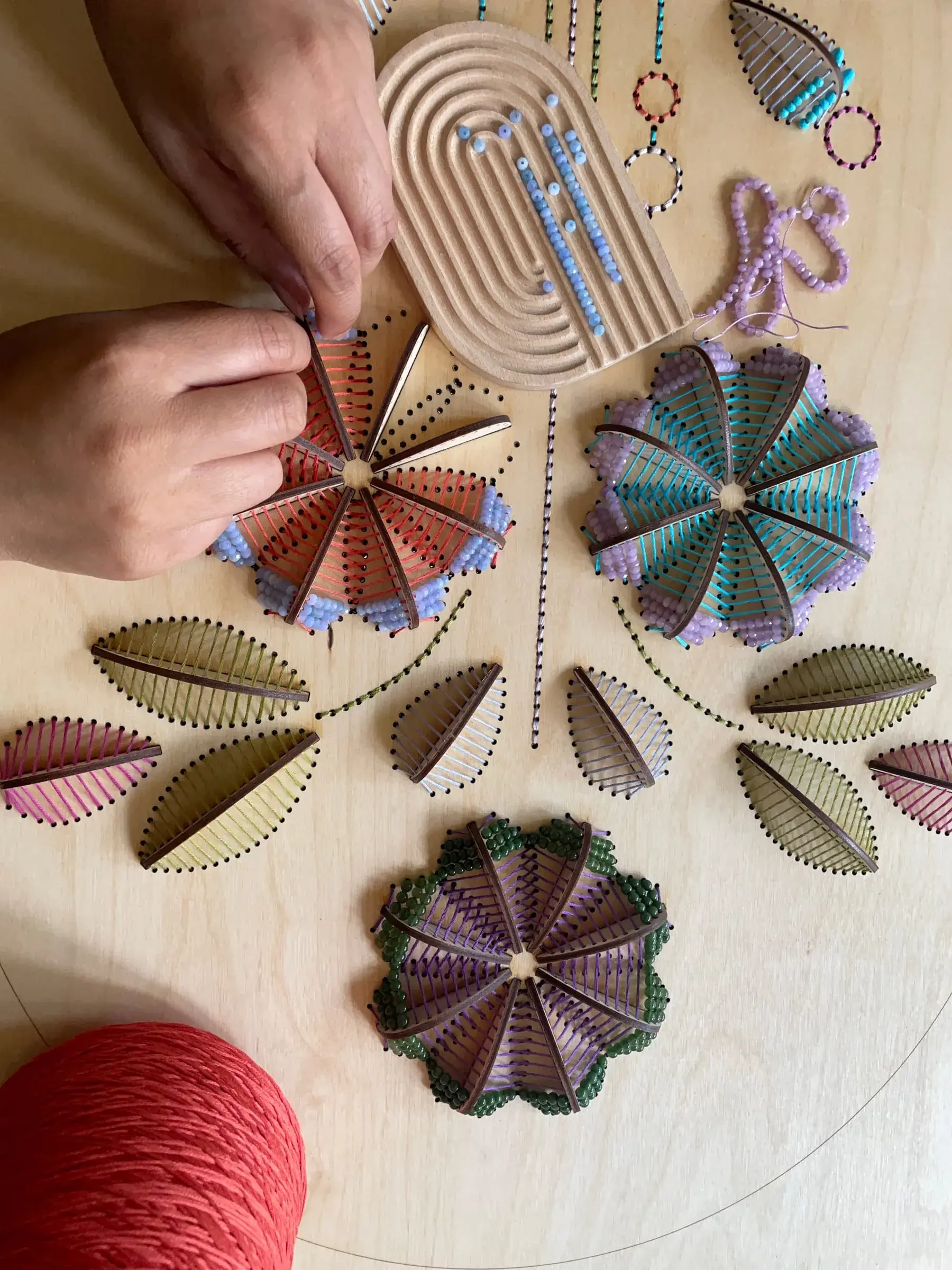
Her process, told to Texas Monthly, starts with a pile of color before any drawing exists. "The first thing I do is pull colors together. I pull the embroidery threads, the roping, and the beads, and I play around with groupings," she said. "What am I reminiscing about when I see those colors? That determines the avenue."3
Then the computer takes over. She maps the geometry in Adobe Illustrator, "probably my most crucial tool," and a laser cutter burns the stitch paths into the panel; some pieces are hand-drilled instead. Sanding and staining come next, on locally sourced wood she calls "happy wood." The embroidery, the part you would assume is the whole story, is the last step, and her favorite.34
Nothing stretches
Why put a soft craft through a hard material? Because the difficulty does work. "Wood is an unforgiving surface, it doesn't stretch, so mistakes are difficult to correct and thread tension must be carefully managed," she told Embroidery Magazine. "The physical demands of stitching through a rigid material can be intense, but those constraints are productive. They demand patience and precision, reinforcing the meditative, intentional nature of the work."5
The shift is easy to miss. In phulkari, the Punjabi embroidery she draws on, the thread is floss silk worked in darn stitch from the reverse side of soft khaddar cloth; the fabric gives under the needle.1112 On wood, nothing gives. So the stage where errors get caught moves upstream, into the Illustrator file, before any thread exists. The laser does not replace the hand; it moves the point of no return earlier. The hand keeps the part no machine can take: slow, deliberate tension management, stitch by stitch, on a ground that will not bend. That is my reading of her pipeline, but it fits her own words: she loves that the practice "lives in this balance between analog and digital."4
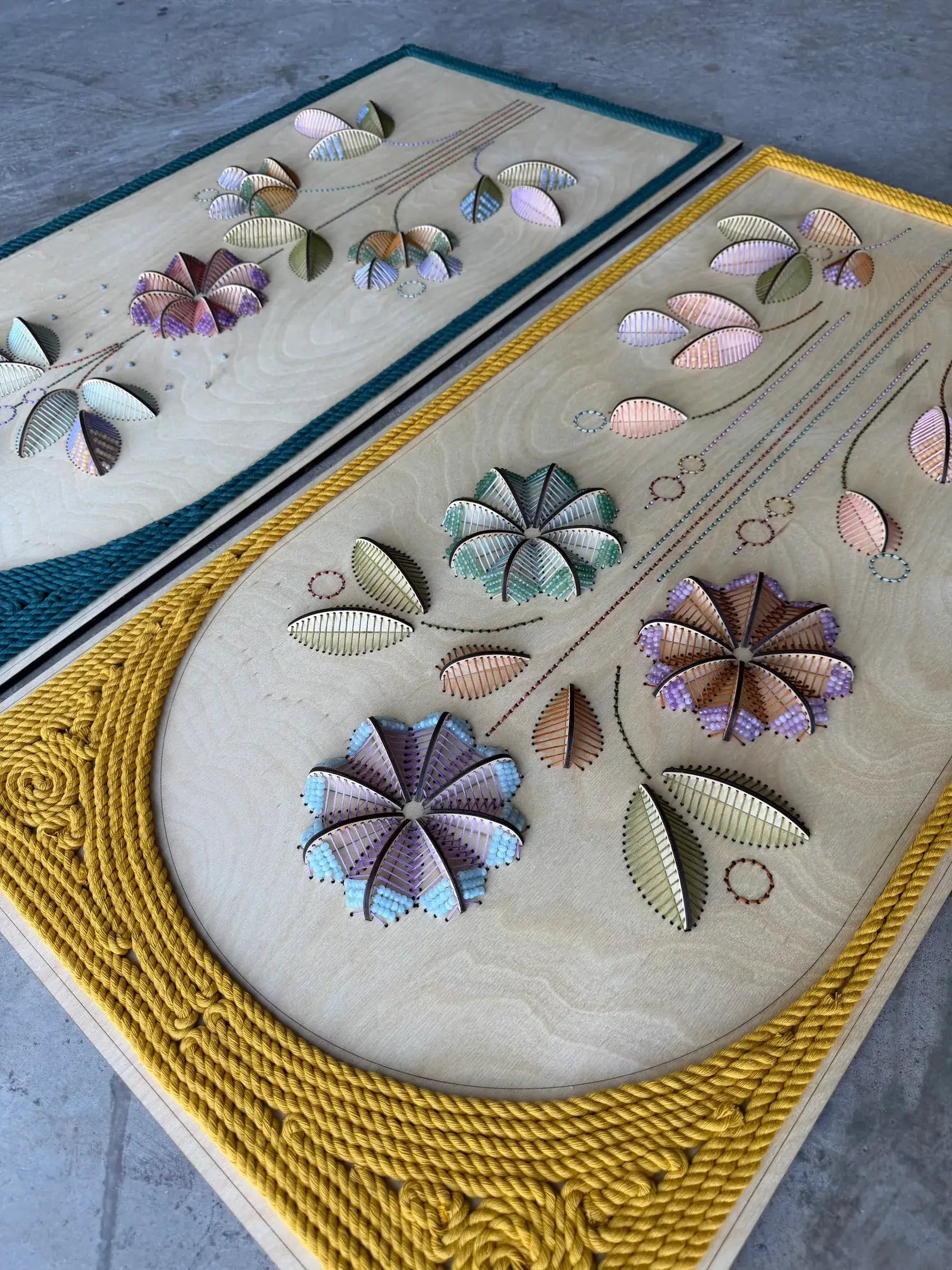
The rigidity pays in light. The reliefs are three-dimensional: petals and leaves stand off the panel, beads catch the glare, the shaded sides of each form go dark. "As light moves across my pieces, it enhances the saturation of colors and emphasizes the intricate threadwork, shifting and revealing new dimensions," she told Colossal last year.8
Full garden
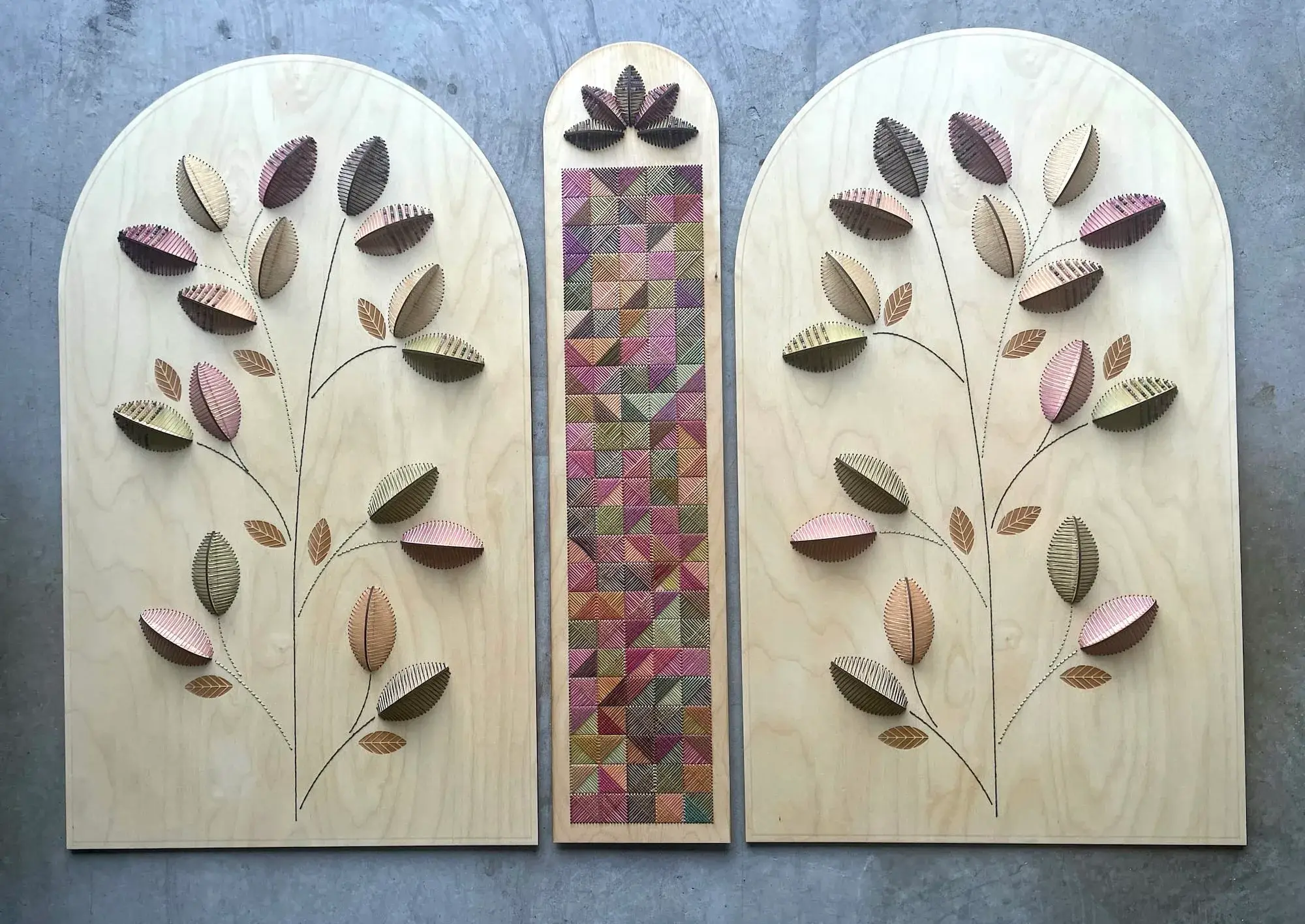
The vocabulary comes from two directions. One is Pakistani textile tradition: phulkari, literally flower work, the folk embroidery of Punjab worked in silk floss on coarse cotton; and bagh, the "garden," the variant where stitching covers the cloth so completely that the ground all but vanishes.1112 The other is Islamic architecture: geometry, arches, ornament repeated until it becomes structure. Her panels borrow the arch shapes and the interlaced patterns, then recombine them into forms the sources never had.56
Her statement for the exhibition reads like a thesis on pattern as storage: patterns passed through generations "carry narratives of identity, belonging, and resilience," and "these inherited forms become a visual language; one that transcends words and quietly preserves histories that might otherwise disappear."12 To American Craft she put it more plainly: "Craft, for me, is both preservation and dialogue that's a bridge between past and present, East and West, and a way to preserve generational connection."4 Her statement for the Galleri Urbane booth at Untitled Miami went one step further, calling the stitching "not only a form of mark making but a ritual of remembrance."7
What thread keeps
The gallery work sits next to a commercial practice that funds it: window installations for Hermès, eighteen pieces for a Mediterranean restaurant on a Virgin Voyages ship, commissions for JW Marriott and Starbucks.346 Her work appeared in CraftTexas 2025 at the Houston Center for Contemporary Craft and at art weeks in Paris and Miami.4210
The heritage framing is the obvious story here. The engineering is the better one: Illustrator and a laser cutter preparing the ground for the oldest tool in the kit, a needle. The pattern remembers what the hands were taught. The wood makes sure nothing gets erased by accident.45