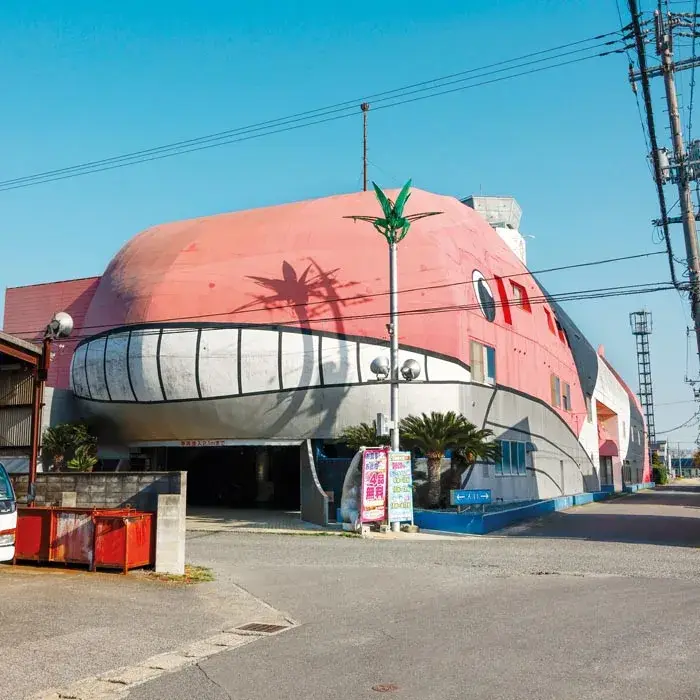
One photograph of a castle-shaped hotel is a curiosity, and a second begins a collection. After roughly two hundred facades photographed in almost the same way, castles, whales, ships and mock palaces gradually stop behaving like exceptions and become variations within the same visual language.
That shift makes François Prost's Love Hotel more interesting than any single spectacular building in it.
In 2023, the French photographer drove roughly 3,000 kilometres across Japan over three weeks, travelling from Tokyo westward and toward Shikoku after preparing the route with Google Maps and Street View.1234 His own site describes several hundred images, while CNN says the series contains the facades of around 200 love hotels.13
Distance alone does not make the method, because the road trip becomes a typology only when Prost repeats a second decision: photograph again and again from a similar distance, in daylight and with consistent framing.4 Repetition lowers the visual dominance of each individual hotel and makes its similarities with the next one easier to see.
Before driving
The fieldwork begins on a screen.
Prost has described spending hours on Google Maps while planning the trip, and Le Monde reports GPS and Street View scouting before the photographs were made.23 That preparation matters because it reverses the romantic picture of a photographer simply discovering a strange building by accident.
Chance still exists, but a list, a map and a route now shape it.
The procedure also belongs to Prost's earlier work. His site places Love Hotel after After Party, on French nightlife venues, Gentlemen's Club across the US, Discoteca in Spain and Club Ivoire in Ivory Coast.1 The subject changes while the tool remains recognisable: isolate a family of ordinary buildings, cross a territory and repeat the protocol until the differences become legible.
The 3,000 kilometres are therefore more than a fieldwork statistic. They give the corpus geographic continuity: large cities, outskirts, more rural roads and intermediate towns all pass through the same photographic procedure.
Same distance
Framing does most of the analytical work. Colossal likewise points to the repeated frontal treatment, which lets the architecture be compared without turning every stop into a new stylistic exercise.5
Prost is not searching for the wildest interior or the most photogenic decorative detail. LM Magazine summarises his method as keeping a similar distance and framing in daylight so the colours remain visible.4 The photographer says he is interested mainly in the fronts of the buildings, which he considers more revealing than their interiors.4
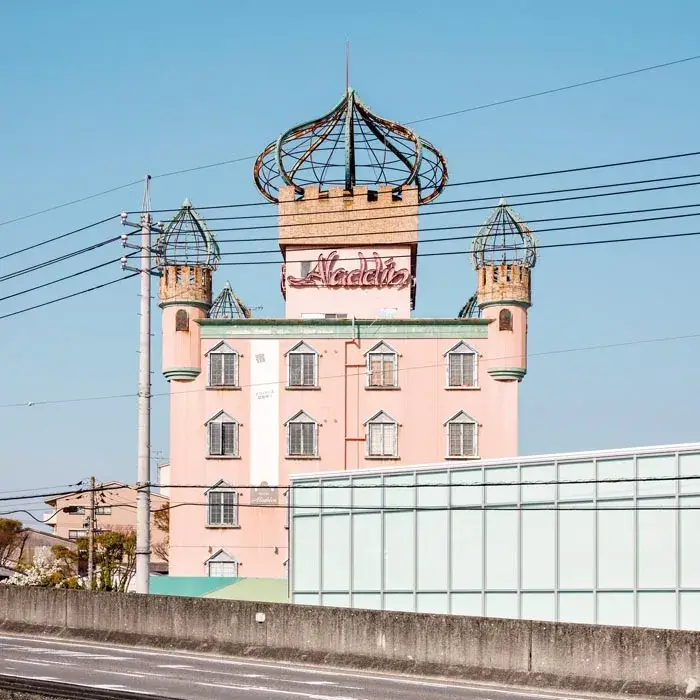
That distance avoids two opposite traps. Move too close and the series becomes a catalogue of decorative motifs; move too far away and the hotels dissolve into landscape. The middle distance preserves both the facade and the elements explaining how it works: road, vehicle entrance, signs, prices, parking, neighbours and overhead infrastructure.
Repetition then makes those details comparable. One castle looks absurd; a sequence of castles reveals a convention. One whale reads like an architectural joke, but among ships, flying saucers, tropical facades and childlike motifs it becomes part of a broader economy of escape.
The photographs stop asking only what each building represents. Together they ask a different question: which forms recur when hundreds of businesses have to sell privacy and fantasy from the side of a road?
Visible privacy
The architecture becomes paradoxical at this point.
Love hotels historically answer a demand for privacy by giving couples space outside the family home and domestic crowding.126 Their use therefore depends on discretion, yet many of the facades in Prost's photographs are visually loud.
CNN points to castles, ships, whales, flying saucers and other instantly recognisable buildings.3 Le Monde also notes an aesthetic whose geography is deliberately hard to pin down: Latin lettering, European or American references, fairy-tale imagery and tropical themes give some buildings a deliberately international character.2
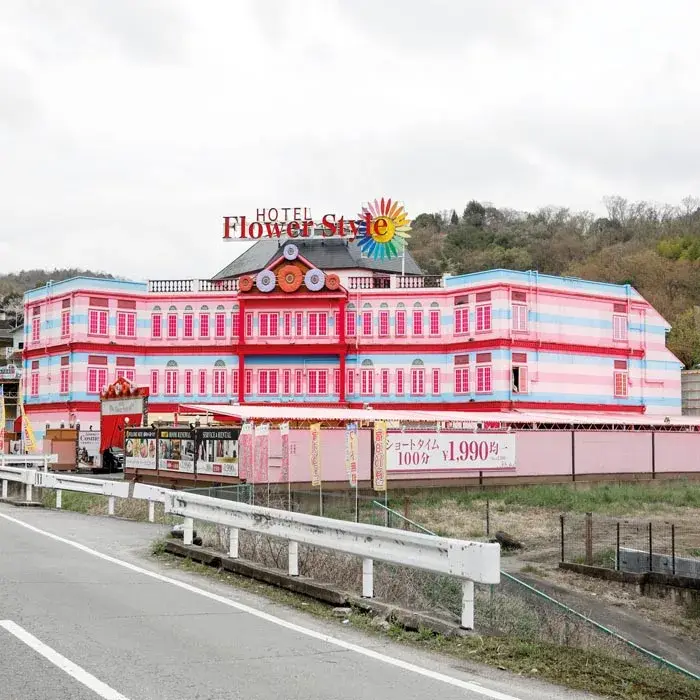
Privacy is not produced by an invisible facade. It is organised elsewhere, through access, short stays, circulation and separation from domestic life. The exterior still has to attract drivers and distinguish one hotel from competitors.
That tension explains part of the kitsch. The building has to communicate two apparently incompatible messages: disappear here, and look at me.
A typology
The word “typology” can suggest a cold or scientific set of photographs, yet this series remains colourful, funny and sometimes frankly absurd.
Their ordering changes how they are read, preventing the most spectacular image from becoming the whole story.
Scale matters for the same reason. The artist's site describes several hundred images,1 and once the series reaches that size, things with little visual prestige begin to carry as much documentary weight as the icon buildings: an empty car park, grey asphalt, power lines, a faded sign or the edge of a field.
The documentary value often lives in those less seductive repetitions. Promotional architecture photography would probably remove the utility pole in front of the building. Prost leaves it there. Across the series, mundane infrastructure becomes a second typology layered over the hotels themselves.
The viewer is no longer looking only at fantasy environments built around desire; the series also shows, almost incidentally, how those environments occupy an ordinary territory.
Photograph alike
Prost's procedure looks simple because it depends on relatively few visible decisions, but following them across an entire journey makes the method restrictive in practice.
The photographer has to resist “saving” every building with the most flattering possible angle. A poor sky may stay because that was the day available; cables stay inside the frame; enough distance has to be recovered each time; a less spectacular photograph may be preferable when it keeps the series coherent.
That discipline turns repetition into a research tool. The same method can move far beyond love hotels: shop signs, workshops, garages, village halls, petrol stations, detached houses, sheds or street furniture can begin to tell a different story when the same viewpoint is applied for long enough.
The lesson of Love Hotel may be exactly that. A visually extraordinary subject does not necessarily need a photographer searching for an extraordinary image every time.
Prost almost does the opposite: he photographs in the same way until the differences become impossible to ignore.