
If you want to build your own e-reader, digital notebook or dashboard, there is a predictable moment when the project becomes strange.
The microcontroller costs a few dollars. So does the battery. The enclosure can be printed. Buttons, cables and regulators are ordinary components.
Then you shop for the display.
Waveshare lists a bare 10.3-inch monochrome panel, 1872 × 1404 pixels, for $159.99 without a controller board.1 E Ink's public shop lists a 13.3-inch black-and-white panel at $449, while a 25.3-inch Spectra 6 panel reaches $1,400.2
Those are not Amazon or Kobo volume prices. They are the prices visible to someone prototyping or building a small run. Still, they expose the oddity: the part that gives an e-paper device its defining character can cost more than all the electronics around it.
The usual explanations are tidy. E Ink has a monopoly. A patent blocks competition. The screens are simply difficult to manufacture.
Each contains part of the answer. None is sufficient alone.
The more useful story is that the foundational patent expired, while the industrial system built around the invention kept accumulating: film chemistry, TFT backplanes, lamination, waveforms, suppliers, factories, customer relationships and newer patents. Knowledge became public much faster than production became interchangeable.
Inside the panel
Electronic paper looks deceptively simple from the outside because its trick is elegant.
In a classic electrophoretic display, electrically charged particles sit in a fluid inside tiny structures. An electric field moves different particles toward or away from the viewing surface. Once they have moved, they can stay in place without continuously consuming power. That bistability is why an e-reader can leave a page visible while barely spending energy to maintain it.
But the commercial panel is not a sheet of magical ink.
E Ink describes its material being manufactured as electronic ink film, including roll-to-roll processing, then cut and laminated onto a TFT backplane that addresses the pixels.3 A module can add protection layers, drivers, connectors, touch and a front light. The company's annual report places color particles, PET film, TFT substrates, driver ICs, PCBs, touch components and timing controllers in the upstream chain before film and module manufacturing.4

That distinction matters because LCD is a bad mental price reference. E-paper is not simply a slower display with fewer features. It uses a different materials stack, different driving methods and, crucially, radically different production volumes.
The expired patent
There really is a foundational patent in this story.
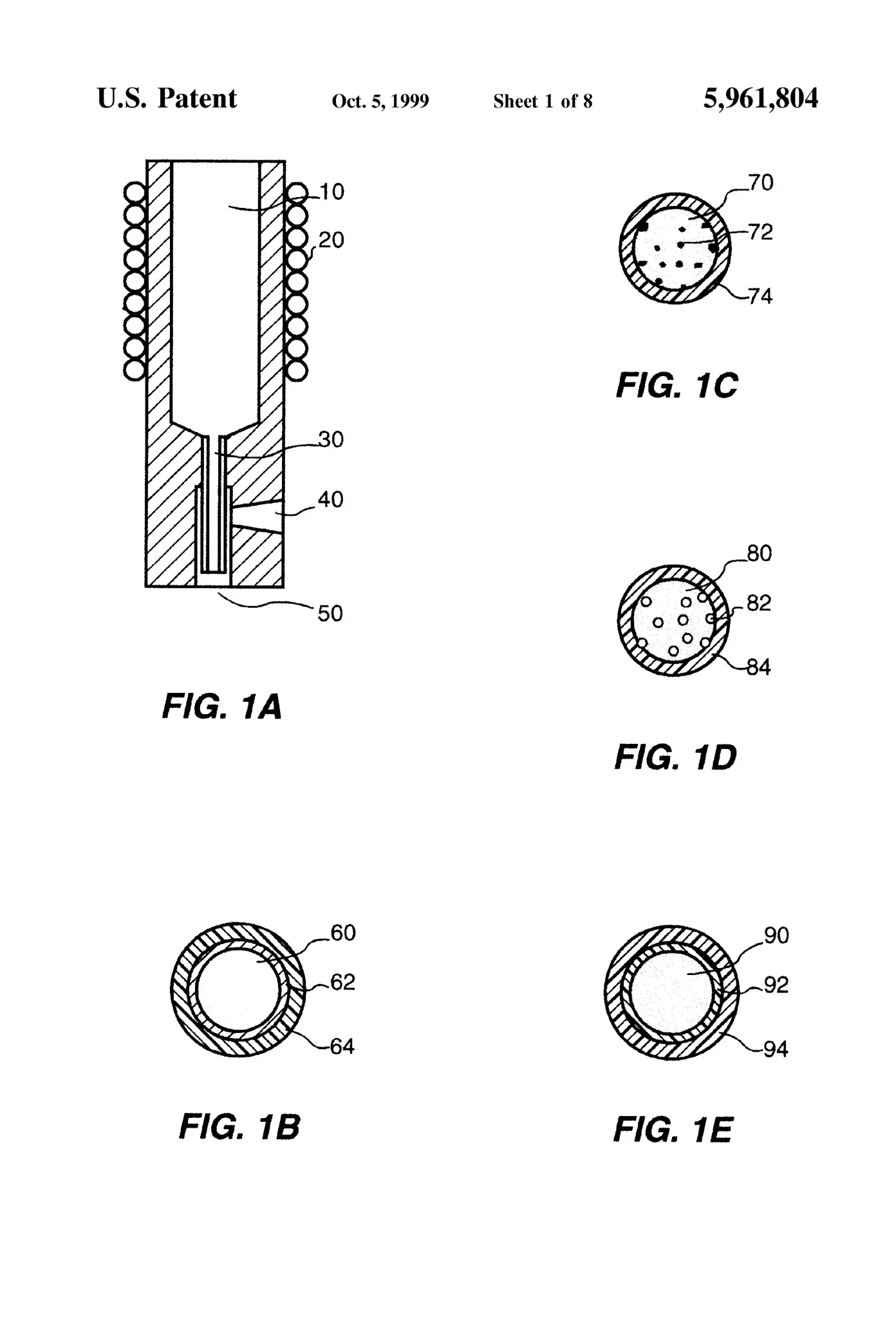
US5961804A, filed by MIT researchers in March 1997, describes a microencapsulated electrophoretic display. Google Patents lists it as expired, with an anticipated expiration in March 2017.5
From a distance, the expected sequence looks obvious: patent, twenty years of protection, expiry, competitors, commodity prices.
The mistake is treating one patent as an entire production system.
By December 2017, E Ink said it held more than 600 US patents and 1,374 patents worldwide.6 That figure comes from E Ink itself, so it should not be mistaken for an independent audit of its moat. It does establish that the 1997 patent was no longer remotely the whole legal or technical stack.
The company had also changed shape while the patent aged. Prime View International acquired Philips' e-paper business, expanded into TFT capabilities, then announced the acquisition of E Ink Corporation in 2009 for about $215 million.7 E Ink later acquired SiPix in 2012, explicitly pointing to its microcup technology and intellectual-property portfolio.8
This did not eliminate every competitor. It did something subtler: it concentrated experience across more of the path from electrophoretic material to an addressable display.
The word “manufacturer” can hide that structure. A company may manufacture an e-paper module without manufacturing the electrophoretic film inside it. In 2020, for example, E Ink announced an agreement in which it would supply film while MICROVIEW manufactured and sold completed display modules.9 SEEKINK likewise describes substantial capacity for assembling EPD modules and devices.10
Those businesses are real manufacturers. But ten module vendors do not necessarily imply ten independent sources for the critical film.
This is the industrial advantage that survives a patent expiry. A public document can tell you what an invention is. It does not hand you process recipes, trained operators, qualified suppliers, yield data or a production line that can make the same material every Tuesday for five years.
Size breaks the economics
Small e-paper displays can be cheap. E-Paper Innovation, for example, sells small electrophoretic products for applications such as labels and flexible devices.11 The painful prices appear when several requirements arrive together: large area, active-matrix addressing, high resolution and low purchase volume.
The simple reason is that a 13-inch panel is not a 2.9-inch shelf label enlarged in CAD.
The backplane is larger. More expensive material is committed to each unit. Lamination and bonding happen across a larger valuable surface. A defect that ruins a tiny region can reject a much more expensive part. The display also needs consistent electrical behavior across that area, and the customer expects the same panel family to remain manufacturable over time.
Public information does not tell us that “yield represents 37% of the price” or any other pleasingly precise number. It does show that E Ink treats yield, TFT materials, quality standards and new production capacity as active industrial problems.4
In April 2025, E Ink and AUO Display Plus announced a joint venture capitalized at NT$390 million to establish large-size e-paper module production lines in Taoyuan.12 You do not need a new industrial line merely because rectangles become physically wider. You need it because producing those rectangles consistently is a distinct manufacturing problem.
Volume then amplifies the difference.
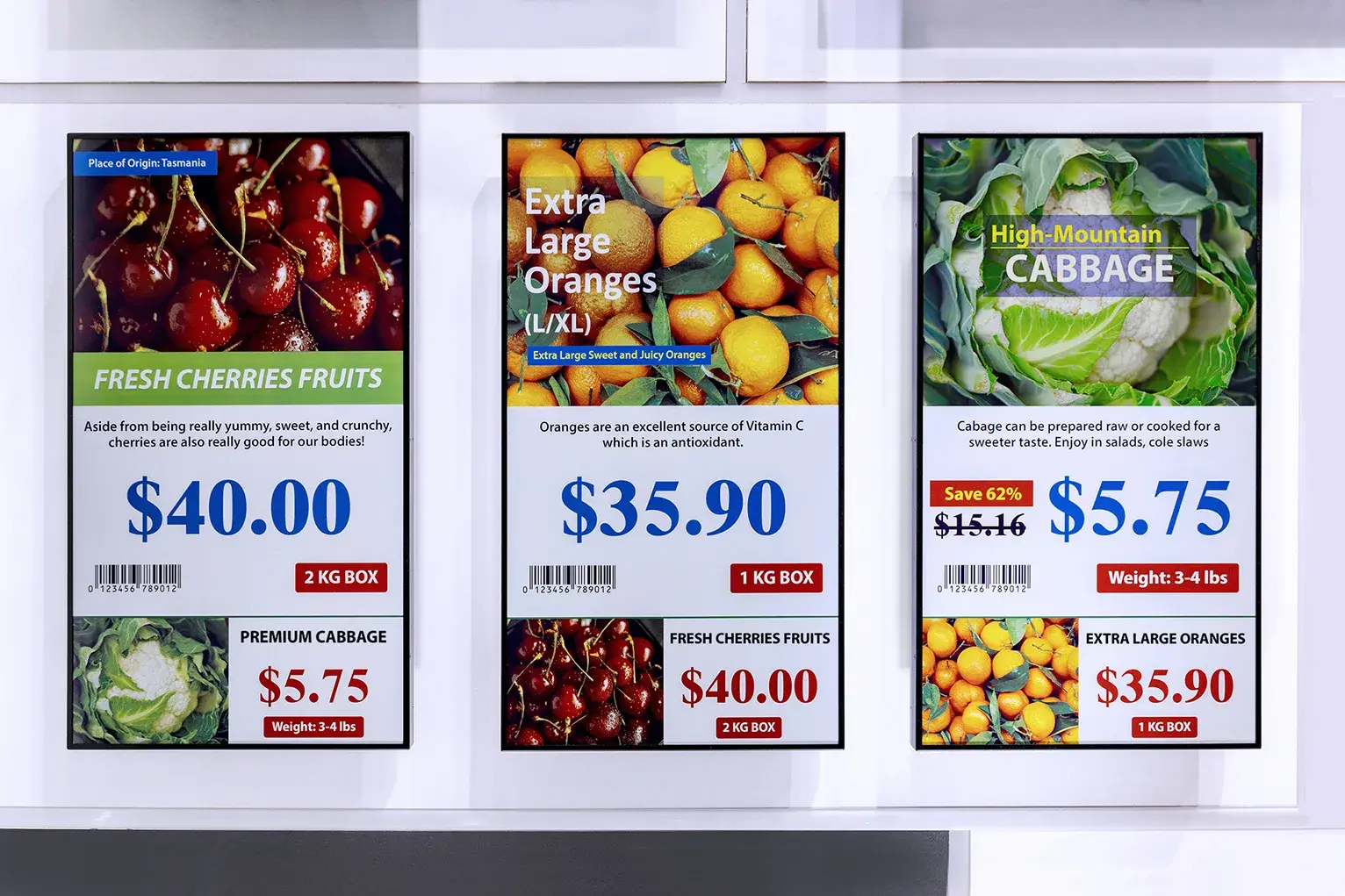
LCD and OLED are produced for phones, televisions, laptops, cars, watches and appliances. E-paper is excellent at a narrower set of jobs: e-readers, shelf labels, signage, note devices and low-power static displays. It never became the default surface of computing.
A technology can therefore be mature without becoming a commodity. Patent expiry alone does not collapse prices. Commodity economics also need large demand, competing capital investment, amortized equipment and suppliers that customers can swap without redesigning the product.
E Ink's own 2025 results make the other half of the story impossible to ignore. The company reported NT$36.116 billion in revenue and NT$10.515 billion in net income, a stated 29.1% profit margin.13 That is consistent with a business possessing valuable intellectual property and substantial market power. It is not enough to calculate a “monopoly tax” on a $159 hobbyist panel.
Both things can be true: the product can be genuinely hard to make at scale, and the company at the center of that difficulty can earn unusually comfortable margins.
Open controller, closed factory
The most useful counterexample is Modos Paper Monitor.
Driving an electrophoretic panel is not as simple as sending a new RGB value to a conventional display. Controllers apply voltage sequences and waveforms that depend on the panel, temperature and the tradeoff between speed, contrast and ghosting.
Modos attacks this layer directly. Its Glider FPGA controller is open hardware, with programmable driving modes and published modes reaching up to 75 Hz on supported panels.14
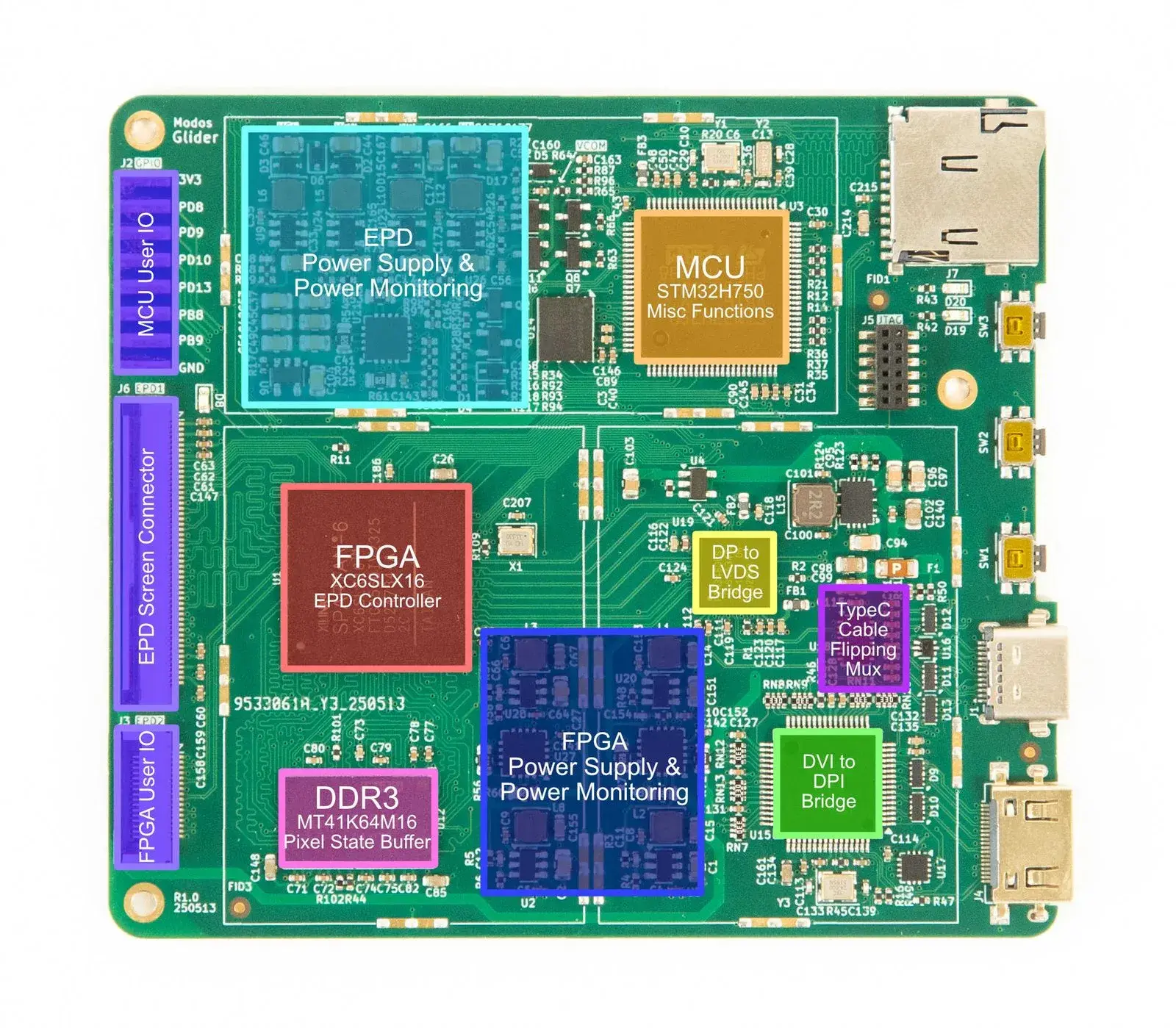
That proves something important. Part of what people experience as “e-paper is slow and closed” belongs to the controller and waveform layer, and that layer can be opened.
But Modos also reveals where openness stops. Its 13.3-inch kit still uses an E Ink Carta 1000 panel.14 When the project moved into production, the material layer came back with a vengeance: in April 2026 the team reported shipping 260 13-inch kits and 215 6-inch kits, while saying roughly half of one received batch of 6-inch panels failed its own quality standards.15
That is one manufacturer's anecdote, not a universal defect-rate statistic. It is nevertheless a clean demonstration of the boundary between digital openness and industrial repeatability.
You can publish a PCB, FPGA design and source code. You cannot git clone a box of physically consistent panels.
There are also genuine alternatives upstream. E-Paper Innovation sells flexible active-matrix electrophoretic displays.11 Good Display markets DES, Display Electronic Slurry, as a technology distinct from the E Ink products it also sells.16 Modos says its controller can work with E Ink, OED and DES panels.14
So “nobody else can make reflective electrophoretic displays” is false.
The harder question is whether an alternative is an industrial substitute for a particular 10- or 13-inch Carta panel, with the same combination of resolution, contrast, lifetime, temperature behavior, availability, controller support and stable supply. That market is much thinner.
Is the price artificially high?
A satisfying answer would split the retail price into two columns: unavoidable manufacturing cost and E Ink rent.
The public evidence does not permit that calculation.
Evidence for market power is strong: decades of accumulated patents, consolidation, major e-reader customers, E Ink's claimed leadership in mass-produced film and high profitability.6 13
Evidence for real industrial constraints is also strong: a specialized material stack, explicit work on yield, quality challenges at larger sizes, new production investment and the small but revealing Modos rejection story.4 12 15
Those are not competing explanations. Difficulty creates barriers to entry. Barriers support margins. Margins fund additional process development, capacity and patents. The accumulated lead then makes entry more expensive again.
That loop explains the market better than “one patent caused a monopoly”.
It also explains why comparing a public bare-panel price with a finished Kindle can be misleading. Amazon is not ordering one screen from a web shop. A large buyer negotiates volume, specifications and supply agreements. For a maker, unfortunately, the public price is still the price that matters.
The maker’s bill
If you are building an e-paper device, the history has practical consequences.
Screen size is an architectural decision, not a cosmetic one. Moving from a small standardized module to a 10- or 13-inch active-matrix panel can dominate the entire bill of materials.
Separate the panel from its controller. A cheap bare display may require unusual voltages, waveform files and considerable software work. Paying more for a complete module can be cheaper than spending weeks turning an attractive gray rectangle into a display.
Salvage can also make sense. Old e-readers and signage contain panels whose replacement cost is disproportionate to the rest of the electronics, although connectors and undocumented revisions can make reuse entertaining in the least entertaining sense of the word.
And projects like Modos matter even when they do not make the film cheaper. Opening the controller changes repairability, experimentation and the number of panels that one electronics platform can support.
What still does not exist at the same scale as LCD is the boring thing hardware designers love most: twenty interchangeable suppliers offering the same large panel class as an ordinary component.
Reproducible, not interchangeable
The 1997 patent is public. Its legal protection expired. The basic physics can be taught, simulated and reproduced in laboratories.
Meanwhile, the industrial object kept moving: new particle systems, color architectures, waveforms, acquisitions, production lines, suppliers and larger formats.
That gap is the interesting part of the story.
Software trained us to associate published knowledge with reproducibility. If code and documentation are public, millions of computers already exist on which the system can run. Physical technology has another dependency tree: machines, materials, capital, process knowledge, quality control and suppliers.
A patent can expire. A controller can become open hardware. An alternative chemistry can exist.
The film still has to leave a production line with sufficiently consistent optical and electrical properties for a large panel to reach your desk intact.
Large e-paper displays are not expensive because an idea from 1997 is still secret. They remain expensive because turning that idea into a repeatable industrial component is still a concentrated business.