A bicycle in a London hallway occupies more than its wheelbase. It blocks doors, marks walls, forces one bike to be moved before another can leave and turns every wet commute into a negotiation with the inside of the house.
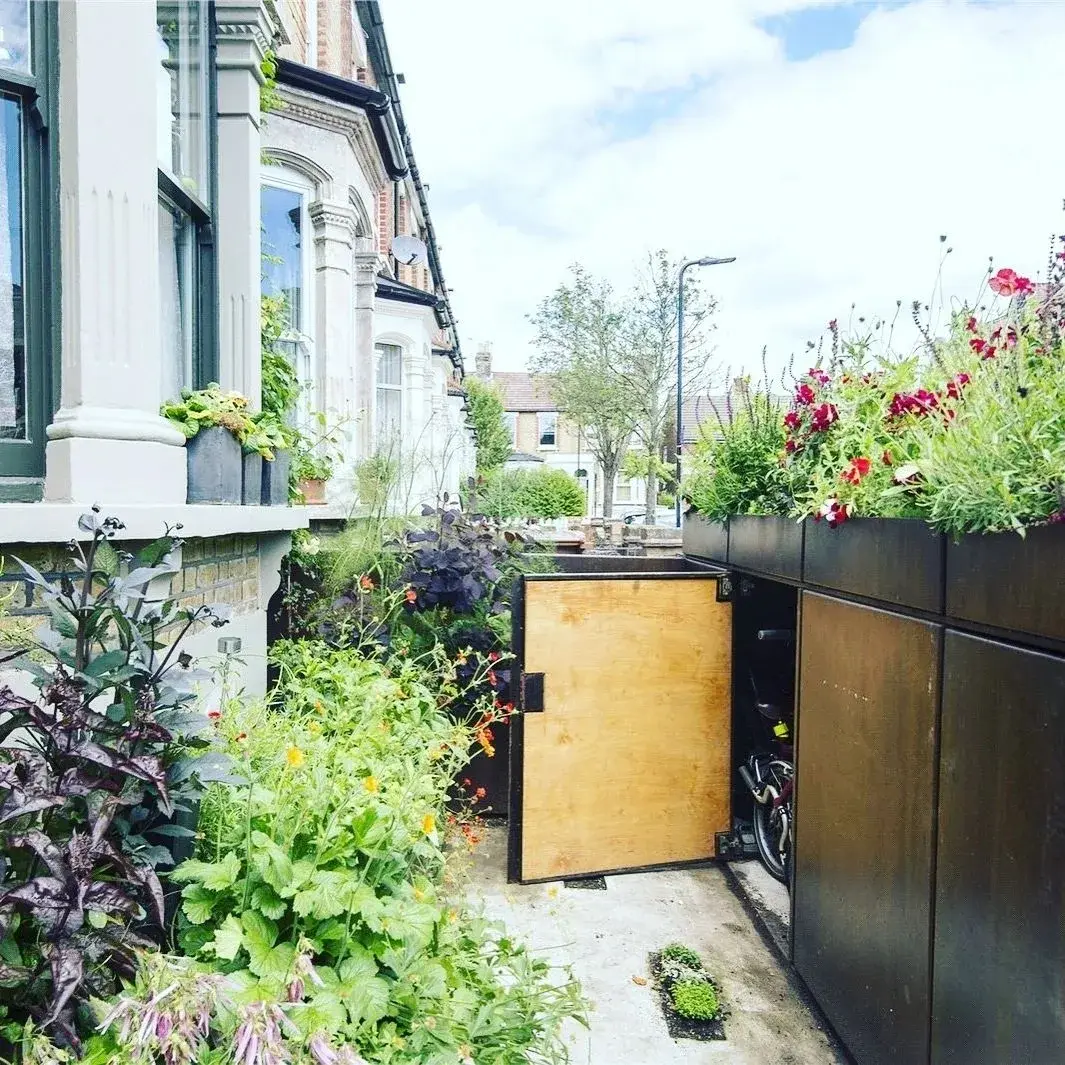
Bikebox Works starts with that ordinary problem, but the design becomes interesting when it refuses to behave like a shed placed apologetically in a corner. The original BikeBox is a steel enclosure installed where the front-garden boundary would otherwise be, deep enough to hold several bicycles and topped by a long planter.12
The store takes over a strip of ground already occupied by the boundary instead of claiming another one behind it.
A useful wall
The Front Enclosure model is roughly 3.77 m long, 0.84 m deep and 1.4 m high. Bikebox Works says this version can take up to five bicycles, or some combination of bikes, bins and pushchairs.2 Its FAQ gives a broader typical range of four to six bicycles depending on the project.3
From the street, the volume reads more like a thick boundary than a miniature utility building. That is deliberate. Core77 recounts how Lawrence Friesen and Tracey Bendrien arrived at the idea when their own front-garden wall was failing at the same time as bicycles were clogging the entrance hall.5
The two annoyances happened to line up on the same strip of ground: a wall that needed rebuilding and bicycles that needed to leave the hallway. Their answer was to rebuild one thicker thing and make it do both jobs.
The same logic appears in built renovations. Ben Kuenzel Architecture describes a Clapton project whose front garden was redesigned to integrate two-level storage from Bikebox Works as part of a much larger house refurbishment.6 At that point the BikeBox is an architectural element rather than an accessory ordered after the garden is finished.
Steel before timber
Bikebox Works builds primarily from structural-gauge mild steel.3 The material arrives dark and is allowed to oxidise for about 12 to 18 months. Once the desired patina develops, a protective finish is added and typically renewed every two to three years.3
The material choice is not only visual. The steel is also the secure shell around the stored bikes. Core77 notes the studio's preference for the oxidised finish, while timber cladding remains an option for clients who do not want exposed rusted metal.5
The official portfolio goes further with iroko, stainless-steel planters, laser-cut panels and shapes squeezed into tiny gardens.2 At that point the product catalogue starts looking more like a list of small architectural commissions.
That bespoke position shows up immediately in the price. A Front Enclosure starts around £7,920, while a shorter standalone model measuring about 1.8 × 0.8 × 1.4 m starts near £4,560 and fits two adult bicycles.2 Groundworks, special doors, irrigation and planting can add to that.
BikeBox is not really competing with a cheap sheet-metal store. It is replacing part of a garden project and gaining storage while doing so.
Plants have a job
Putting plants above a steel box could easily become architectural camouflage: add greenery, make the large object feel nicer. Here the planter does more than decorate it.
From the pavement, planting changes the object before it changes anything else. A 1.4-metre wall of metal would read as a hard boundary; a continuous planted strip gives that height back to the garden. In Livingetc, Bendrien describes the studio's approach as taking away garden space and trying to give it back in a more useful form.4
The greenery also arrives with its own plumbing problem. Soil above a steel enclosure receives no groundwater. Bikebox Works recommends a nearby water supply and automated micro-drip irrigation.24 The company estimates around 200 litres of compost per metre of BikeBox.2
Hybrid furniture keeps the maintenance demands of every function it combines. A planter remains a planter: it still needs water, growing medium, suitable plants and somebody willing to look after them.
Access without the hallway
For bikes kept indoors, the daily irritation is often access rather than raw capacity. A bicycle behind three others or at the bottom of a garden with no side passage is technically stored, but the owner pays for that arrangement every morning and evening.
BikeBox projects can be configured with doors facing the pavement, the garden or both sides according to the site.2 The portfolio also shows larger versions built around tandems, trikes and cargo bikes.2
Livingetc runs through the options residents often end up choosing anyway: communal street hangars with waiting lists, entrance halls, rear gardens reached through the house, or ordinary sheds in front.4 BikeBox fits a very London-specific condition particularly well: narrow terraced house, small front garden, no side return and several bicycles used every day.
Security stays physical. The portfolio mentions five-lever mortice locks on some installations.2 The FAQ also stresses that this is secure outdoor storage rather than a heated room, so it is a poor place for objects sensitive to humidity or temperature swings.3
Planning still exists
Replacing the front boundary is not administratively invisible. Bikebox Works warns in its FAQ that every borough is different and clients remain responsible for checking local planning requirements.3
Bendrien also tells Livingetc that front-garden bicycle sheds do not automatically fall under Permitted Development in England and Wales.4 A carefully integrated object may therefore still require approval, particularly in conservation areas.
This dependence on site conditions pushes BikeBox closer to architecture than furniture. Site level, neighbours, existing walls, water, door swing, local rules and access all enter the project before fabrication.
One strip of land
By the end, the oxidised steel and the planting are almost secondary. It is what the project does with the few tens of centimetres between a London house and the pavement.
That strip may already act as boundary, tiny garden, wasted depth behind a wall, bin collection point and access route. BikeBox turns it into thickness that objects can occupy.
This explains why the design makes more sense inside a front-garden renovation than as a giant box bought in isolation. It does not really hide bicycles underneath plants. It replaces several separate pieces of garden with one thicker piece.
The result costs more than a shed, needs water and maintenance, and may need planning approval. The underlying idea is cheaper and more transferable: before adding storage to a small space, check whether a fence, bench, low wall or planter is already occupying the strip where that storage could live.