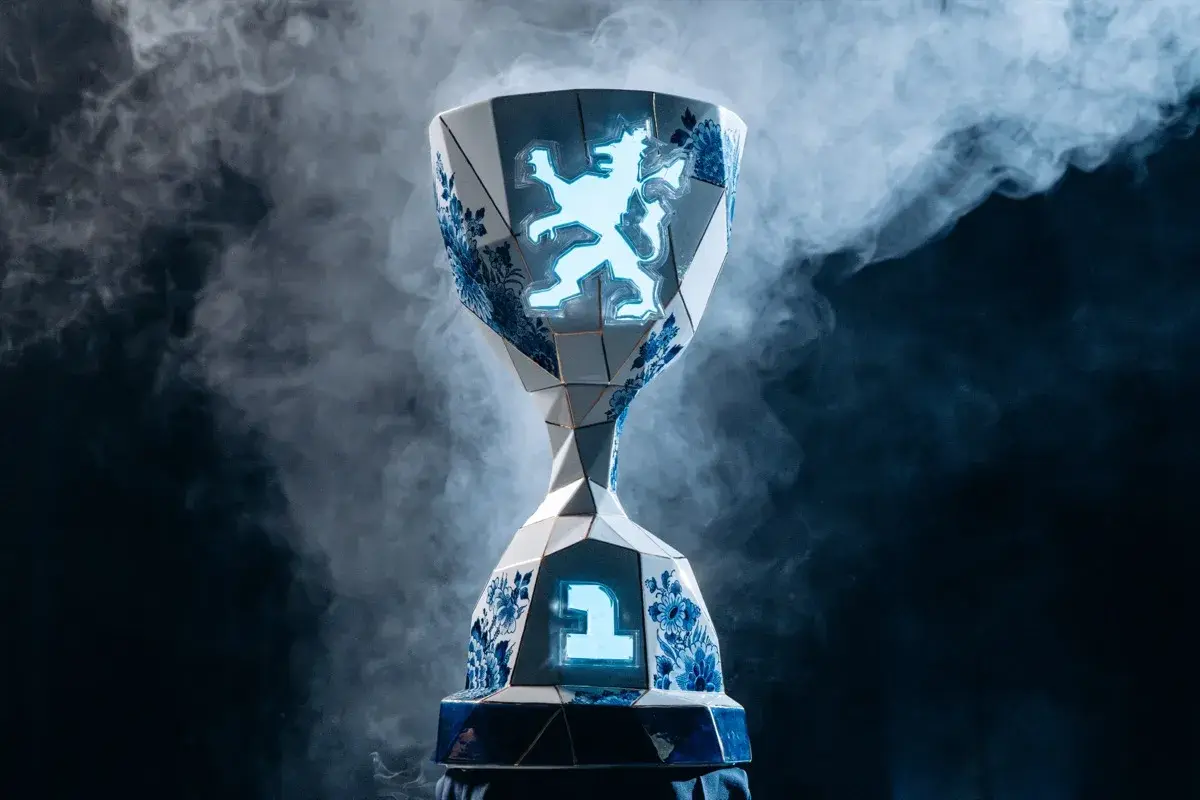
This Sunday, August 23, when King Willem-Alexander hands the winner's trophy on the Zandvoort podium, the object will look like no recent Formula 1 prize: a Delft porcelain cup in blue and gold, whose Dutch lion and oversized number 1 emit light of their own.12
The Royal Delft manufactory is on its fourth series of trophies for the Dutch Grand Prix. It has known how to keep Delft blue on premium ceramics since 1653; it had never tried making it glow from within. For this edition it invited two designers and handed the lead pieces to Anouk Wipprecht, a leading figure in FashionTech.1
The result holds together one simple tension: an object shaped and painted entirely by hand, threaded through with an electroluminescent material. Two worlds of making that share nothing, fused into a single ceremonial object.
A commission at the end of a run
Context makes this denser than paddock bling. The Zandvoort race ends after this edition, with Formula 1 confirming the event's conclusion following a one-year contract extension.3
So Royal Delft is signing off its final Grand Prix trophies, after 2023, 2024 and 2025. For this last series the organizers brought in two Dutch talents: Anouk Wipprecht for the winner's trophy and the constructors' trophy, musician and visual creator Don Diablo for second and third place.1 Everything will be presented on Sunday inside the Louis Vuitton Trophy Trunk staged for the ceremony.3
What Wipprecht knows how to do
Casting Wipprecht is no random celebrity pick. Her work lives exactly at the contact point between textiles, electronics and the body: a speaker dress, a ScreenDress driven by brain signals, robotic garments built with Elegoo 3D-printing hardware.3 Porcelain was a new material for her.3
She describes her proposal this way: "I translate the dynamics of Formula 1 into light, transforming the traditional ceramic object into an interactive, almost living interface."4
Concretely, her contribution sits less in the shape than in the behavior: working with the workshop, she integrated a flexible electroluminescent material inside the Dutch lion and the number 1, so those details emit their own light instead of merely being lit from outside.3
Getting light into earthenware
The technology involved stays modest. A "specially developed electroluminescent material," say the press materials echoed by specialist outlets.4 Electroluminescence is the emission of light by a material under electric current or a strong electric field; EL panels work like capacitors, a phosphor layer sandwiched between two electrodes — one transparent — driven by alternating current, drawing little power and producing almost no heat.5
In other words: no visible LEDs, no filaments, but a surface that becomes the light source itself. That's what lets the lion and the numeral appear lit from within without betraying the trophy's silhouette.
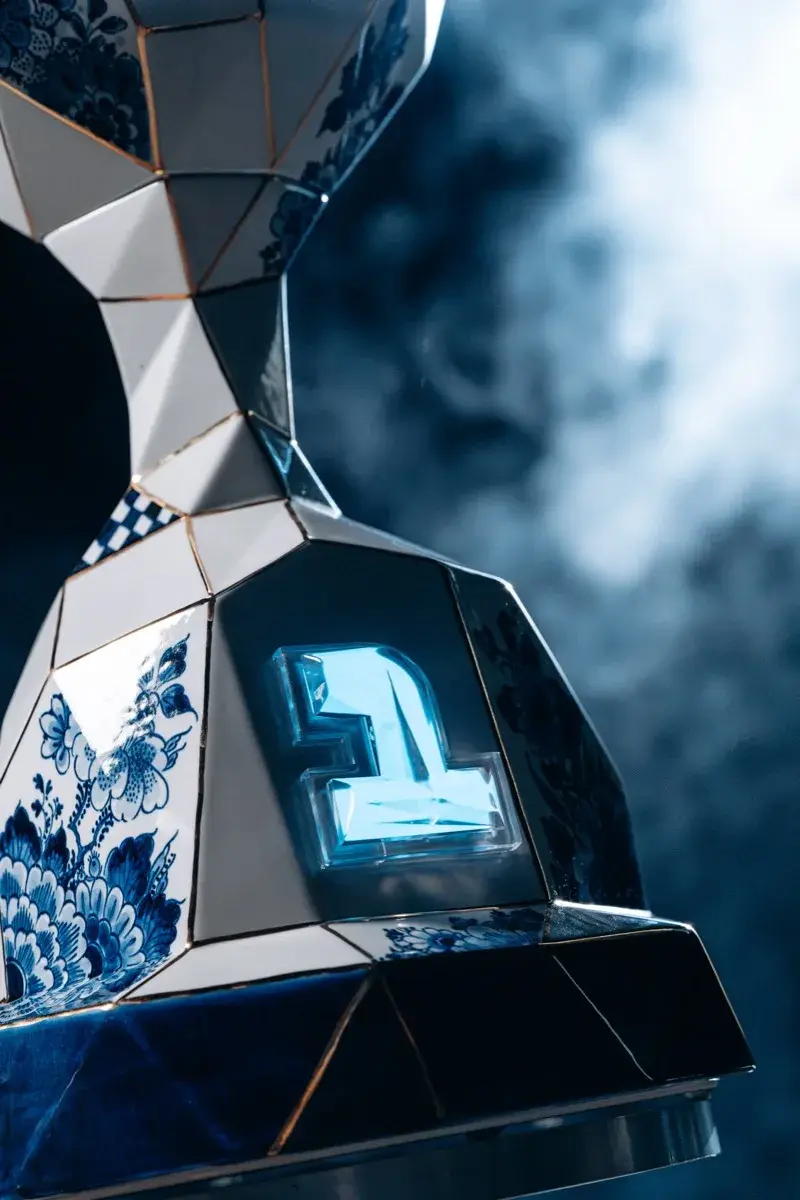
The visual language leans into the break. Classic Delft blue floral motifs are fragmented like shards, joined by gold lines inspired by kintsugi, the Japanese art of repairing broken ceramics while celebrating the scars.14
The constructors' trophy plays another card from the house deck: it draws on the historic Pijnacker decoration, a family of polychrome decors from the manufactory,6 its deep red paired with Delft blue and gold — a claimed nod to the Dutch flag.14
Don Diablo, meanwhile, painted a landscape of windmills under a sky of hexagons, his graphic signature, with chrome details; the windmill nods to his childhood in the Drenthe countryside, and the design's maritime character slips in a quiet reference to his family name, Schipper — Dutch for boatman.24
Handmade, short-run, with spares
Every trophy is shaped and painted by hand by the artisans and master painters at the Delft atelier.1 The manufactory, founded in 1653, wears that detail as a title: it is the last remaining seventeenth-century Delft blue pottery factory still in operation.1[3](#ref-3]
A making-of video walks through the process, from shaping to the final brushstrokes.1112 And this production method has already taught a public lesson.
In 2025, Isack Hadjar, third at Zandvoort, broke his trophy during team celebrations: set on the ground for a photo, it had likely been resting slightly tilted, creating stress points in the ceramic, according to Royal Delft.9 The workshop could replace the piece quickly thanks to an internal rule: for a project of this importance, unpainted backup models are always prepared.9 The replacement followed at Monza, where the trophies happened to be aluminium.10 Hadjar, for his part, insisted on keeping the pieces of the first one.10
The anecdote beats a picturesque aside: it documents the real constraints of ceremonial ceramic production. Short runs, accepted fragility, backup logistics. None of that shows up on a machined metal trophy.
{% irzImage src="/src/assets/images/articles/wipprecht-delft-fabrication.webp" alt="Making the trophies in the Royal Delft atelier in Delft" caption="Hand shaping and painting at the Delft atelier: every trophy passes through the hands of the manufactory's artisans and master painters." credit="Royal Delft" creditUrl="https://royaldelft.com/en/the-final-trophies" /%>
What an object gains by showing its process
The analysis below is editorial interpretation, not sourced fact.
The recent history of the Dutch trophy helps frame this edition. In 2021, as the race returned, Heineken and Studio Piet Boon designed a cup inspired by the 1939 trophy, made from recycled materials.7 Ceramics arrived in 2023, again with Piet Boon, on the pre-war cup's silhouette.7 In 2024 Robbie Williams added speech bubbles listing what drivers sacrifice to succeed.8 Each year: one designer, one gesture, one material. The commission already ran as a small stage for contemporary design before electronics entered.
What Wipprecht changes comes down to an honest decision: rather than hiding the electronics behind a veneer of magic, the trophy displays its own heterogeneity. Light reveals the assembly — fired ceramic, luminescent material, gold lines acting as visible seams. Ceremonial objects usually show the opposite of their process; here the process became the subject.
Two guardrails are needed. First, no source consulted describes these trophies as 3D printed: they are shaped and painted by hand,1 and 3D printing only concerns Wipprecht's wearable past.3 Second, the "specially developed electroluminescent material" rests solely on the brand's messaging and its press echoes; no independent technical sheet exists, so we report it as such rather than as a measured characteristic.4
What remains is the closing image: Sunday, on Zandvoort's final podium, a Dutch king will hold a one-off piece — fired, painted and wired in Delft. When the light goes out, what's left is exactly what Royal Delft has done since 1653 — hand-painted porcelain. The light tells you how things get made in 2026.