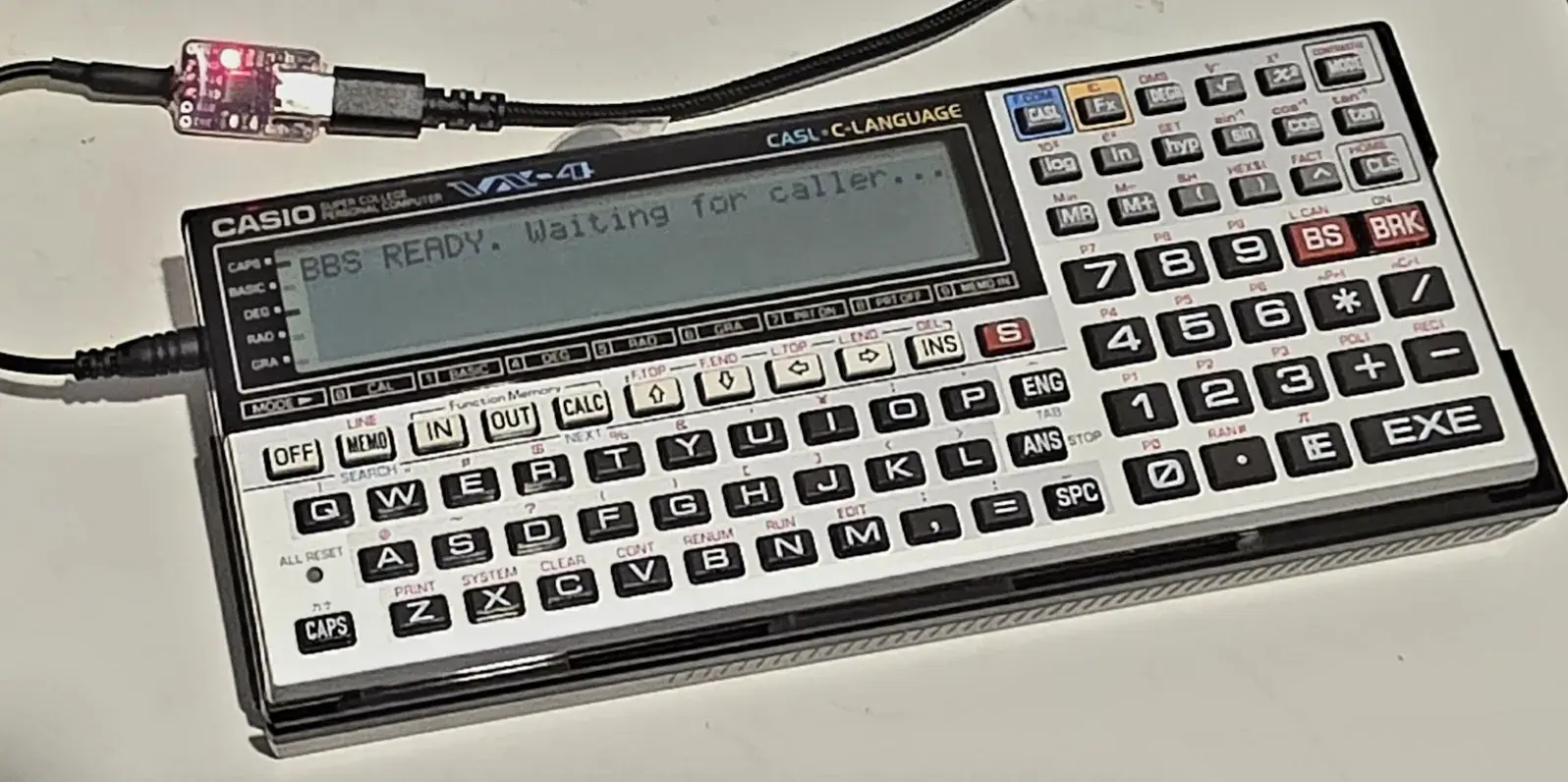
On a phone connected over 5G, the result looks like a conventional BBS: a banner, an identity prompt, four menu choices, then message reading and writing. At the far end, the program is running on a Casio VX-4, a programmable pocket computer whose base configuration has 8 KB of RAM.15
EI3LH's arrangement is wonderfully unnecessary, but it also raises a better question than “can a calculator run a BBS?”: how much of a server has to execute on a machine before we say that machine is hosting it?
There is, after all, a Raspberry Pi Zero W sitting between the Internet and the Casio.
Who does what
EI3LH describes the split fairly clearly. The VX-4 runs the BBS application written in BASIC; its COM port waits for a CONNECT signal, then the calculator prints the welcome banner, requests an amateur-radio callsign, presents the menu and manages messages.1
The Pi Zero W provides network connectivity. The calculator reaches it through its serial port and an FTDI RS-232-to-USB-C cable, while remote access during the current work-in-progress phase is invite-only through Tailscale.1
The Pi has acquired a second job as well: it mirrors messages into a text archive. EI3LH says the VX-4 still stores the messages used by the BBS, with the Pi copy acting as a vault that preserves history and allows old material to be cleared from scarce calculator memory.1
That footer matters. We can audit the architecture the author describes, but not yet the exact implementation of the bridge.
No TCP/IP here
EI3LH is explicit that the VX-4 does not connect to the Internet by itself. Doing so would have meant hardware modification and likely reverse engineering beyond the project, so the existing serial interface became the practical boundary.1
This makes a useful comparison with fxIP, a 2021 Casio hack documented by KittenLabs. On fx-9750GII/fx-9860 calculators with SuperH processors, the developers ported the uIP 1.0 TCP/IP stack onto the calculator. SLIP carries IP packets over the serial port, leaving the old handheld itself able to serve a web page or act as an IRC client because it actually runs the network stack.3
The VX-4 project makes a different trade: keep the application on vintage hardware and move modern network plumbing outside it.
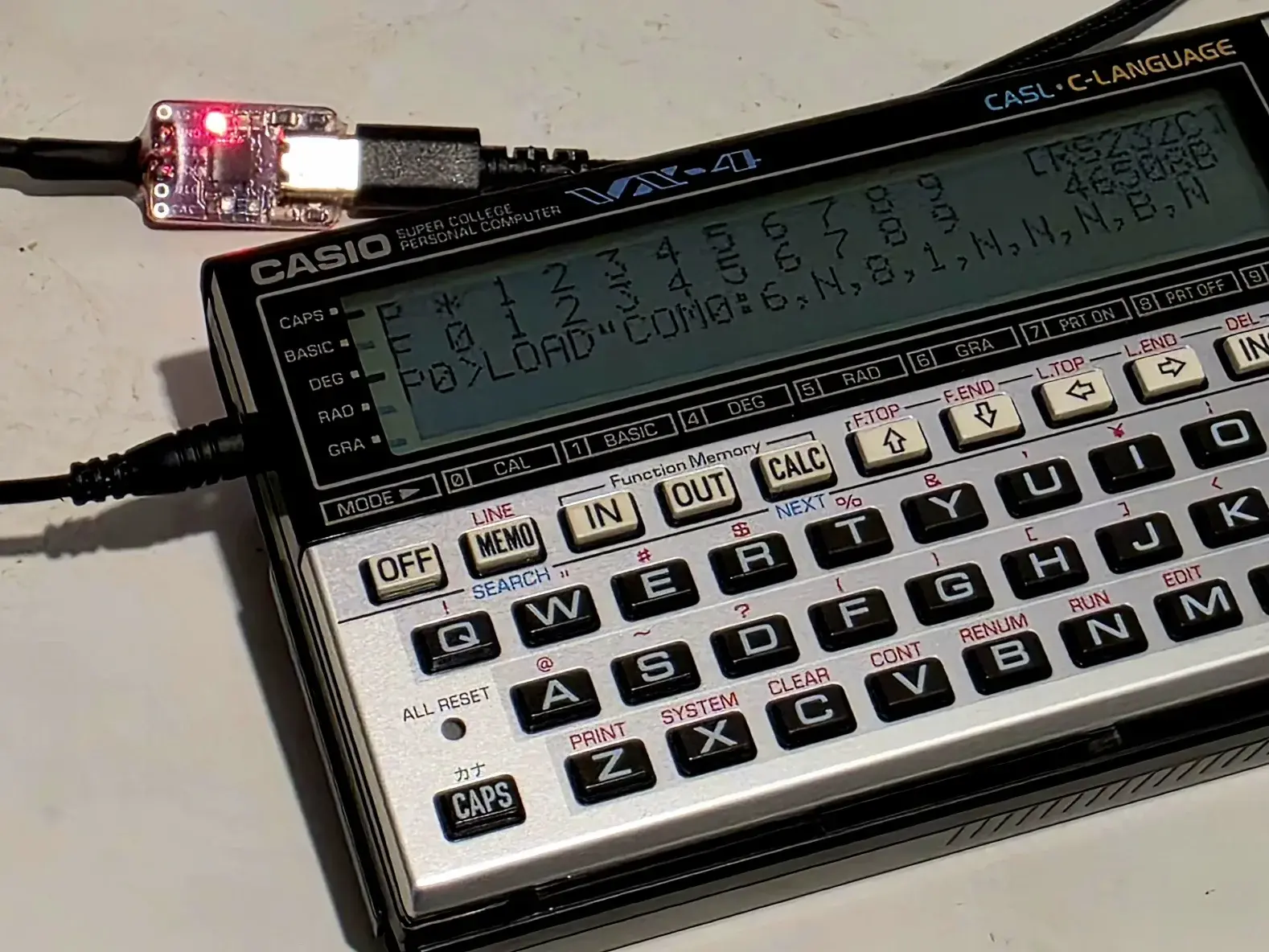
That also makes the word Telnet slightly slippery. A visitor does use a Telnet client to reach the service, but the bridge source has not been published, so there is no independent way yet to inspect exactly where the network connection and any Telnet negotiation are handled. The defensible claim today is narrower: the Pi supplies connectivity while the BBS program and its user-facing logic execute on the Casio.1
Eight KB, with an asterisk
The VX-4 was sold as a lower-memory relative of the FX-870P. Period documentation preserved alongside modern emulator work lists 8 KB of standard RAM for the VX-4.45
EI3LH's physical machine does, however, contain the optional 32 KB expansion card. He says he deliberately targeted the baseline 8 KB VX-4 and reports that the BBS works there as well.1
To be sure, we cannot reproduce that result yet. As of August 20, EI3LH's GitHub account contains only the separate jamoncito-fx project, and the BBS article says its source will be published once the alpha is ready for other people to use.16
The distinction is worth keeping. A demonstration on a calculator physically equipped with extra RAM and a program independently rebuilt within the baseline 8 KB constraint are two different pieces of evidence; for now, the second rests on the author's report.
Constraints write the menu
Other limits are visible without source code. EI3LH keeps the serial connection at 4,800 baud, although 9,600 is available, because the lower rate has been more reliable in this setup. The BBS accepts a single caller at a time.1
Messages stop at 60 characters, and the whole menu offers four actions: read messages, write one, view a short information page or disconnect.1
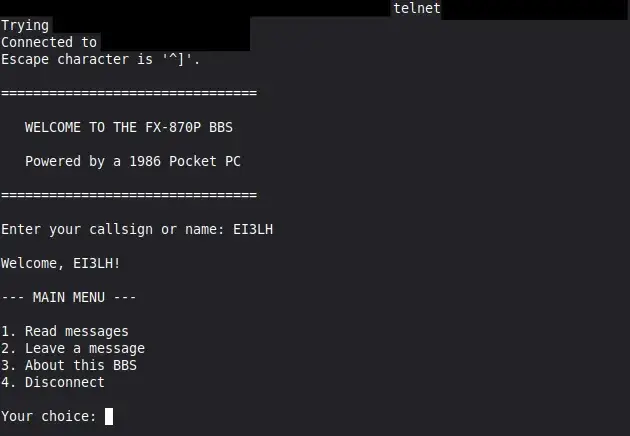
The interesting part is how quickly hardware limits become product policy. Sixty characters reduce memory pressure and make spam less effective; a single connection avoids concurrency that BASIC and the serial channel were never designed to handle. The Pi archive compensates for tiny storage without, according to the author, taking over the calculator's message operations.
Security follows the same pattern. Rather than place an unfinished retro-computing bridge directly on the public edge of a home network, access remains private through Tailscale while the project is being hardened.1
Evidence, not reproduction
EI3LH has published a video showing a complete remote session over cellular data: connection, login, reading a message, writing one, reading it back and disconnecting.1 That is useful evidence that the assembled system works.
It is not yet a reproducible build. We still lack the BASIC listing, the exact Pi bridge program or configuration, complete serial settings and a procedure another person can follow from an empty VX-4 to a reachable service.
Adafruit picked up the project on August 19 and described it, like the original post, as a true Telnet BBS hosted on a calculator.2 The phrase is catchy; the design becomes more instructive once we refuse to compress it into that phrase.
An old machine does not have to absorb every modern layer before it can become useful again. State and application logic can stay with the vintage object while protocol adaptation and security live on newer hardware, provided the boundary remains simple enough to understand.
In this BBS, the Raspberry Pi is not an embarrassing footnote. Without that modern bridge, the Casio would have to stop behaving like a Casio.