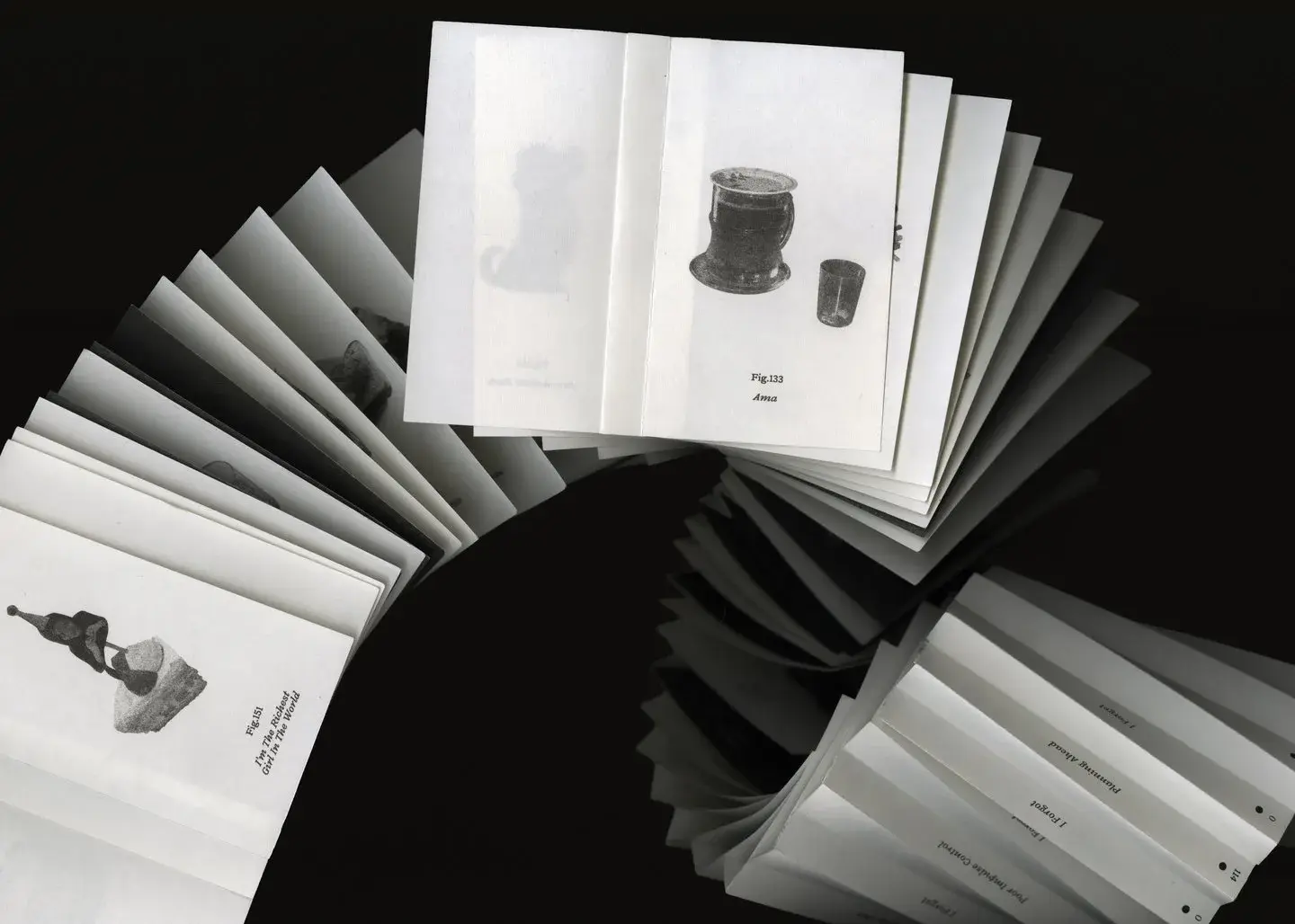
A personal archive can turn into a folder called final_v2_actual_final, then three hard drives and a box containing a train ticket nobody remembers keeping.
Amber Pjongluck chose another format: a two-metre book.
Find The Earth, her Parsons thesis project, gathers remembered and forgotten objects into a Risograph-printed publication. Her portfolio describes it simply as “a two-metre archive of forgotten and remembered objects.”1
It is more than an oversized scrapbook. Pjongluck treats memory as an information-design problem.
Three unstable boxes
The book sorts its material into categories that would make a conventional database mildly uncomfortable: remembered, forgetting and forgotten. Objects become markers for connecting different versions of the self.2
It's Nice That says the thesis took a year. Pjongluck uses it to look at events years apart and asks how situations she thought were finished can return or mirror one another.2
So the taxonomy does not pretend to produce a clean chronology. A memory is allowed to change status.
That is much closer to how memory actually behaves, although considerably less convenient than ORDER BY date DESC.
The paper interface
Pjongluck traces some of her interest in systems back to childhood libraries. What fascinated her was not only the books themselves but the methodical system for organizing large amounts of words and images.2
That fixation survives in her own publishing. She describes books as design artifacts from periods of her life, each becoming a visual library with its own language and system.2
On her site, Find The Earth sits alongside two related structures. The Spiral gives the objects a physical home, while Field Notes draws connections across versions of the self and language.1
It starts to look like a small information architecture: objects exist, the publication orders them, and the notes create relationships.
Perfectly incomplete
A digital archive can pretend to be clean, searchable and endlessly editable. A two-metre publication has sequence, weight and length. You have to physically move through it.
Pjongluck describes Find The Earth as storage for memories that is eternally incomplete, unreliable and detached, but also an ode to the forgotten and mundane.1
That is probably the strongest part of the project. It does not solve memory. It gives memory a structure rigid enough to inspect without pretending the structure is the truth.
The method also travels beyond autobiography. An archive does not have to begin with a perfect taxonomy. It can begin with the question you want to ask the objects, then build a system that makes a different reading possible.