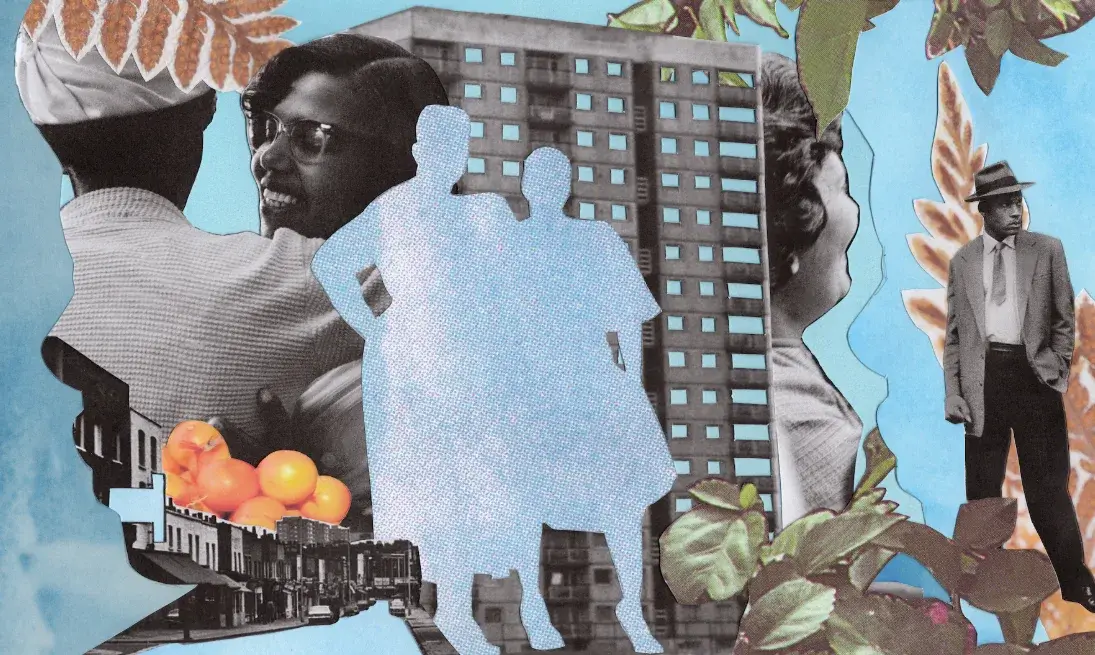
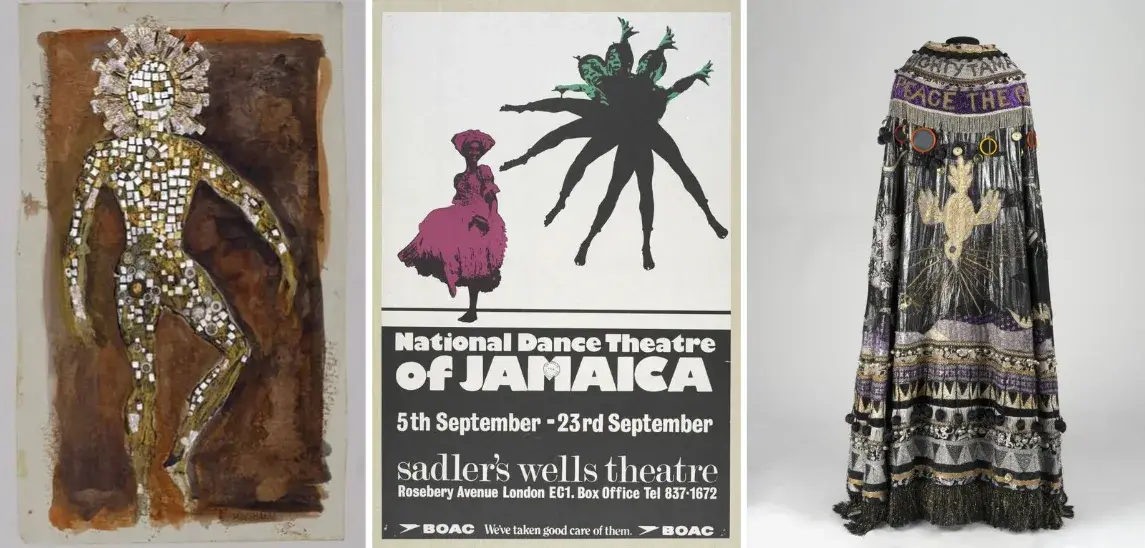
Jazz Grant went into the V&A East stores following a personal thread and came back with a group of five objects that would hardly have found one another through an ordinary catalogue browse: a nineteenth-century Jamaican lacebark mat, a costume and a costume drawing by Peter Minshall, a 1972 National Dance Theatre of Jamaica poster, and an embroidered screen from the 1920s. She brought Howard Grey's photographs of the Windrush generation arriving at Waterloo Station into the same piece.12
What followed was familiar territory for Grant, who works by photographing, printing, cutting, shifting and overlapping images until their relationships change. The museum records supplied the material and its provenance; the collage was where she decided what should actually meet.
Five objects
Grant's search began with Jamaica. She says she looked for the oldest Jamaican object she could find at V&A East Storehouse and landed on the lacebark mat, a nineteenth-century object made from bark and plant material.2 From that first find she moved toward Trinidadian carnival designer Peter Minshall, rather than trying to build the whole project around one apparently representative artefact.
The V&A sourcebook makes four of her choices unusually easy to trace. It lists the 1974 Play Mas costume, the Jamaican mat, a 1972 poster and a Minshall costume design dated November 19, 1969, each with its museum record.2 Culture Hackney identifies the fifth piece as an embroidered screen by Mary Hogarth from the 1920s.1
None of those objects needs rescuing from obscurity to be interesting, but their usefulness to Grant comes from the route she builds between them. Family heritage leads to a Jamaican material, which leads into carnival, dance, textile, photography and finally the local history of Hackney. A search engine can retrieve those things one by one; putting them in the same rectangle is an editorial decision.
Cutting to see
Collage is easy to reduce to its visible tricks, especially the cut edge and the pile-up of images, although Grant's process makes the physical operation matter more than the look. The V&A describes her as sourcing, photographing and hand-cutting materials,3 and an earlier commission shows the same habits years before this residency.
For a Jay-Z mural installed at Brooklyn Central Library in 2023, Grant was given access to a large visual archive and spent four months printing, enlarging, hand-cutting, curating and collaging the material with VisionCurate.5 Small archival photographs had to survive enlargement, while hundreds of possible images had to become a finite composition rather than a folder called final_final_2 containing everything anybody liked.
That physical stage forces decisions that a search result can postpone indefinitely. One image has to cover part of another; a silhouette either survives the cut or loses its force; the scale changes; a fragment becomes useful because of the fragment beside it. Provenance still belongs to the catalogue, but adjacency is made by hand.
Grant describes one of those adjacencies very plainly in To Travel This Ship: she mixed foliage from the lacebark mat with the energy and chaos of a Minshall costume design.2 No museum field proposes that pairing. It appears after looking, selecting and moving pieces around until a connection becomes visible.
Local history
Hackney Council launched the Windrush Amplified Art Grant in 2024 with an unusually helpful constraint: the programme wants artists to widen Windrush history beyond a single group, island, class, age, ship or story of injustice.4 Grant therefore did not need to find one definitive “Windrush object”, a task that would have been both impossible and rather grim during a short museum residency.
Instead, the work can follow several lines at once: Jamaica, Trinidad, London, carnival, family, arrival and ordinary life. Howard Grey's Waterloo Station photographs add another layer, and the connection is not merely institutional because those photographs also appear on the cover of Homecoming, written by Grant's father, Colin Grant.1
She titled the finished collage To Travel This Ship, after a poem by James Berry.1 The title fits the method better than an inventory would. Objects, people and photographs travel between places and periods, but the work does not ask them to become interchangeable evidence for one neat story.
Paper to wall
The V&A presented Grant's research and finished work in October 2025, with the original collage later remaining on display at V&A East Storehouse into 2026.13 Its next life was much larger: Hackney Central Library turned the collage into a permanent mural in 2026.1
That return to a public library gives the project a satisfying loop. Material found in museum storage was cut into a paper work, shown back at the museum and then enlarged until it became part of a civic interior in the borough connected to the commission. The archive has not simply been “made accessible”, one of those phrases institutions can stretch until it means almost anything; a particular reading of it has been put somewhere people can live with it.
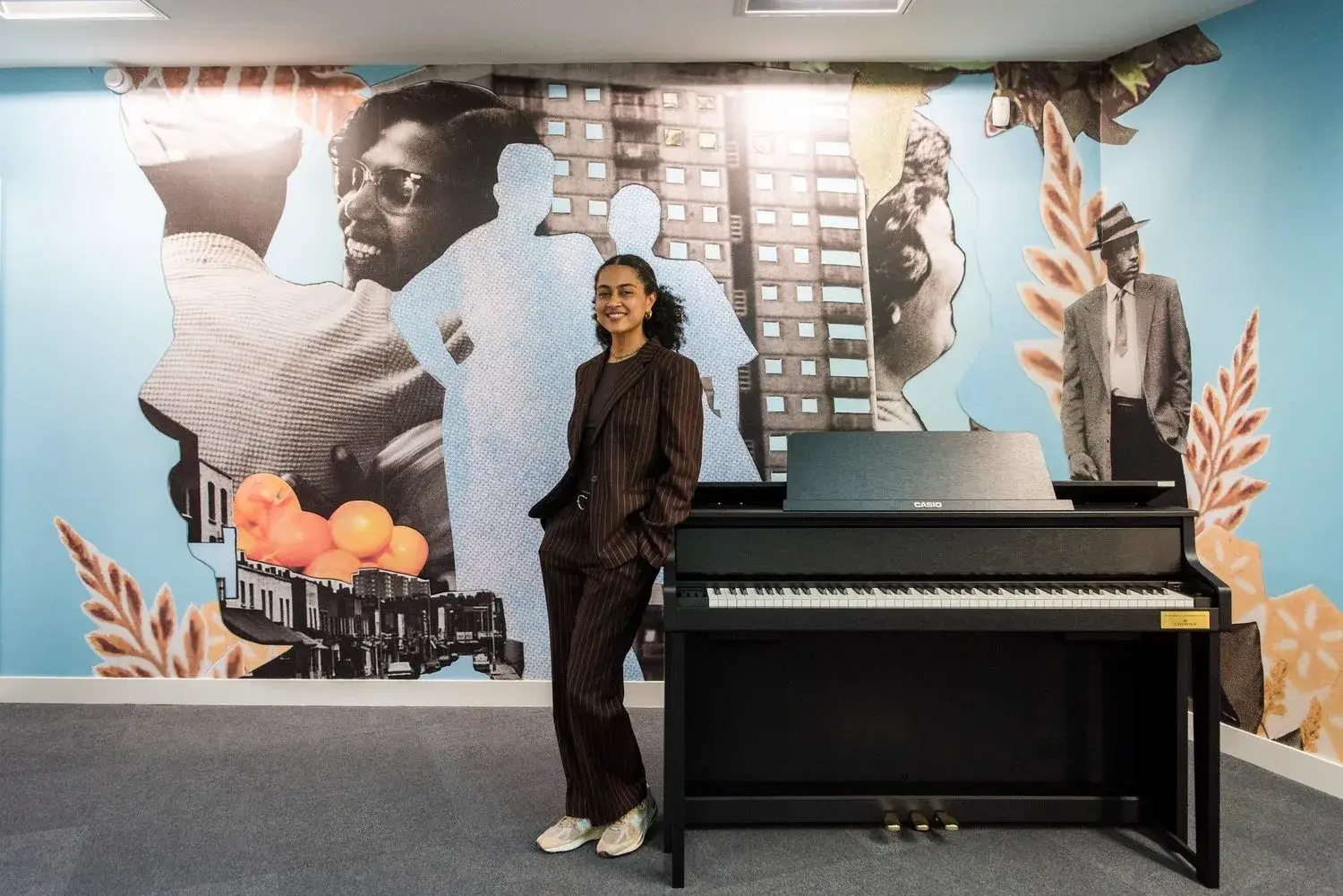
The chain is unusually legible: five museum objects, additional photographs, one paper collage, a public V&A presentation and finally a library wall. That clarity matters because nobody has to pretend the mural somehow contains “the history of Windrush”. It records one researched path through a much larger history.
What gets cut
Selection is useful precisely because it is not innocent. Five objects cannot stand for millions of lives, and a collage can pull distant periods or places together so elegantly that the gap between them becomes easy to forget. A spectacular carnival costume may also dominate a quieter object whose documentation tells a more complicated story.
Trying to make collage neutral would miss the point. A better protection is keeping the route back to the sources, which the V&A does particularly well here by publishing Grant's sourcebook with museum numbers, dates, materials and maker information where known.2 Someone standing in front of the mural can still leave the finished image, inspect a record, disagree with the connection and build another one.
Without that return path, archival collage can become a very handsome moodboard in which provenance disappears as soon as the composition works. With it, the cut image remains an argument rather than a replacement for the archive.
Research scissors
You do not need scissors to borrow the useful part of Grant's method. When a corpus is too large to narrate, choose a very small number of items and write down why each survives the cut; then force a few comparisons across time, material, place or use, and see which relationships produce evidence rather than decoration.
Collage merely makes this stage wonderfully difficult to conceal, because every element needs an actual position and every overlap costs something. Jazz Grant did not uncover a secret answer waiting in the V&A stores. She found five objects and made a sequence of decisions about what they could reveal together.
The wall in Hackney is where those decisions finally became public.