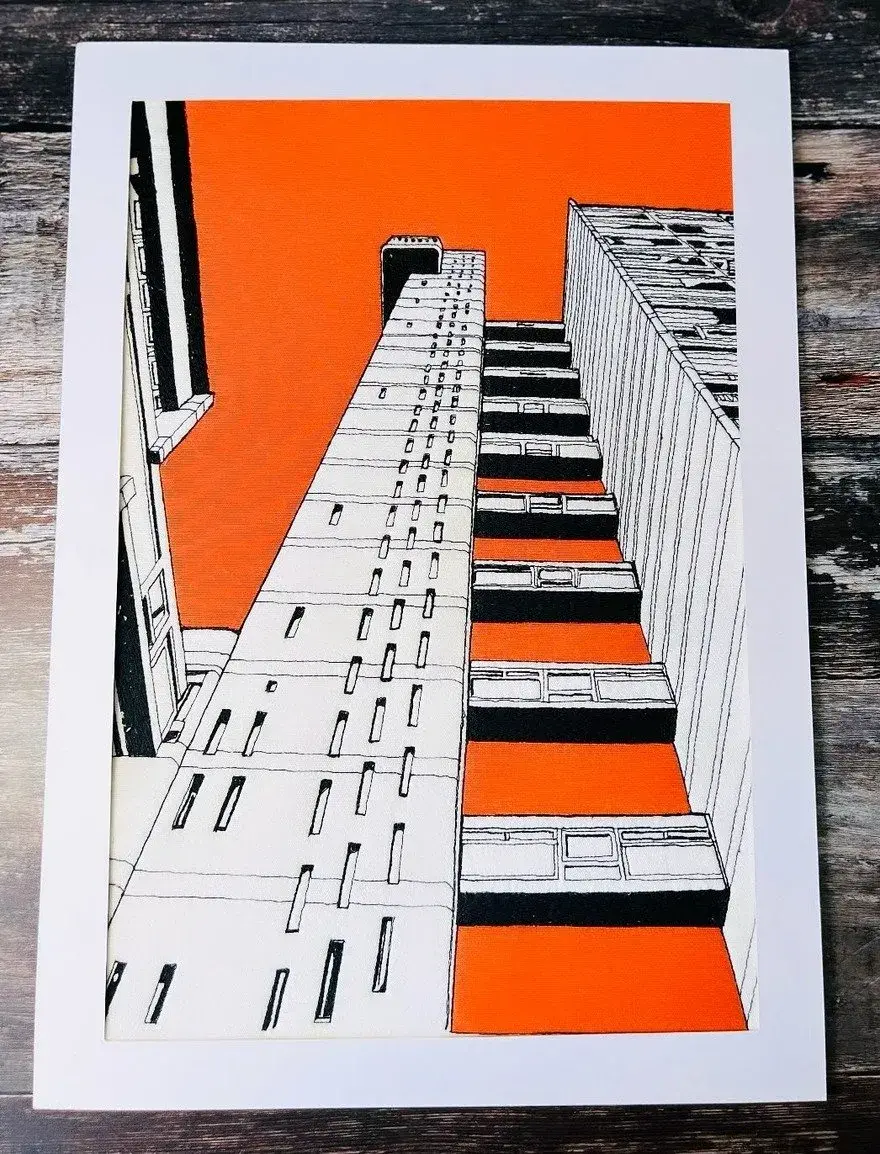
A sewing machine moves on its own, but only in a straight line. The job belongs to the feed dogs, the little metal teeth that pull the fabric under the needle. Drop them, and the machine loses every ounce of autonomy: nothing advances without a hand. That is exactly where Ali Hill parks her buildings.
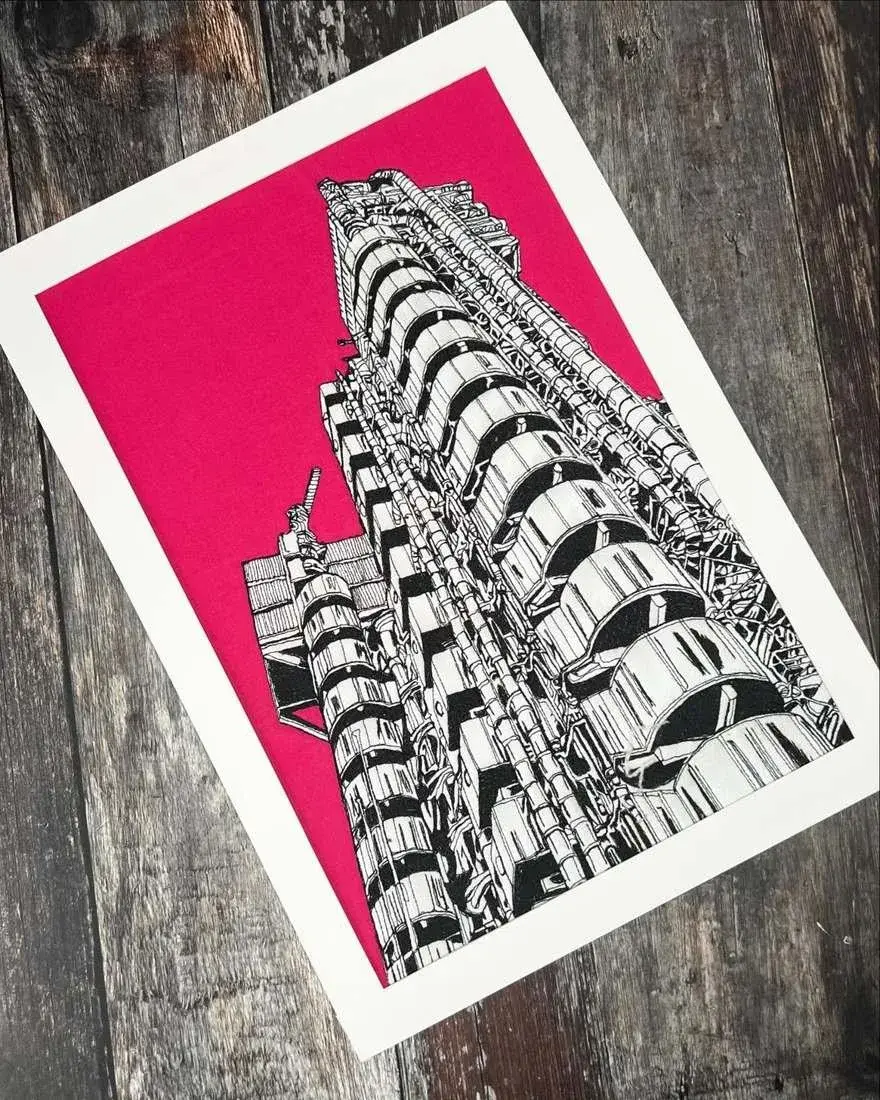
The UK textile artist draws architectural renderings in thread, directly on her sewing machine.1 Design site Core77 showed a series of these pieces on August 25: brutalist compositions, signage, towers seen from below. The line regularity surprises even more coming from a tool built to join straight seams. Hill sells the works as prints through her Etsy shop.1
Feed dogs down
The process has a name, free-motion embroidery, and a simple mechanism. In normal sewing, the feed dogs move the fabric while the needle pierces it. In free-motion work, you drop the feed dogs and swap the presser foot for a darning foot that floats above the fabric: the needle stitches in place, and your hand moves the fabric in any direction.34
No dial on the machine decides stitch length here: the faster the hand travels relative to the needle's rhythm, the longer the stitch becomes.3 BERNINA sums up the frame shift in one sentence: the needle becomes the pen, the fabric becomes the paper, and it is the sheet that moves.2
What Hill operates, then, is a strange plotter: the pen is fixed, the sheet is soft fabric, hooped and backed with stabiliser as the technique's standard practice goes.34 Every window, every mullion on a facade goes through a hand movement. Long lines and regular repetition, precisely what architecture counts as detail, sit among the hardest things to keep clean in this mode.
With or without pencil
Core77 documents two ways of working in Hill's studio. Some pieces start with a drawing that the machine then covers in thread.1 Others involve no underdrawing at all: the image is born directly under the needle.1
The difference sounds trivial. For the hand, it changes everything. Tutorials in the field give the same first piece of advice: sketch the design in chalk or water-soluble pen, then follow the lines, because freehand drawing with a machine has a reputation for being hard.3 Sewing Bee Fabrics recommends marking the design before stitching, for a very plain reason: mistakes are miserable to unpick.5
The no-pencil mode removes that safety net. It merges two skills that the traced mode keeps apart: drawing ability gets exercised at the same time as machine control, with no draft stage. It is the part of Hill's work that says the most about the practice this process demands.
No eraser
A pencil line can be faded, covered, redrawn. An embroidered thread cannot. Artist Alison Carpenter-Hughes describes what correction costs in free-motion work: the denser the stitches, the more they resist unpicking, to the point where the fabric underneath starts to disintegrate.6 She also notes that dense stitching warps the structure of the fabric itself.6
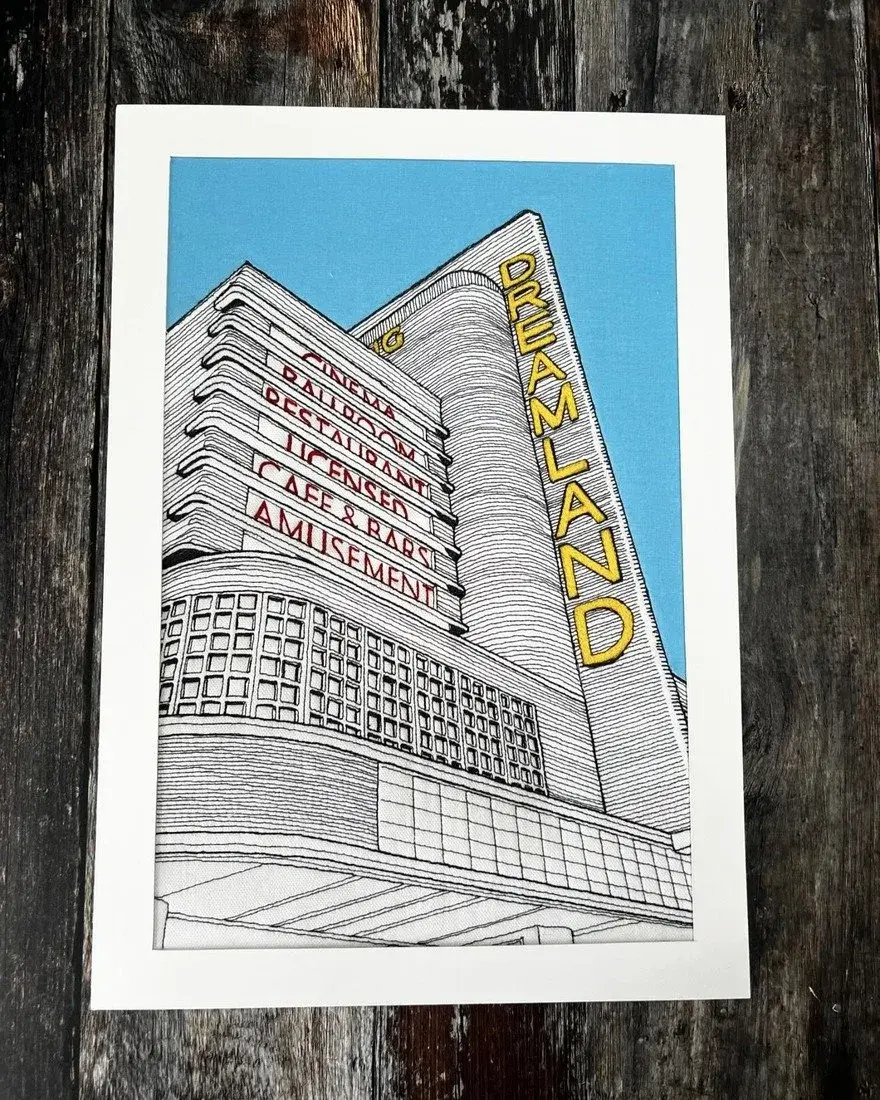
Drawing buildings under those conditions means choosing a surface where precision cannot be patched. A crooked window shows, and stays. Lettering makes the constraint even more visible: in her pieces devoted to the sign of Dreamland, the Margate amusement park, every letter is a thread path that tolerates no sloppiness.1
A family of plotters
Hill did not invent the technique. Free-motion embroidery has long been taught, runs on almost any machine whose feed dogs can drop, and BERNINA presents it as approachable: a little rhythm practice is enough to get started.2
The most striking precedent is Harriet Riddell, another Briton, who performs free-motion stitching in public. In March 2026, local press picked up her viral video: she embroiders the architecture of the Oxford University Museum of Natural History while visitors pedal a bicycle to power her machine.7 Riddell chases the visible gesture and the interaction; she learned the technique from her grandmother at around age ten.7
Hill takes the opposite road with the same tool: no stage, no bicycle, but precision work meant to become prints. Her thread originals become prints, which drags the architectural rendering, a genre built to show a building before it exists, into the slowest medium available.1
What transfers
For a curious maker, the entry barrier is low: a machine whose feed dogs drop, a darning foot, some stabiliser, a hoop.34 The cost shows up later, in the relationship with error that thread imposes. The traced mode tames it; the no-pencil mode turns it into a signature.
Nothing stops you starting with the first and aiming for the second. That is, in any case, the order in which the process seems to be learned.