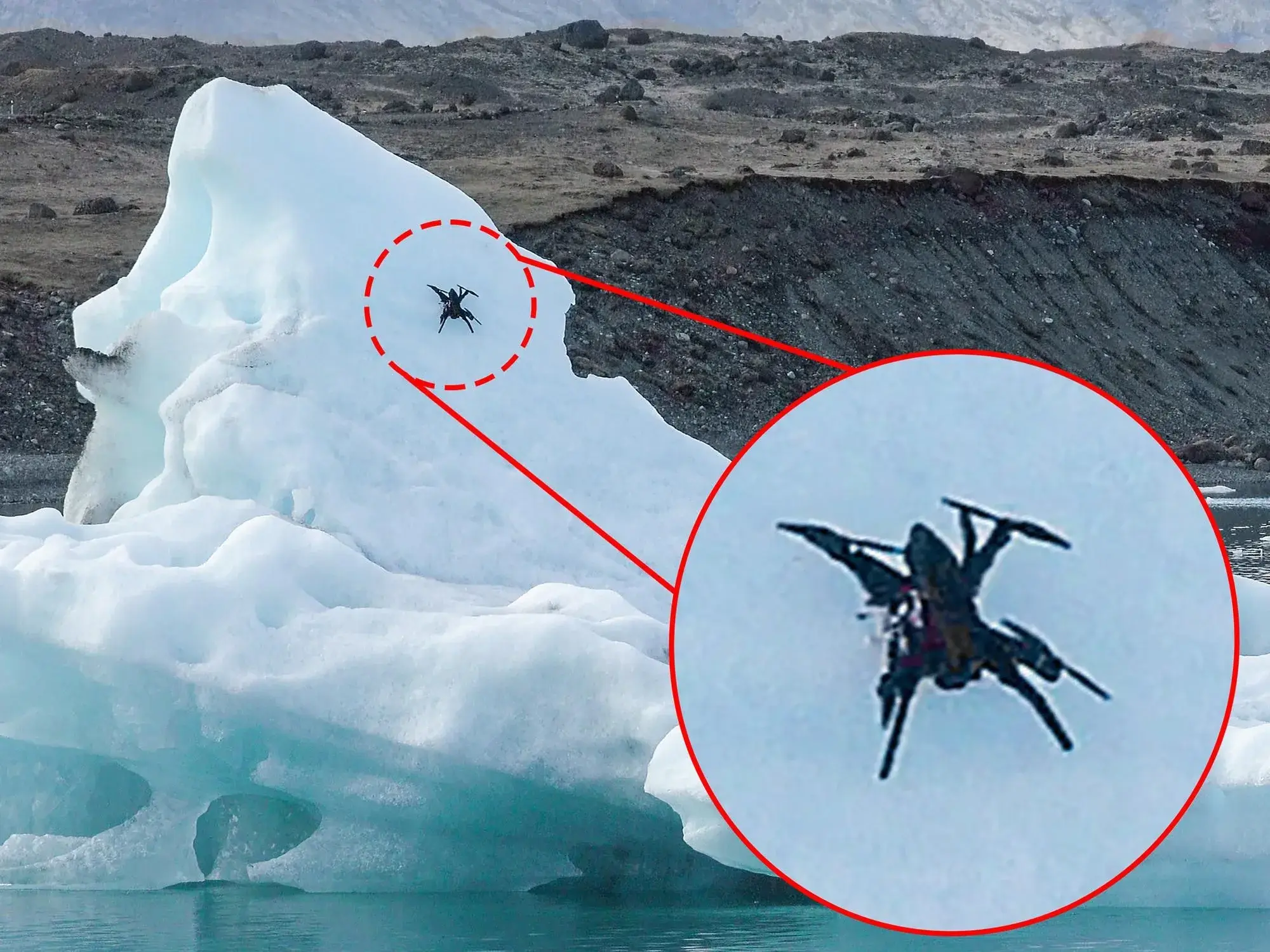
A drone above an iceberg runs into a mundane problem very quickly: staying in the air costs energy even when the aircraft is doing nothing except holding position. A few minutes of imaging can afford that bill. A measurement meant to last for days cannot, so flight eventually becomes the expense to remove.
Ice Dart, developed at Université de Sherbrooke by Isaac Tunney, John P. Bass and Alexis Lussier Desbiens, is built around that inversion: rather than searching for a neat horizontal patch, it accepts a fast arrival on steep, irregular, slippery ice and uses the collision as the beginning of attachment.1
In Iceland the mechanism produced 24 successful landings on icebergs and a glacier, reaching slopes of 58 degrees in winds up to 30 km/h.12 The claws make the memorable photograph, although the landing itself depends on a sequence: absorb the arrival, let the points bite, and briefly press the aircraft into the ice.
Leave flight
The scientific payoff begins after touchdown, because a hovering multirotor keeps feeding its motors every second it stays on station, while an aircraft anchored to the ice can stop paying for lift and reserve the battery for sensors, computing or communications.2
Alexis Lussier Desbiens also points to two quieter benefits (useful ones for a field instrument): after landing, the aircraft becomes silent and can greatly reduce thermal signatures or radio emissions by shutting down systems it no longer needs.2
On an iceberg, the gain is mainly time. A flyover gives a snapshot or a short sequence of measurements; an instrument attached to the same mass of ice can travel with it and build a much longer record. The researchers frame the opportunity in days or even months, while acknowledging an important gap: Ice Dart has yet to demonstrate months of unattended operation, but perching removes the constant energy bill of hover.2
The aircraft becomes a delivery system for a sensor that would be difficult or dangerous to install by hand. Flight gets the instrument to the ice; staying there creates the longer experiment.
Brake first
Driving a rigid spike into the ice at the first instant of contact sounds simple, but the impact can make that spike bounce, skid, break, or tear away a piece of ice before useful grip develops.
Ice Dart begins by dissipating the landing energy. Four X-shaped legs pivot around the body and drive a friction shock absorber built from 38 disks; as the gear compresses, the center of mass drops and part of the aircraft's kinetic energy ends up as friction instead of sending the machine back into the air.2
Compression also deploys the spines passively, with no extra actuator. Protected through the approach, the points begin penetrating only after the landing gear has already swallowed part of the impact.12
That timing matters: the tip no longer has to survive the entire collision while stopping the aircraft in the same instant.
Two claws
Why put two opposing spines on each foot, and why give them different geometries? On a steep slope, the four contact points simply do not carry the same load.1
Downhill feet carry more weight and need aggressive braking, so they receive the larger spine. By contrast, uphill feet can be barely loaded; a thinner point engages more readily there and can re-establish contact under a small normal force.12
The paper describes the result as anisotropic shear force.1 In plainer terms, equal grip in every direction would waste design effort; the foot needs to resist the motion that gravity and the slope are actually trying to produce.
Tunney cites a cat's retractable claw as inspiration.23 The paw makes a convenient image, while the useful borrowed idea is timing: protect the point during approach, expose it when contact finally gives it something to work against.
Push harder
A well-shaped spine works only if it is pressed into the ice, and the uphill feet of an aircraft resting near 60 degrees are precisely where that normal force may become scarce.
At touchdown Ice Dart therefore asks its propellers to do the opposite of their usual job: the motors briefly generate reverse thrust, increasing the force pressing the chassis into the ice and, relative to the unassisted touchdown, giving the spines more penetration and shear force.1
Reverse thrust lasts through the unstable transition, lending the landing gear and claws extra normal force until the aircraft has settled into a load the passive mechanism can hold.
The Sherbrooke lab arrived with some history here. Earlier work explored friction dampers and reverse thrust for multirotors landing on fast-moving vehicles, followed by systems able to settle on steep roofs.24 Ice Dart brings those ideas onto less cooperative terrain, brittle, wet, sculpted and difficult to read precisely from the air.
Twenty-four hits
Controlled drop tests covered descent speeds from 1 to 3 m/s on ice slopes up to 60 degrees.1 Iceland took the mechanism away from prepared laboratory ice and onto different ice types and shapes at Fjallsjökull glacier and among the icebergs of its lagoon.12
We can put a denominator under the “100 percent” figure: 24 field attempts, 24 successes.1 That describes this campaign, rather than every possible iceberg face. To be sure, the denominator is small enough that the next field campaign still matters. The study also reports heading offsets up to 45 degrees, showing that the aircraft did not require perfect orientation along the steepest direction of the slope.
Mechanical success leaves a large software problem behind. Autonomous selection of a safe landing patch remains future work, along with emergency takeoff when an iceberg rolls or fractures.2 A sensor perfectly attached to a slab that flips over would, technically, be very well attached to the wrong place.
Sleep there
Ice Dart makes an overlooked boundary in aerial robotics unusually visible: drones are normally judged by speed, endurance in the air and sensing payload, whereas the decisive capability here is knowing how to stop flying.
At 2.65 kg, the carbon-fiber aircraft remains a small carrier rather than a giant science station.2 Its useful scale comes from delivering modest instrumentation to ice that ships, people and dropped beacons struggle to reach, then sharing the motion of the iceberg instead of immediately leaving it.
IEEE Spectrum reported in August that a Canadian Arctic mission was expected to use the drone on icebergs and gather measurements to check ship-based detection systems.2 Results from that campaign have yet to be published, so it belongs to the next chapter of the project rather than the list of demonstrated outcomes.
The Iceland prototype has already crossed the most dramatic transition: at three meters per second Ice Dart is still arriving as an aircraft, the gear compresses, the claws bite and the motors push one last time toward the surface; moments later, the aerial part of the job is over. The sensor's job can finally begin.