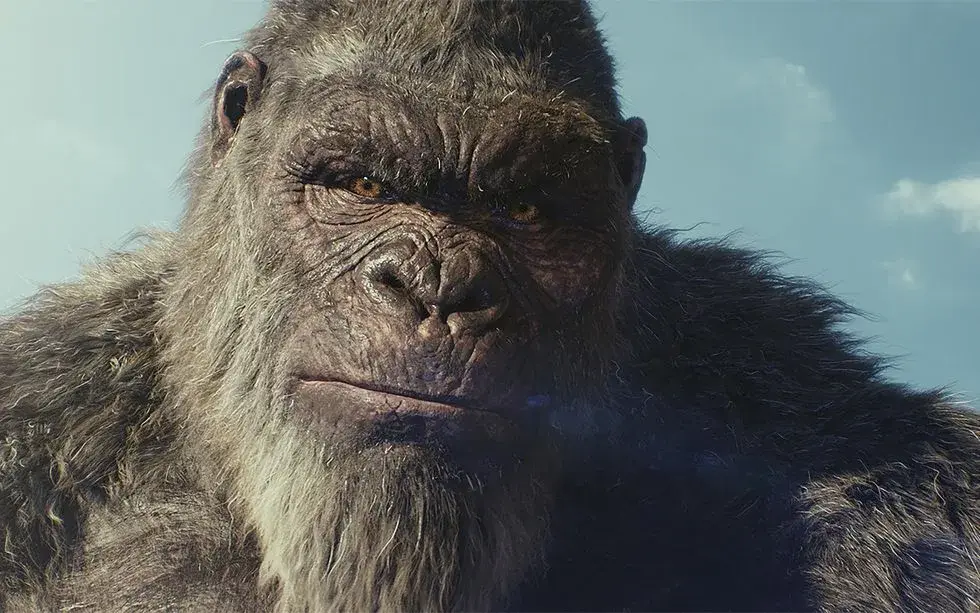
In Godzilla x Kong: The New Empire, most of the work on King Kong is invisible on screen. That is the point: it happened before the drawing. Someone built bones, muscles, fat, fascia and skin in three dimensions, then handed the whole thing to a program that computes how that material deforms when the skeleton moves. Only the skin reaches the frame. The rest exists for physics alone.
Jernej Barbič, a professor of computer science at the University of Southern California (USC) and the designer of that software, called Ziva VFX, sums up what the gorilla shows: “When King Kong is walking, you can see the muscles, how they're very pronounced, and how they influence the shape of the skin. You can really feel the strength of King Kong. And this was made through my software, so I think it's amazing.” 1 In 2025, Ziva VFX received a Technical Achievement Award from the Academy of Motion Picture Arts and Sciences for a system that “constructs and simulates muscles, fat, fascia, and skin for digital characters.” 234
Five people appear on the certificate: Essex Edwards, James Jacobs, Barbič, Crawford Doran and Andrew van Straten.2 The software has been used on more than sixty films, among them Aquaman and the Lost Kingdom, Venom: Let There Be Carnage and the 2024 Godzilla x Kong.1 For the visual effects industry, the award is not the most interesting part. The order of work the tool imposes is.
Build an anatomy
Ziva VFX ships as a plugin for Maya, the animation software found in almost every production pipeline.7 The artist does not directly sculpt the character's final look. They build an anatomy: geometries for bones, muscles, fat and skin, each given a “material” describing its flexibility, how strongly it keeps its volume, and its density.57 For muscles you add a fiber field, the direction in which the muscle will contract, plus contractile forces. “Attachments” then connect the parts: a muscle can be pinned firmly to a bone, or slide along a surface.57
The end result is no longer a surface the animator bends by hand, but a coherent mechanical stack that the software solves. The Academy describes it as “an artist-friendly interface that emphasizes easily understood physical metaphors, coupled with a robust, physically accurate solver.” 2 Both terms matter. The interface turns the feel of matter into familiar gestures; the solver, meanwhile, does not cheat on the mechanics.
This way of working did not come out of nowhere. It descends directly from academic research on deformable solids, the branch of computer graphics that borrows its equations and numerical methods from structural mechanics.114 To put it plainly, what gets animated is a set of partial differential equations of nonlinear elasticity describing how muscles, fat, skin and connective tissue deform, interact with bones, and contract.1
From the inside out
The solving chain reads from the inside out.567 The skeleton is not simulated: it is a kinematic input, the animation performance the artists have already produced. Next, the muscles are simulated over that animated skeleton, then they become the collision geometry for the fat and fascia, and finally the skin is solved last, over the fat cache.67 Each pass exports its result as an Alembic cache that feeds the next pass.6
The detail that changes everything sits at the last stage. Fat and skin are not solved the same way. The epidermis is treated as cloth while the subcutaneous fat stays a full volume solved with volumetric elasticity.6 This coupled method — muscles, fascia and fat simulated together as volumes, with the skin solved as a drape — is uncommon because it is complex and expensive. But it produces a stable, anatomically coherent result, and it is what gives that feeling of skin sliding over matter instead of being glued to it.6
In practice, changing a performance means feeding the animated skeleton back in and letting the passes recompute. It is iterative, and rather fast compared with what it replaces: Mohsen Mousavi, VFX supervisor at Scanline VFX on The Meg, described a flow in 2018 where you can “get a simulation within a few minutes, look at the results, discuss, and iterate.” 15
Math in tetrahedra
Why did a whole corner of the simulation world converge on finite elements, FEM? Because, unlike springs or constrained positions, it treats matter as a continuous volume cut into small elements, and it computes at every point how the material deforms, compresses and twists.113 Every Ziva VFX muscle is a tetrahedral mesh.5 A tetrahedron is the simplest of volumes: four vertices, four triangular faces. A large muscle mass contains tens of thousands of them, and it is on this discretization that the solver lays down the equations of continuum mechanics.14
FEM belongs to the same mathematical repertoire used by engineers checking whether a bridge part or an implant will hold. Seen from the inside, simulating a Kong leg is not radically different from a fatigue simulation: the same deformations, the same quantities, the same implicit integrators.1314 The Vega library, released as open source by Barbič and colleagues, offers several families of material models — corotational linear, Saint-Venant-Kirchhoff, neo-Hookean, Mooney-Rivlin — and several time-stepping schemes, including implicit Newmark and backward Euler integrators.1213 That whole engineering literature, built for real load-bearing structures, ends up applied to rendering movie monsters.
Accuracy has a price. At every time step, the implicit solver must build and invert sparse matrices that couple every degree of freedom of the mesh.13 In production, the final solve stays an offline computation run on server farms, and resolution times are counted in minutes for large creatures, not milliseconds.15 This is a difference in nature from the position-based methods (PBD, XPBD) used by Houdini and now Blender: those trade physical exactness for interactive stability by manipulating positions directly to satisfy soft constraints. Ziva plays the volume and the exact elasticity, and you feel it in how the mass behaves.13
Twenty years to the Oscar
The IEEE Spectrum profile published on August 28 is worth reading for the genealogy of a technique alone.1 Barbič grew up in a village in northwestern Slovenia. At eight, his mother, an elementary school teacher, brought home a ZX Spectrum borrowed from her school; two weeks later he had written his first game in BASIC. A bachelor's degree in mathematics from Ljubljana in 2000, a PhD from Carnegie Mellon in 2007 on deformable-object simulation, a postdoc at MIT, then a professorship at USC from 2009.1
His thesis and the work that followed, notably the open-source Vega library, earned him a reputation in a narrow circle: the people able to simulate deformable solids at scale.1213 In 2011, at SIGGRAPH, he ran into James Jacobs, then creature supervisor at Weta Digital, the studio behind The Lord of the Rings. Jacobs was already pushing physically based tissue in his creature work; he had been honored in 2013 for the tissue physically-based character simulation framework he developed at Weta.5 In 2013 Weta hosted Barbič for a summer, and that immersion convinced him there was a hole in the industry: studios could render beautiful skins, but nothing made the mass underneath move correctly.
In April 2015, Jacobs, Barbič and Chris Godsall founded Ziva Dynamics in Vancouver.511 Ziva VFX launched in 2016, and the software entered productions through the hardest creatures: the megalodon of The Meg at Scanline VFX in 2018, King Kong at DNEG in Godzilla vs. Kong and Godzilla x Kong: The New Empire, the sharks and monsters of the DC films, and characters in Dune: Part Two and The Garfield Movie at DNEG.1415 Thirty years after the problem was first tackled, two worlds finally met: structural mechanics and entertainment. The Academy wrote it down in 2025.23
What the solver removes
The change in craft is visible in the vocabulary of the time. Before Ziva, a slice of character work was “shot sculpting”: when skin moved badly in a shot, an artist redrew the surface, frame by frame, or dropped corrective shapes on top to patch the deformation.7 Anatomical simulation displaces that gesture. It replaces it with setup done upstream: you fix the material, the fiber field or the attachment, and the correction propagates to every shot.57 Jacobs put it in 2018: “Ziva's physics-based character animation system uses computational resources in lieu of exhaustive artist effort.” 5
The cost moves to the front of the pipeline instead. Building a believable anatomy takes time up front: muscles, attachments and volumes must be modeled properly for the solver to produce anything useful.5 Anatomy-transfer tools appeared to amortize that investment — porting a muscle from one character to another while warping geometry and attachments, or generating variants by script with the open-source zBuilder module.57 The economic bet is that a well-anatomized character gets reused instead of rebuilt from zero.
There is one thing the solver does not take away: artistic direction. Muscle contraction is automated, for instance, so the software guesses when a muscle should “fire” from how the geometry moves. But which muscle flexes for a given gesture, and how hard, remains a decision. The software makes the matter plausible; the meaning of the movement stays human. That is another way of reading the Academy's sentence: the solver is “physically accurate,” while the interface stays “understandable,” which is to say drivable.2
A tool that changes hands
The rest of the story is a warning. In January 2022, Unity Technologies announced it was acquiring Ziva Dynamics, aiming to bring cinema-quality digital characters into real time.1011 The announcement's demo was named Emma, a digital face trained on more than thirty terabytes of 4D data and able to emote from some 72,000 learned shapes.16
Then, on April 2, 2024, Unity announced that Ziva was no longer sold or supported: existing subscriptions could be converted into a five-year license, and DNEG signed an agreement for a perpetual exclusive license to the Ziva IP.89 A significant part of the team joined the studio, but Unity kept ownership of the technology.89 For a studio that built its creature pipeline on Ziva, this means a central tool can change hands overnight, with no unit sales and no mainstream next version. You do not “keep buying it”: either you inherit the chain, or you abandon it.
The DNEG phase turns that structural fragility into a competitive edge. The tool that won the Oscar is now the exclusive asset of one major studio, not a public good.489 For the rest of the industry, this trajectory is a lesson about owning your own tooling: when a platform pivots, the rigs accumulated through years of artistic work follow the vendor's calendar. A studio's ability to keep producing then depends on its ability to negotiate a license, not on the quality of its artists.
Simulation as a data factory
The Unity acquisition was not just marketing. Behind Ziva VFX sits a machine for turning expensive simulations into something interactive. The principle, described in the Intel case study around The Meg, is easy to state: run hundreds of offline simulations, and use the data they produce to train a machine-learning model that learns to reproduce the deformation in real time.15 That is the spirit of Ziva RealTime: instead of solving the volume every frame, which takes seconds or minutes, the model rebuilds the shape in milliseconds.4
The detail is worth pausing on, because it inverts the usual relationship between real time and offline. Normally the offline simulation is the expensive reference and real time a compromise. Here, offline simulation serves as a data factory: its physical accuracy becomes training material, and the real-time version is no longer an approximate computation but an interpolation of already-solved cases.15 The weakness sits elsewhere: a machine-learning model only knows what it has seen. A genuinely new gesture, outside the sample, exposes the limits of the bargain. High-fidelity proof remains offline.
The hand that follows
Barbič, meanwhile, went back to the lab. His recent research is about hands: modeling, simulating and animating the human hand to design tools, prosthetics and robotic hands.1 The team MRI-scanned the hands of four people, two men and two women, in twelve poses, to capture how bones, muscles and fat move during motion, then released the dataset openly for other teams to use.1
The continuity is striking. The same bricks used in films — medical imaging, geometric modeling, finite elements, multibody simulation — now serve to understand grasping, calibrate a prosthesis or build a robotic hand.1 The tool that solved the muscles of virtual monsters now serves objects that must actually hold, push and transmit force. Entertainment and real mechanics use the same mathematics; the difference is that in one case the error is fixed in the cache, and in the other, in an operating room or on a test bench.
For an independent creator, this is one of the most portable lessons of the story: simulation skills and libraries developed for spectacle do not belong to spectacle. Once you can build a deformable solid and make it obey physics, you can drop it into a game engine, a medical preview, or a printed prosthesis. The discipline transfers almost unchanged.
The honest limit
There are things this approach does not solve, and it is worth saying them out loud. Anatomical simulation is expensive: every volumetric pass multiplies compute time, and Ziva's coupled method — muscles and fat as volumes plus skin as cloth — is explicitly described as complex and costly by the people explaining it.6 It depends on an accurate but closed solver whose maintenance has already shown it can stop in favor of another business model.8 And physically plausible does not mean spontaneously expressive: a correctly solved body can still be an empty body if nobody decides what it means.
The contrast with the open road opening up elsewhere is useful. Blender has put an XPBD solver at the heart of Geometry Nodes for cloth and hair, and Houdini runs Vellum on the same family of methods: no finite elements, but soft point constraints with large time steps, stable and hackable. This is the other end of the trade-off: where Ziva chases volumetric exactness and pays in offline cost, the PBD family chases interactive stability and pays in mechanical fidelity. Both philosophies produce matter; neither replaces it.
The real question raised by Ziva VFX's Oscar is therefore not “does the physics fool the audience?”. It is more interesting: where do you place the decision in the making of an image? Ziva moved decisions from the surface to the inside of the character, and from the shot to the tool. The artist did not disappear; their gesture changed. Instead of fixing a skin that lies, they build an anatomy that will later tell the truth being asked of it. The monster is drawn after its tissues have been computed. The next chapter, meanwhile, will play out in the hand, the prosthesis, the medical preview — and in the question of who still controls the tool.