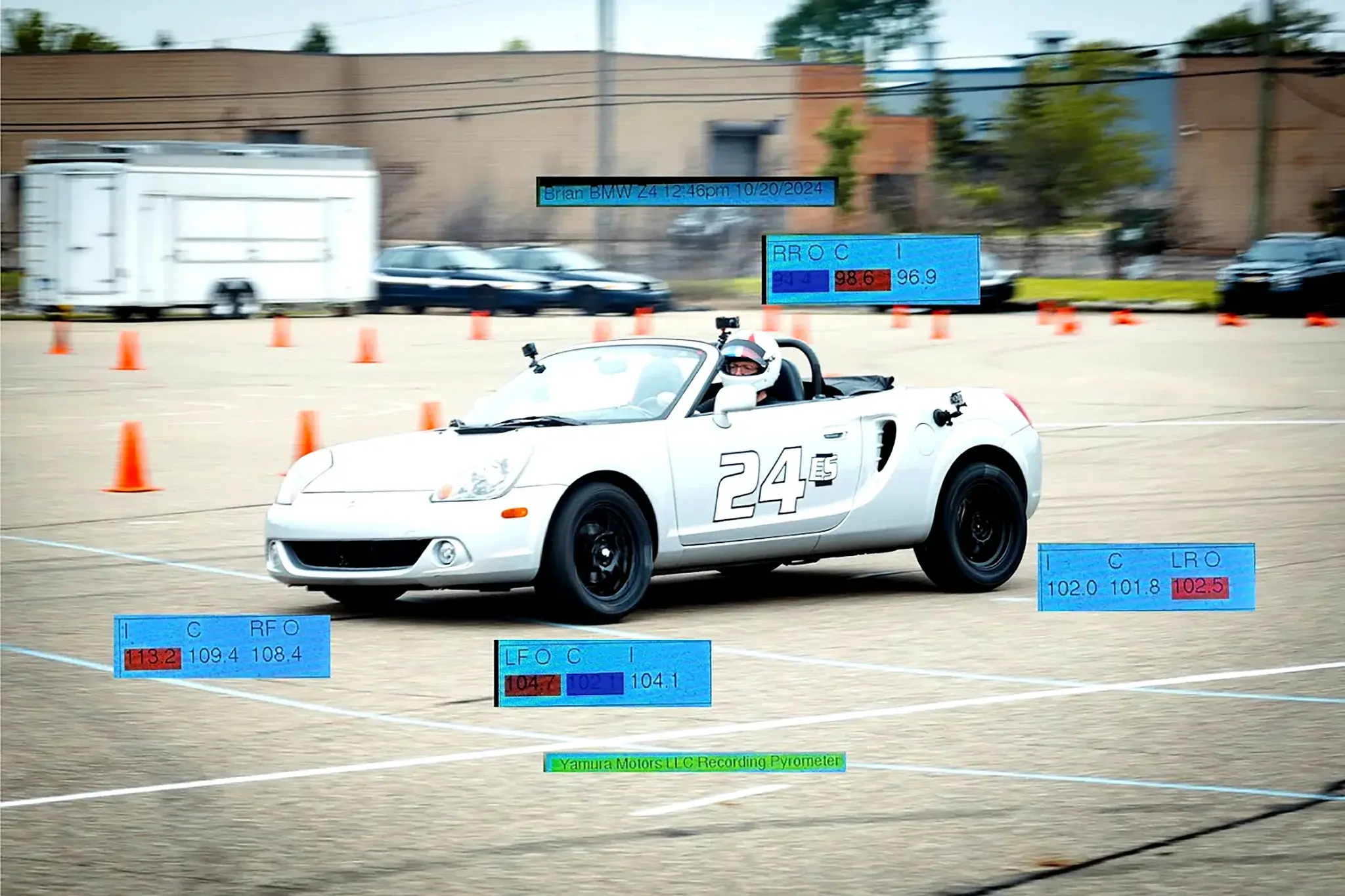
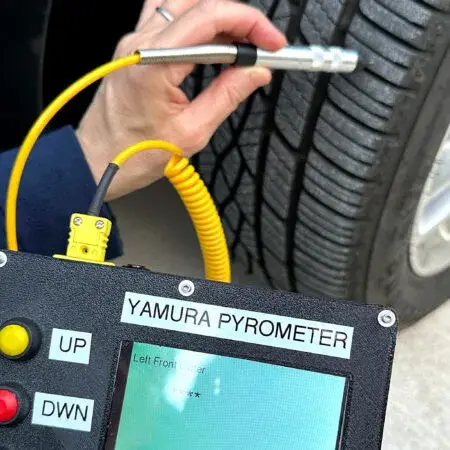
Between autocross runs you get ten to fifteen minutes, and the tires don't wait: as soon as the car stops, the rubber starts giving its heat back, and every degree that escapes takes part of your setup with it. Brian Smith built a recording pyrometer to win that particular race. The device fits in one hand, plugs into a K-type probe, logs to a microSD card, and the full project appears in Make volume 98, firmware and printed enclosure included.12
Smith's résumé explains why the object exists. Across forty years he raced sprint and enduro karts, Formula V and Formula Ford, and today he runs SCCA Solo in a Toyota MR2 and a BMW Z4; he also likes to tell how he skipped his own college graduation to go buy a kart. A career in software and hardware development followed, put to use for one purpose, which was going faster.1
Inside, center, outside
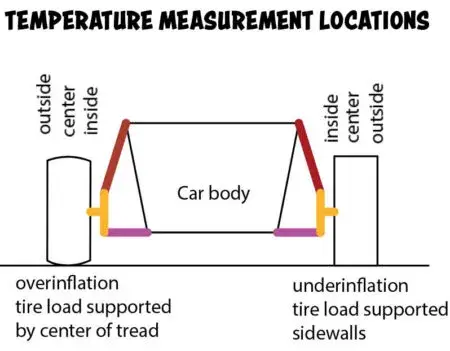
The measurement itself works like a tight ritual, three spots per tread, inside, center and outside, times four wheels, which comes to twelve values per run.1 You push the probe tip into the rubber, confirm, watch the screen while the reading settles, then move to the next spot; when the cycle ends, the device lays out the whole grid, hottest spot of each tire in red and coldest in blue.1
The method matters as much as the sensor. Prisma Electronics, which supplies race teams with paddock instruments, requires measuring every tire in the same order at every session and changing only one variable at a time.4 At JOES Racing, a probe pyrometer maker, the instruction is even more physical: set the probe's depth stop to match the rubber thickness of your own tires, so the tip reaches the cords at the same depth at every point, because without that discipline twelve numbers refuse to compare.5
The rubber gives it all away
Why bother with twelve numbers? A tire makes grip through friction, and friction makes heat, so the temperature map describes how load spreads across the contact patch.1 What you want is an even tread working inside its compound's temperature range; a center running hottest signals overinflation, where the crown carries the car alone, while hot edges point to low pressure and sidewalls doing work they were never meant to do.1
Probe or infrared
Infrared thermometers read without contact and even work while the car is moving,1 but once you're stopped, the probe wins whenever the surface is no longer clean. Prisma Electronics keeps infrared for the quick verdict between sessions and recommends the probe for deeper point-by-point readings, especially with graining or blistering, those surface degradations that fool an optical reading.4 Smith's probe, for its part, reads into the thickness of the rubber rather than settling for its skin.1
The hard part
Smith names the hardest part himself: the enclosure. One hand holds the probe while the other holds the device, outdoors, sometimes in the rain. That constraint explains the 4-inch TFT screen readable in direct sun, the three buttons within thumb reach, the real-time clock stamping every reading, the four AA batteries, and the probe cable routed out of the way.1 The plastic is PETG, and Smith passes along advice that smells of experience: a PLA box deforms inside a car left out in the sun.1
Inside, an ESP32 runs the firmware, an MCP9601 amplifier reads the thermocouple, the microSD card keeps the history, and Wi-Fi serves the recorded temps to a phone or updates the firmware without anyone opening the box.1 All told you pay $75 to $120 in parts plus a weekend of assembly, while an off-the-shelf Longacre Memory unit showing twelve temperatures at once and storing ten sessions lists at $539.99 in specialty catalogs.16
Twelve numbers, three adjustments
Once the grid fills the screen, reading it gets almost mechanical: let air out when a center runs hottest, add a little when it sits coldest, and blame camber for an overheating edge, too much negative lean when the inner shoulder cooks alone, the opposite when the outer one does, while toe leaves its own trace in the rubber.1 Smith suggests adjusting a few psi at a time and writing everything down, so you know what changed.1
{% irzImage src="/src/assets/images/articles/tire-pyrometer-camber.webp" alt="Diagram of cornering load transfer: with zero static camber the outer edge overheats; with negative static camber the temperature evens out across the tread" caption="Under cornering load the body rolls and static camber disappears: the right setup spreads temperature across the whole tread." credit="Brian Smith / Make:" creditUrl="https://makezine.com/projects/race-car-tire-pyrometer/" /%>
Then there is time, the factor that motivated the whole device. Autocross gives you no warm-up lap, so the rubber has to sit in its window from the start line onward.1 Heat then builds up run after run; tires that worked well on the second or third run are likely to fall off their peak by the fourth or fifth, sometimes as empty of grip as a cold tire would be.1 Which is where the water sprays between runs come from, along with blankets on cool days and the ban on tire warmers at club events.1 On the Z4 run overlaid on the article's lead photo, the twelve values span 94.4 to 113.2, nearly nineteen degrees between the coldest and hottest tire, recorded on October 20, 2024 at 12:46 pm.1
The platform stays generic
Anyone who never races autocross should start with the last layer, where the pyrometer turns out to be just one use case among many. Any I2C or SPI sensor with an Arduino library bolts onto this base, Smith notes: soil moisture, GPS, sound level, air quality.1 On his blog he has documented two derivatives already, an onboard logger tracking speed, acceleration, steering angle and throttle position over CAN-FD,7 and string potentiometers built for about twenty dollars each, after commercial units gave him sticker shock.18
In the public repository, the sample file sets the tone: lines timestamped to the second, driver and car names in plain text, "Brian Z4", "Mark MR2", "Jody P34", and twelve temperatures per line.23 Twelve numbers and a timestamp per line, which is barely anything and exactly enough to stop guessing.