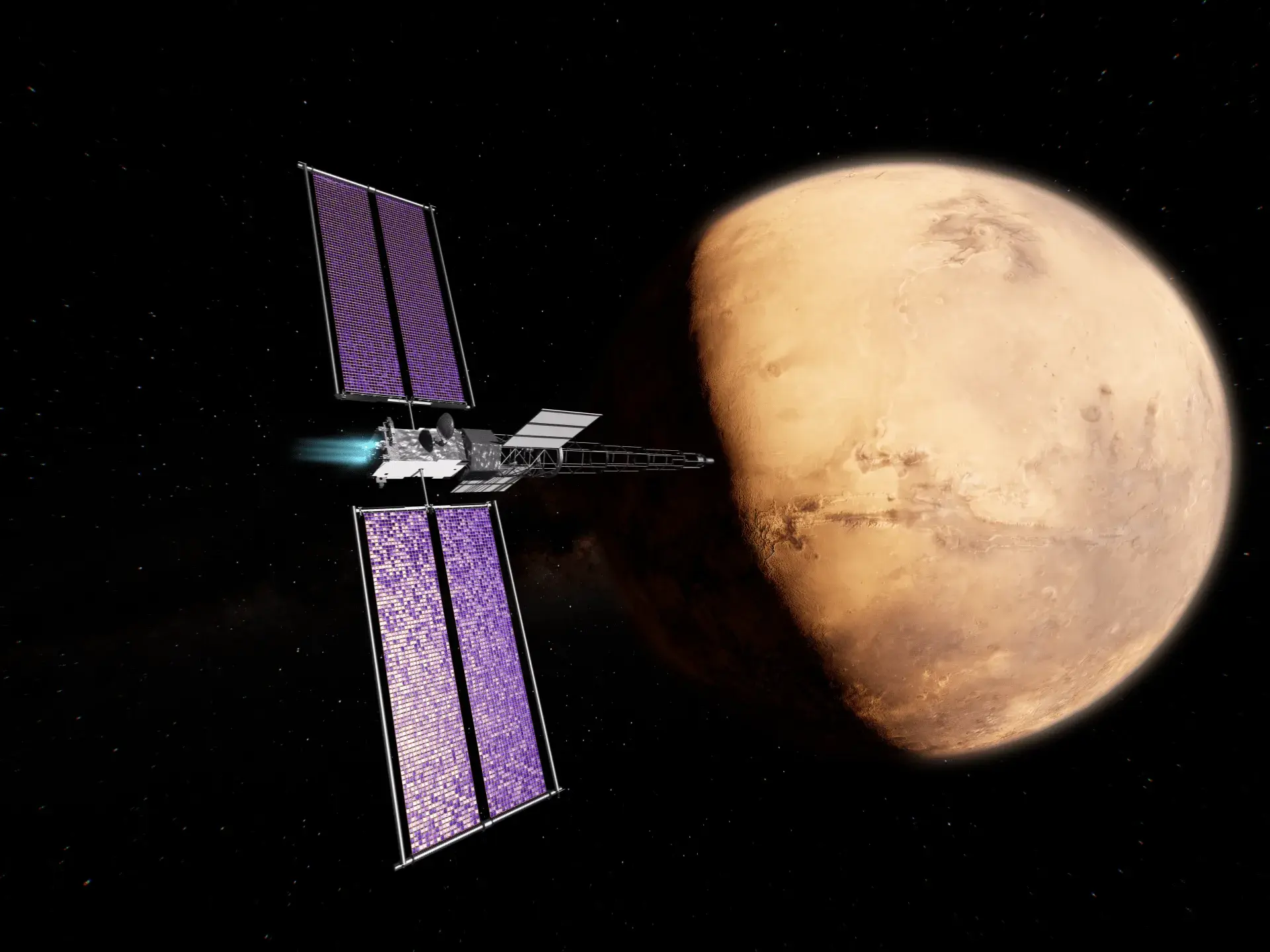
On August 26, 2026, IEEE Spectrum published a piece by the two engineers who believe they have finally found a way to make the "bimodal nuclear rocket" fly — a goal that teams have chased since at least the 1990s.1 Kurt Polzin is chief engineer of NASA's space nuclear propulsion project at the Marshall Space Flight Center. Robert Schleicher is chief engineer for nuclear technologies and materials at General Atomics, with a career going back to the first US nuclear propulsion programs of the early 1970s. Their proposal has a restrained name that hides the ambition — synchronal bimodal nuclear rocket, S-BNR — and an idea that is easy to state: one reactor, two hydraulically independent fluid loops, two specialized fuel zones, and no mode-switching valves at all.1
Let's get one thing clear at the start: this is not a hardware announcement. It is a design proposal from two practitioners, published in an engineering magazine, riding a real revival of space nuclear propulsion. Six months earlier, on March 24, 2026, NASA announced that it would launch SR-1 Freedom before the end of 2028 — what would be the first interplanetary spacecraft propelled by a fission reactor, carrying three Mars helicopters.23 The S-BNR is not part of that schedule. It opens a route for the generation after it, at the precise moment the window reopens.
Why this architecture deserves more than a catchy headline: it carries a transferable design lesson. When a reliability-critical component becomes untenable, the right answer is not always to harden it — sometimes it is to restructure the system so the component no longer exists.
The concrete fact
The biggest enemy of a crewed trip to Mars is not distance, it is time. The authors recall that NASA's shortest blueprint for sending people to the Red Planet and back requires 620 days in space, including 30 days on Mars.1 Every extra day costs life support, radiation exposure, microgravity effects and more chances for something to go wrong. The two engineers state a clear target: bring the transit under 335 days.1
The mechanism they propose combines two technologies NASA currently pursues separately. Nuclear thermal propulsion (NTP) heats hydrogen with a reactor to produce high but temporary thrust. Nuclear electric propulsion (NEP) uses the reactor as a power plant to drive ion thrusters that are extremely efficient but weak. Since the 1990s, the idea of wedding both in a single reactor has been attractive: less mass, fewer systems, a vehicle that can perform both strong maneuvers and an efficient cruise.1
The S-BNR is that attempt, with an architectural twist: two hydraulically independent circuits inside one core — an open loop for propulsion, a closed loop for electrical power. Each loop has its own fuel zone, optimized for its regime. The core produces thrust when needed and electricity permanently. The detail that changes everything is that there is no longer a valve to switch.
The proposal lands in a context that makes it credible on paper. In March 2026, NASA launched its "Ignition" initiative and bet on a short schedule for SR-1 Freedom: launch in December 2028, arrival at Mars in 2029, a HALEU reactor producing 20 kilowatts of electricity, and a spacecraft bus inherited from the lunar Gateway project repurposed for the occasion.24 The S-BNR remains a study, but it stands on the shoulders of the first generation of space nuclear hardware that is actually being built.2
The mechanism
To see why the S-BNR changes the picture, it helps to revisit the basic numbers of thermal propulsion. A chemical rocket is a heat engine: it ejects hot gases through a nozzle. Performance, mass and trajectory all follow from the exhaust velocity, measured as specific impulse (Isp), the number of seconds during which one kilogram of propellant produces one kilogram of thrust. The best available mix, hydrogen plus oxygen, tops out around 450 seconds.1
A nuclear thermal rocket escapes chemistry. Put a fission reactor in the core: a turbopump forces liquid hydrogen through the fissile material, the gas exits above 2,700 kelvins, and specific impulses reach 900 seconds or more.1 The gain is enormous, on the order of half the propellant for the same velocity, but there is a price: the energy leaves through the nozzle, and nothing is left to run the spacecraft. Thrust is powerful and brief, not continuous.
At the opposite end, electric propulsion converts part of the reactor's heat into electricity, which accelerates an ionized gas (xenon or lithium) electromagnetically. Specific impulses reach 2,200 to 4,600 seconds, but thrust is tiny: a force that accumulates over months, useless for escaping a gravity well or for a maneuver on a clock.1
Mating the two regimes has been a blocker for a long time. Earlier bimodal proposals used switch valves to divert the same circuit between propulsion mode and power mode. The problem: those valves must stay leak-tight for months or even years under a neutron flux and constant mechanical strain. And the fuel elements must briefly reach very high temperatures for thrust, then run for long stretches at moderate temperatures for power — two demands that are hard to meet in a single element.1 The bimodal dream, chased since the 1990s, remained a prisoner of its valves.
The S-BNR answers with geometry rather than mechanisms. The core is split into two zones, each feeding its own loop: the regime split lives in the material, not in a moving part.
The propulsion zone is made of high-temperature fuel elements (HTFEs). In the preliminary design, these are beds of "pebbles" — uranium fuel encased in zirconium carbide — surrounding a central tapering channel. Hydrogen passes through the bed, whose large surface area maximizes heat transfer, and exits above 2,700 K for thrust. A solid-fuel alternative in the style of NERVA is under study.1
The power zone uses low-temperature fuel elements (LTFEs): solid uranium surrounds a double-walled channel, in which the power-conversion fluid flows down the inside and returns along the outside wall, absorbing heat from 1,200 K upward. This zone is built to last for years and to deliver, depending on the mission, from tens of kilowatts to several megawatts of electricity.1
Both zones contribute neutrons to the chain reaction: the neutrons that feed the HTFEs also come from the LTFEs, and vice versa. That interdependence is what makes the design delicate. In power-only mode, residual heat from the HTFEs migrates into the adjoining LTFEs; the interface between the fuel elements is designed to throttle that flow — enough to remove decay heat safely, not enough to push the LTFEs past their temperature limit when the HTFEs run at full power.1
In combined mode, a heat exchanger on the power loop preheats the hydrogen of the thrust loop, easing the work of the turbopump. After a burn, the control elements damp the reaction in the HTFEs, and the power loop takes over cooling: no longer, as in earlier proposals, does the spacecraft need to carry extra hydrogen purely to remove decay heat during standby.1
This symbiosis is the heart of the argument: the loop that generates electricity doubles as the cooling loop and the reserve of thrust. The generator never stops at any point of the mission. For a crewed spacecraft, where energy is the first reserve of safety, that is a strong argument.
The primary sources and their limits
Before being carried away by the promise, let's separate what is established, what is proposed, and what remains hypothetical — the discipline a deep-read format imposes.
Established. The IEEE Spectrum article is signed by the two people best placed to defend the architecture: the chief engineer of NASA's space nuclear propulsion program and General Atomics' chief nuclear engineer.1 The physical orders of magnitude they cite — 450 s for chemistry, 900 s or more for nuclear thermal, 2,200 to 4,600 s for electric — are standard values in the field, consistent with the literature. NASA itself documents the NTP and NEP tracks as separate lines in its space nuclear propulsion program.5 The existence of SR-1 Freedom is factual, dated, described on the official mission page and confirmed by independent space press.234
Proposed. The S-BNR itself is a preliminary design proposal. The HTFE and LTFE numbers come from a study design, not a prototype. The "335-day transit" figure is an argued target; no calculated trajectory has been published. No ground test, no demonstration irradiation, and no schedule accompany the proposal in the article.
Corroborated elsewhere. The idea of a bimodal reactor is not marginal in the scientific literature. A Georgia Tech team published in 2026, in Annals of Nuclear Energy, the design and performance analysis of a bimodal core derived from the Rover-era Pewee reactor, running HALEU with a closed helium-xenon Brayton loop: the reported result is 50 kilowatts electric per engine with no penalty on propulsion performance — a quantitative result that gives the concept materiality.7 An L3Harris study presented at AIAA SciTech in January 2026 specifically examines bimodal NTP/NEP concepts for a human Mars mission.8 And an "epithermal" bimodal reactor with open propellant elements and a closed noble-gas power loop was modeled and peer-reviewed in the early 2020s (the BEAR project), with the verdict that the hard part is not the physics but the interface engineering.9
What the literature says about the risks. A 2007 University of Maryland dissertation built one of the first numerical models of a bimodal engine derived from NERVA, and its conclusion deserves to be spelled out: the same reactor can produce 316 MW thermal for thrust (66.6 kN at 917 s Isp) and then run at 73.8 kW thermal to generate 16.7 kW electric — but this requires reactor control that works with precision over a power range spanning several orders of magnitude, and the analysis of decay-heat transients still needs to be done.10 In short, the S-BNR's architecture removes the valves but leaves intact the problem nobody has solved experimentally: reactor control across the full power range.
One more signal deserves attention: NASA has talked about bimodal reactors before, and programs rarely survive past the drawing board. Project Prometheus was cancelled in the early 2000s; the DRACO program, launched with DARPA in 2021, was shut down in 2025, according to Ars Technica.6 The S-BNR belongs to a lineage where credibility is not decided by the idea but by execution — and execution has, so far, consistently failed.
The precedents and the orders of magnitude
The technical history matters here because it fixes what is already proven. The idea of using a reactor as a space thermal engine dates to 1946.1 The Rover and NERVA ground-test programs of the 1950s and 1960s fired real nuclear cores in the Nevada desert and brought the technology to the edge of a flight test in the early 1970s — before the budget shutdown of 1973.1
Two milestones frame the safety question, because they are the only experimental worst-case data the field has. In 1965, the Kiwi-TNT test deliberately ran a core into a runaway reaction to see what an accident would look like: the core vaporized, measurable radiological damage stayed within roughly 3.2 kilometers, and the site could be cleaned up in a few days.1 The same year, NASA orbited SNAP-10A, the first and still the only US nuclear reactor in space: about 600 watts electric for 43 days before shutdown — and it is still in orbit.1
This spread of orders of magnitude is why nobody bets on an all-electric crewed mission: the thrust is not enough to leave a gravity well, and electricity cannot replace a maneuver with a deadline. The S-BNR does not choose between the two regimes; it makes them coexist.
The concept takes on mass when you line up the real numbers of the generation that precedes it. The SR-1 Freedom demonstrator, targeting a December 2028 launch, would weigh about 12,000 kilograms, carry a HALEU reactor with a closed Brayton conversion system producing 20 kilowatts electric, a Gateway-derived bus capable of 48 kilowatts electric, and an Advanced Electric Propulsion System Hall thruster in the 12 kW class.26 That is already roughly 20 times the electricity generated by the radioisotope generators currently operating in deep space.611 The reactor is being developed under the auspices of Idaho National Laboratory, with heritage from a concept named VALKRE, at a preliminary cost estimate of about $2.1 billion — and with a constraint that orbital mechanics does not negotiate: if the December 2028 window is missed, the next one opens in early 2031.11 The initiative's fact sheet summarizes the requirement set: more than 20 kilowatts electric, a one-year operational lifetime, and a launch designed as the first step of a sustained cadence of space nuclear missions.12
Reading the same numbers from the other edge of the spectrum sharpens the difficulty. The Georgia Tech study reports a bimodal engine capable of 50 kW electric without degrading thermal thrust.7 The 2007 dissertation quantifies the gap between the two regimes of one core: 316 MW thermal in thrust mode versus 73.8 kW in power mode — four orders of magnitude that must live in the same fissile material.10 The S-BNR answers by separating the fuels, but that separation creates its own thermal-interface problem, to which the IEEE Spectrum article gives a statement of principle rather than a calculation.
The trajectory itself shows the trade-off. A path developed at NASA's Glenn Research Center depicts an Earth-Mars transfer in which the high-thrust maneuvers are executed by the thermal engine (escaping Earth's gravity well, injection, corrections) while interplanetary acceleration and deceleration are left to electric propulsion, whose gentle thrust accumulates over weeks.1 This is the division of labor that bimodal propulsion enables without carrying two reactors.
The limits and the conditions of reuse
The S-BNR is an elegant, well-documented architecture. It still is an architecture, and the article admits as much: the challenges begin where the schematic ends.
Control over a vast range. The reactor must remain precisely controllable between a few percent of its power (electricity generation) and hundreds of megawatts thermal (a thrust maneuver). The control drums the authors describe — rotating beryllium cylinders with a boron-carbide segment that either reflects or absorbs escaping neutrons — must work with precision across both regimes, for years on a Mars mission and potentially a decade on an outer-planet probe.1 Academic studies have flagged the same obstacle for twenty years.10
Interface materials. The NTP fuel elements inherited from Rover/NERVA survive extreme temperatures but live for hours; power elements last for years but at moderate temperatures. The S-BNR plays the heritage of both tracks, yet the thermal interface between HTFE and LTFE — enough heat flow to remove residual heat, not enough to cook the power zone — must be qualified experimentally, which has not been done.1
Ground testing. In the Rover/NERVA era, exhaust from test engines was blasted into the atmosphere. That is no longer acceptable: any ground test must now capture and scrub all potentially radioactive exhaust products. Methods exist, but they carry a significant price tag — a cost the S-BNR, even stripped of its valves, will have to pay before flying.1
Launch. International rules on nuclear launches were written in response to the Soviet RORSAT radar-spy satellites of the 1970s and 1980s, whose most serious incident scattered radioactive debris across a swath of Canada in 1978.1 The community's consensus became a firm rule: no reactor may reach criticality in any Earth orbit that decays faster than its dangerous isotopes. Concretely, an S-BNR would launch on a conventional chemical rocket, reactor cold, fuel fresh — fresh uranium is hardly radioactive at all, and the bigger concern, its chemical toxicity, is manageable with light protective gear. The authors note in passing that launching a cold reactor carries less radiological exposure than launching a radioisotope thermoelectric generator.1 The worst case, a booster exploding and damaging the control elements in just the right way to trigger a runaway, is bounded by the 1965 Kiwi-TNT test, which measured radiological impact confined to a few kilometers.1 That is paper insurance, but it is at least insurance grounded in a real experiment.
Programmatic execution. The trajectory NASA set for SR-1 Freedom is itself a credibility test: launch in December 2028, with the reactor assembled by spring 2028, components inherited from a cancelled program, and a preliminary cost of $2.1 billion.611 An independent review board expressed skepticism about a two-year development schedule — more typical of a cubesat than of a flying nuclear power plant.11 That is the kind of friction a future S-BNR program would face, amplified by how unprecedented the machine is.
What can the industrial and scientific community actually take away from the S-BNR? Four points. The first is methodological: splitting the two regimes into two dedicated loops is a general answer to the valve problem in a radiative environment, applicable to any future bimodal system, even one built by another player. The second is materials: the two fuel families (high-temperature pebbles, low-temperature double-walled channels) are independently useful building blocks that can be qualified by separate programs before any integration. The third is thermal: using the power loop as the post-burn cooling loop eliminates a waste of hydrogen, and that design trick is reusable even outside a bimodal system. The fourth is political: the article explicitly calls for NASA, the Department of Energy, the Department of Defense and industry to cooperate — an obvious condition that is never guaranteed in a field where every program so far has been shut down before the final test.1
For a reader following nuclear propulsion from afar, the most useful marker may be this: the S-BNR is not "a faster rocket." It is an attempt to make two jobs that refuse to combine — emergency thrust and permanent energy — live inside one core, by moving complexity out of moving parts and into the geometry of the fuel. The promise (335-day transits, a power plant that never shuts down) depends less on physics, which is known, than on thermal-interface engineering and reactor control — the two domains that twenty years of studies flag as unresolved. The next interesting news will not be a redesign of the architecture. It will be a test bench that fires two different fuel zones in one core, or a long-duration irradiation that validates the LTFEs. If either arrives, the S-BNR stops being a holy grail and becomes a program.