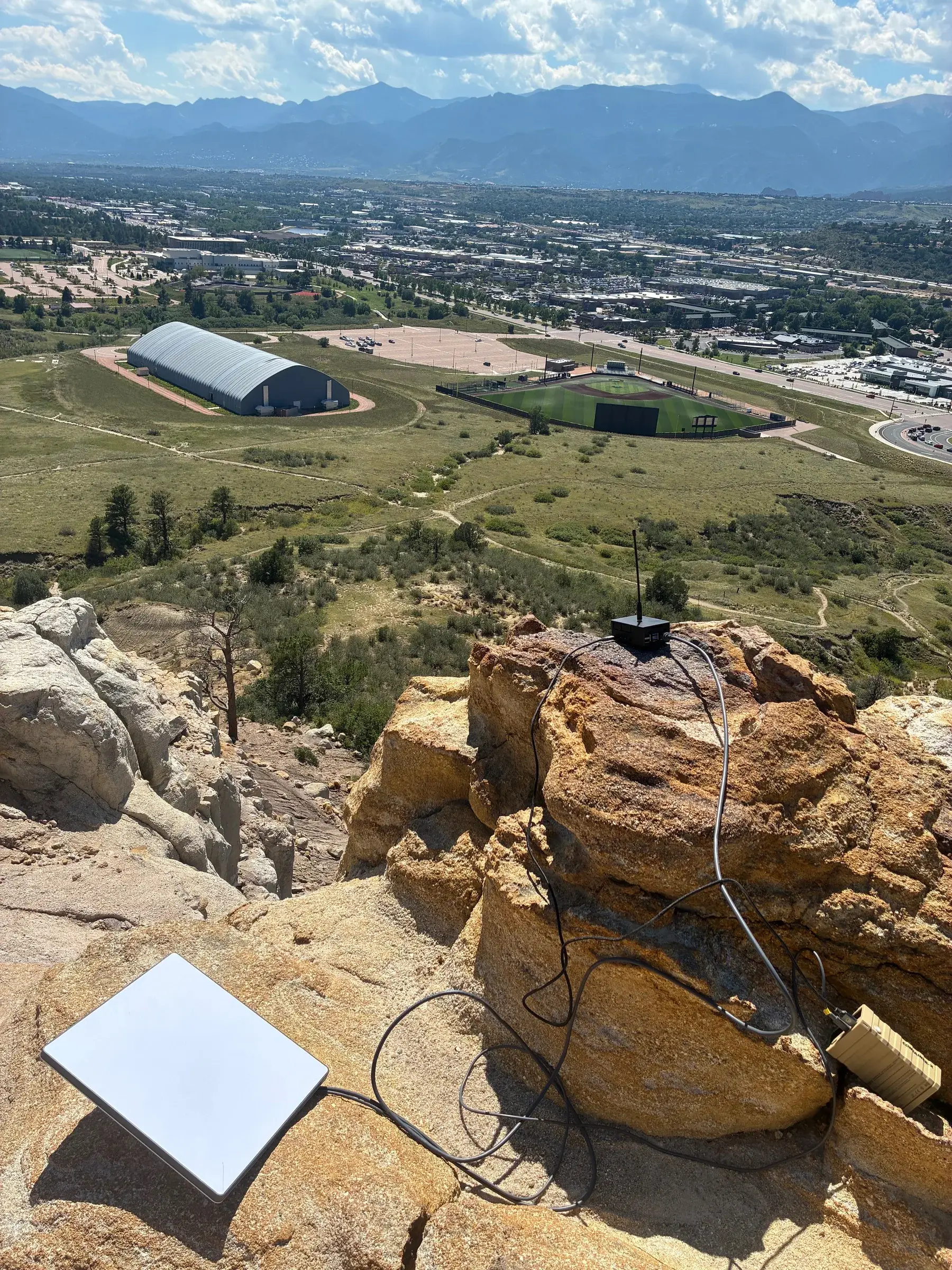
About 1.55 kilometres from its access point, the OpenMANET prototype tested at Pulpit Rock, Colorado, still measured 0.37 Mbps down and 0.21 Mbps up. At 619 metres, the same test produced 2.84 and 1.10 Mbps. Close to the starting point, on a 2 MHz channel, it exceeded 4 Mbps.3
This is not a distance record, which is exactly why the test is useful. Meshtastic documents a 331 kilometre ground link using a LoRa "Very Long Slow" profile.6 That is precisely why the comparison is useful: these systems are not competing for the same trophy.
OpenMANET asks a different question: what if an off-grid network needs to carry more than a few messages, GPS positions or tiny telemetry packets?
Its answer is to accept more hardware and higher power consumption in order to recover something mundane on a home network but unusual in the middle of nowhere: a real IP network capable of carrying voice, RTSP video, web interfaces and ATAK data.14
Calling it "Meshtastic, only faster" misses the point. The compromise has moved somewhere else.
Two budgets
Meshtastic starts with inexpensive LoRa radios, small packets and an explicit goal of excellent battery life. Its own introduction emphasizes encrypted text, GPS/location features, decentralisation and long range.5 LoRa earns that range and efficiency by accepting very little bandwidth.
OpenMANET is willing to pay elsewhere.
The project uses Wi-Fi HaLow, IEEE 802.11ah in sub-GHz spectrum, paired with computers capable of running OpenWrt. Current documentation covers Raspberry Pi 4, Raspberry Pi Zero 2 W, Gateworks Venice, HaLowLink 2 and selected Heltec hardware, with a different feature set on each platform.17
CNX describes practical bandwidth as roughly 1 to 15 Mbps depending on country and configuration, while also noting higher hardware cost and power consumption than a LoRa-based Meshtastic node.4 That is not an unfortunate footnote. It is the central design decision.
Calling one field radio "better" without naming the traffic, battery and terrain is a little like ranking a bicycle and a van by top speed alone.
Three layers
The word mesh is convenient, so naturally it ends up hiding the plumbing. Three distinct layers are doing the work here.
The HaLow radio provides the long-range wireless link. 802.11s forms mesh peering between Wi-Fi interfaces. Then batman-adv, using BATMAN-V in the current setup, observes neighbour link quality and chooses forwarding paths.12
OpenWrt then puts some aggressively ordinary network services on top, which is exactly the point.
Nodes share a 10.41.0.0/16 space. Each mesh point keeps a local DHCP server, so a laptop, tablet or phone can still join over Ethernet or local Wi-Fi even when the main gateway is unavailable. mDNS makes hosts reachable by name, while one "Mesh Gate" can NAT the MANET to Starlink, cellular service or another uplink when Internet access exists.2
That last distinction matters: the local mesh does not require the Internet. The uplink is optional.
This architecture changes what application developers have to care about. On Meshtastic, software has to respect scarcity. On OpenMANET, it can often behave as if it were attached to a small, slow and unreliable LAN.
For the software running on top, that difference is enormous.
Almost a mile
The documentation gets more interesting once it leaves network diagrams and reaches the Pulpit Rock parking lots.
At Pulpit Rock, the project placed a mesh gateway with Starlink on top of the rock and moved the other node among locations around Colorado Springs. The two radios used a 2 MHz channel at 923 MHz and Muzi Works whip antennas.3
Out in the field, the curve is messy:
- 4.03 Mbps down and 4.27 up within 15 feet;
- 2.84 / 1.10 Mbps at roughly 619 metres;
- 2.77 / 1.37 Mbps at roughly 669 metres;
- 0.37 / 0.21 Mbps at roughly 1,548 metres;
- 0.33 Mbps down at roughly 1,038 metres with obstructed line of sight.3
On a local 8 MHz test, the team says it saw about 15 Mbps.3
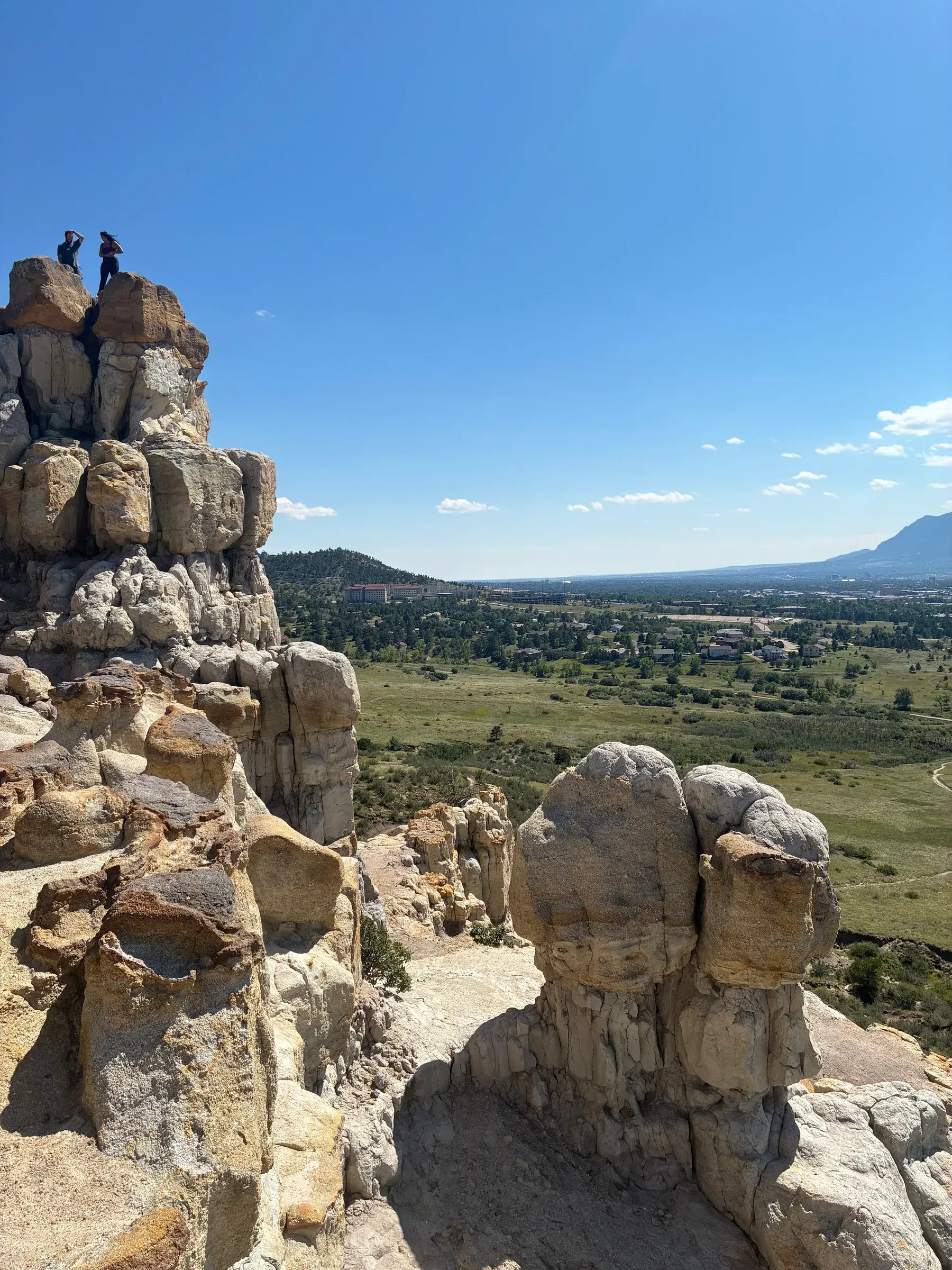
It would be a mistake to turn these figures into a definitive benchmark. The project's own page says the measurements used the Google Speed Test app on an iPhone and explicitly notes that iperf3 would have been a better tool. More tests with extra nodes and different channel widths are planned.3
Read these measurements as field notes: they show the scale of what is possible, not a throughput promise.
The wall matters
The most revealing point may not be the near-mile one at all.
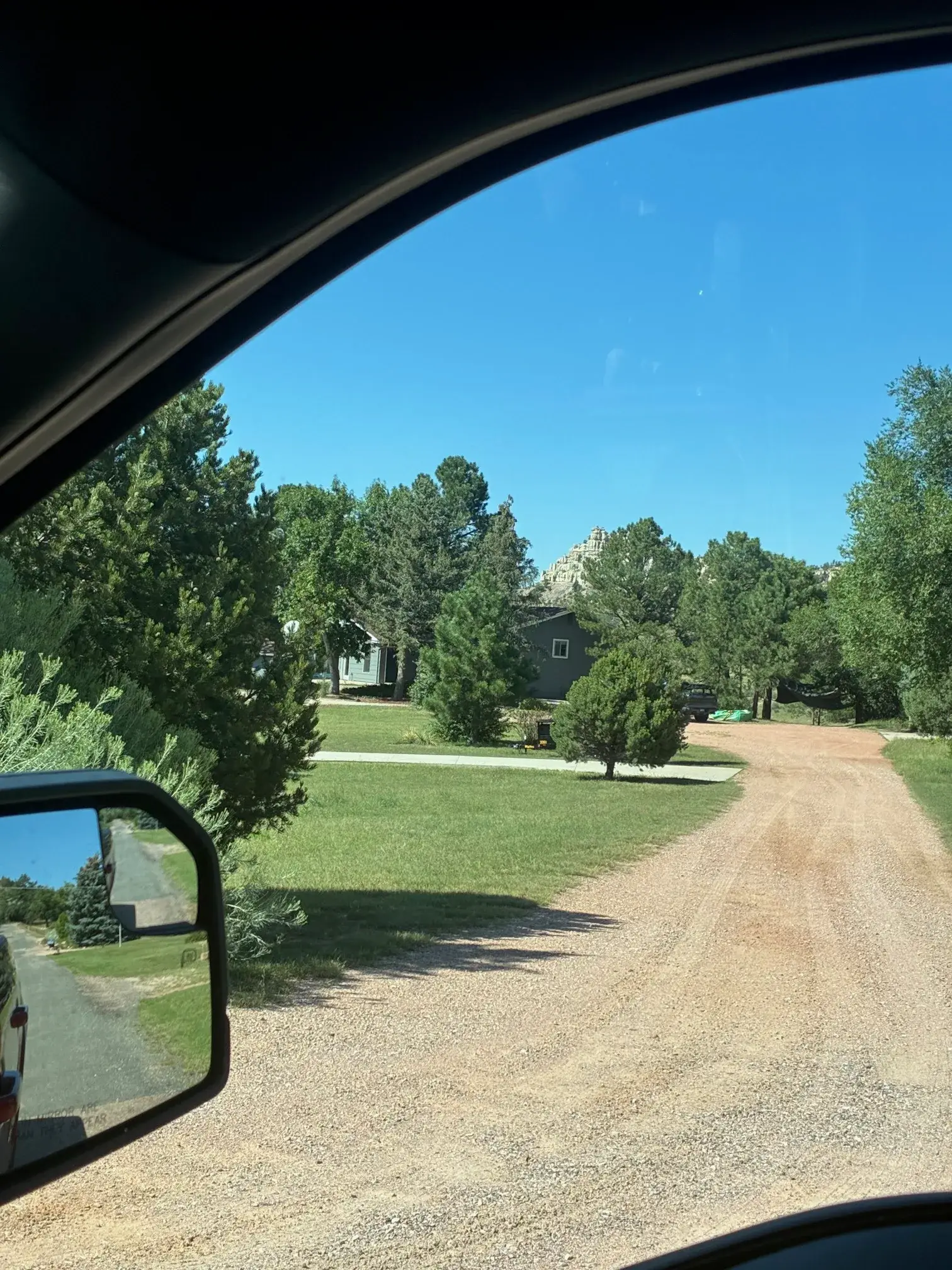
Inside a neighbourhood with obstructed line of sight, download speed falls to about 0.33 Mbps at 1.04 km.3 Sub-GHz improves the link budget; it does not hand the signal a diplomatic passport through walls, trees and terrain.
This is also why comparing only kilometres between OpenMANET and Meshtastic is meaningless. Meshtastic's 331 km record demonstrates exactly what LoRa can do when the range-versus-throughput compromise is pushed to an extreme.6
Conversely, a few hundred kilobits per second at one kilometre may be extremely valuable if the goal is to load a map, carry audio, sync a web interface or send a compressed image.
A kilometre is a useless metric until you say what you need to move across it.
A computer
The hardware tells the same story rather bluntly.
A documented Raspberry Pi 4 OpenMANET build can combine a HaLow radio, battery system, USB GPS and CSI camera. The firmware can then provide the core network, PTT communications, RTSP streaming, camera markers in ATAK and BLOS features for linking separate MANETs through the Internet.17
Other targets do not have the same headroom. The compatibility matrix notes severe storage and CPU limits on HaLowLink 2 and Heltec HT-HD01 V2, while some camera and communications features are absent there.1
Even the radio interface changes the design. SPI HaLow modules can leave the Raspberry Pi's onboard Wi-Fi available as an access point, whereas some SDIO configurations conflict with that bus. The project's hardware documentation says MM8108 modules offer higher peak throughput and improved receive sensitivity compared with MM6108 hardware.7
The finished object looks less like a digital walkie-talkie and more like a small Linux field router, battery and sub-GHz radio included.
All that networking comfort has a bill: more silicon, more power and more moving parts.
What you buy
The number worth remembering is neither 15 Mbps nor 1.55 km.
The luxury is being able to reuse the IP world.
A camera can publish RTSP. A tablet can open a web UI. Mapping software can receive positions on the same network. A computer can be reached over SSH. End devices do not have to understand individual radio hops: BATMAN-V can change paths in the background while users remain inside one network domain.12
Here, off-grid no longer has to mean a bespoke tiny-message protocol; the system tries to preserve the habits of a LAN.
Meshtastic starts from constraint: the link is tiny, so every feature must be adapted to scarcity. OpenMANET starts from the opposite ambition: spend enough energy, silicon and spectrum that the application can forget some of the radio underneath it.
There is no universal winner, only a use case that makes one compromise sensible.
For an emergency text node expected to live for days from a small battery, carrying an entire IP network may be pointless luxury. For a team that wants voice, maps, video and several computers at a site without infrastructure, reducing the network to tiny packets becomes the wrong economy.
That explicit choice, more than the radio protocol name, is what makes OpenMANET interesting. Long-range mesh is not one category. It is a slider between how long the node should live and how much network you want to carry with you.