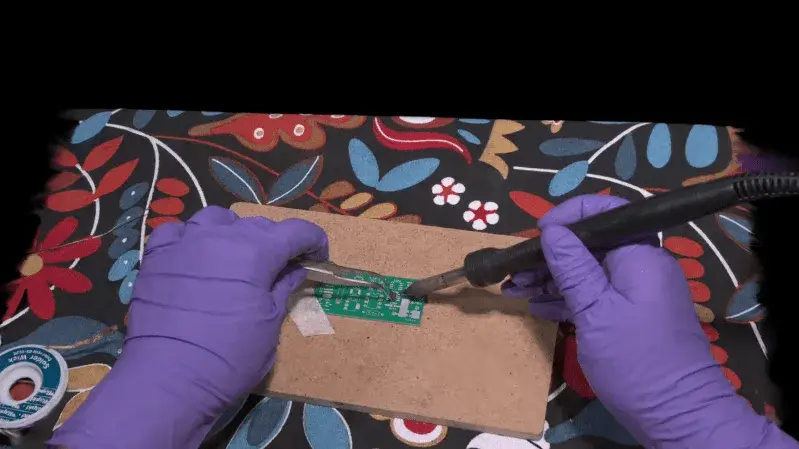
A soldering tutorial usually has a camera problem: move the lens far enough away to see both hands and the joint becomes tiny, but come close enough to watch solder wet the pad and a hand, tweezer or iron tends to block exactly the place you wanted to see; from above the learner loses the tip angle, while from the side the component itself may hide the pad.
PCB Hand-Soldering Basics tries a different approach. The project is available online through Gracia, while Hackaday’s post points readers to the demonstration video and the free-viewpoint scenes. Across thirteen soldering demonstrations, the operation is represented as Gaussian splats. The rendered scene frees the viewer from the camera position chosen during filming, allowing inspection from different positions and distances.13
That sounds like a VR feature. For a manual skill, it is more interesting as a change in who controls the viewpoint.
Move after capture
A Gaussian-splat scene differs from flat stereoscopic video because the reconstructed 3D representation is rendered from nearby viewpoints rather than from a single recorded pair of cameras; Gracia describes its platform around this kind of free-viewpoint photorealistic VR.1
In this post, Hackaday emphasizes the same property, while the published video makes the hand movement easy to compare with the reconstructed scene: the iron, components and PCB remain visible in fine detail while the viewer moves around the scene or gets closer.3
That matters because soldering contains many tiny relationships that are hard to name precisely.
How far does the iron touch the pad rather than the component lead? At what angle do tweezers hold a package while one corner is tacked? When does the solder become fluid enough to move the part without dragging it across the board?
The public demonstration video gives a concrete example, and because it remains online the timing is easy to check against the transcript. Its transcript describes holding an IC in tweezers at about 0:18, resting the iron against the side of the pad around 0:22, then sliding the IC into alignment once the solder becomes liquid at about 0:32.2
Those instructions are understandable as text. The useful part of the 3D representation is being able to inspect the spatial relationship they refer to.
The preselected angle
Good instructional video solves viewpoint through editing, cutting from a wide shot to a macro angle, perhaps adding a diagram and then repeating the operation from whichever position the editor judged most useful.
Good editing may solve the problem beautifully, but it still fixes the viewer inside decisions made before the lesson is watched.
The teacher decides in advance which view answers the learner's future question.
A free-viewpoint recording gives part of that decision back to the learner: when the iron blocks the joint the viewer moves around it, a lower angle reveals package alignment, and someone interested in grip instead of solder may pull back to watch the hand.
This is especially suited to tasks where occlusion is itself part of the skill. Hands work close to the object. Tools enter the same small area. Unfortunately, the useful contact point frequently sits behind the hand or tool that is making the operation possible.
The technology does not need to simulate an entire electronics bench to improve that one problem. It only needs to preserve enough of the scene for the viewer to ask a different visual question after capture.
Seeing without feeling
There is an obvious temptation to call this a better way to learn soldering. The sources opened for this run do not establish that.
To be sure, no comparative learning study was found during this run, so the project supports a claim about representation rather than one about measured educational outcomes.
And a large part of soldering does not arrive through vision.
A learner still has to discover how the iron feels in the hand, how easily a small pad lifts, how much force a connector tolerates, how fast heat travels into a large copper plane, what flux smells like when it starts cooking and how a bad joint changes when reheated.
The visual model cannot transmit resistance, temperature or hand tremor.
That limitation is healthy. It tells us what the tool is actually for.
Its plausible benefit is better observation of a gesture, which is not the same thing as performing that gesture and developing the corresponding feel.
The difference is similar to a transparent mechanism in a technical drawing. Making an internal relationship visible answers a visual question, which is useful, but observation and practice remain two different things.
Capture the operation
Gaussian splats are often demonstrated with rooms, landmarks, people or static objects. Soldering is a more demanding target because the important content is a changing interaction between tool, hand, molten metal and component.
The scene is valuable only if the reconstruction preserves the details needed to read that interaction.
That is why the project feels more significant than another photorealistic VR tour. It points at a class of material knowledge that is routinely flattened into two dimensions because video is easy to distribute.
Wood carving, tattoo-machine setup, watch repair, sewing, electronics rework, sharpening and instrument maintenance all contain moments when knowing what the expert did gives only half the lesson; the missing information is frequently where everything was when the gesture happened.
A movable viewpoint can answer part of that question without asking the expert to perform the same step six times for six cameras.
Beyond the final cut
The online version changes something mundane but useful about a tutorial: the viewer can return to it. On the Gracia website the reconstructed scene sits beside an ordinary demonstration video, while Hackaday's post points readers toward the same project from the web.123
With a conventional video, returning later means watching the sequence chosen by the editor again. A free-viewpoint scene behaves differently because the user can revisit the operation with another question, move the camera, compare the hand position with the video and then inspect the joint from a direction that was not part of the original shot.
That makes the project interesting as documentation even before anyone proves that it teaches soldering better. A photograph can preserve the state of a board, and a video can preserve the order of a gesture; this kind of capture tries to preserve some of the space around the gesture as well.
The limitation is equally important. The website does not preserve temperature, pressure or the feel of the iron, and an online service is itself a dependency that may disappear. If this format proves useful for craft training, durable export and access years later will matter as much as visual fidelity. A spatial lesson that only works while one platform remains online would be a rather modern way to lose an old skill.
A spatial craft archive
There is another consequence.
A conventional tutorial preserves a sequence of chosen shots, much like any other instructional video posted online. A free-viewpoint capture preserves something closer to a small navigable volume around the operation.
That creates a different kind of archive.
Years later, a viewer may care about something the original editor treated as incidental, perhaps the grip on a tool, the clearance around a component or what the supporting hand was doing at the same moment. If the captured representation contains that detail, the viewer can inspect it without a new shoot.
The resulting archive is still incomplete: space outside the capture is gone, forces and temperatures are absent, and reconstruction artefacts remain part of the record.
But the principle is useful for transmitting practical knowledge: record enough of the relationship that future learners can choose their own question.
For soldering, that means the camera finally stops insisting that there is only one good seat at the bench.