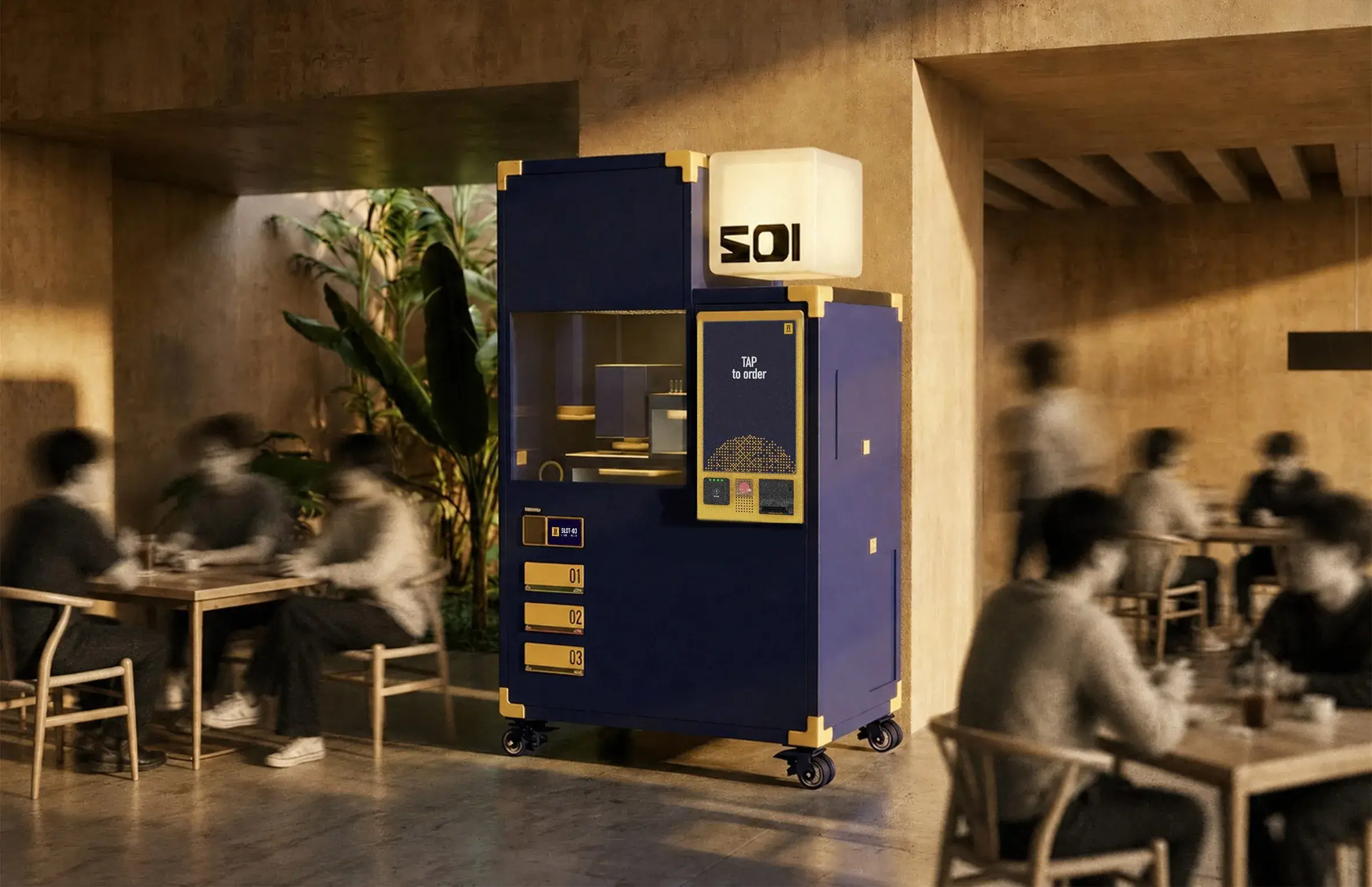
The gesture looks simple. A ball of dough, a rolling pin, a hot plate, a few seconds on each side, and the disc puffs up. That is a chapati, the daily bread of hundreds of millions of people in India. A University of Nottingham student has just made it the subject of her final-year project: Soi, a fresh chapati vending machine designed for corporate canteens in India 1.
The project appears in the end-of-year show of the Product Design and Manufacture course, published by Dezeen on 20 August 1. There is no workshop photo on the page: a midnight-blue cabinet on castors, a TAP to order screen, a window onto the mechanism, three numbered collection slots. A render, in other words. But the choice of subject points at a very real problem: the chapati may be the hardest bread in the world to put in a vending machine.
The bread that won't wait
Unlike bread, a chapati does not keep. Food science is blunt: as soon as it leaves the plate, gelatinised starch starts to re-associate, and the soft disc turns tough and brittle within a few hours at room temperature 3. That is starch retrogradation, the same physics that stales bread, only faster: the authors of the reference study on the subject rank the chapati as far more prone to staling than bread 3. A 2021 review confirms that staling remains the central challenge in any industrialisation of the product 4.
Hence the domestic rhythm. In India, chapatis are traditionally made twice a day, just before the meal, and roughly 90 per cent of the country's wheat is eaten in this form 3. For an employee who packs lunch in the morning, the arithmetic is harsh: by noon, the homemade chapati is already dry. The project description throws in a figure, more than 3.3 billion chapatis consumed per day in India, which we could not find anywhere else; it comes from the student's presentation, not an independent study 1.
Kitchen versus factory
Automating the gesture is not a new idea, and it already exists at both ends of the scale.
In the kitchen there is Rotimatic, sold by the startup Zimplistic and developed over nine years by the couple Pranoti Nagarkar and Rishi Israni 67. You fill it with flour, water and oil; the machine measures, kneads one ball at a time, flattens it and roasts it in about ninety seconds 5. Rotimatic cracked the mechanics early. The hard part sat elsewhere: when is the dough right? Their patented answer is to gauge consistency during mixing by measuring the deflection of a plate and the speed of the shaft 6. The current product page counts ten motors, fifteen sensors and two hundred moving parts 5.
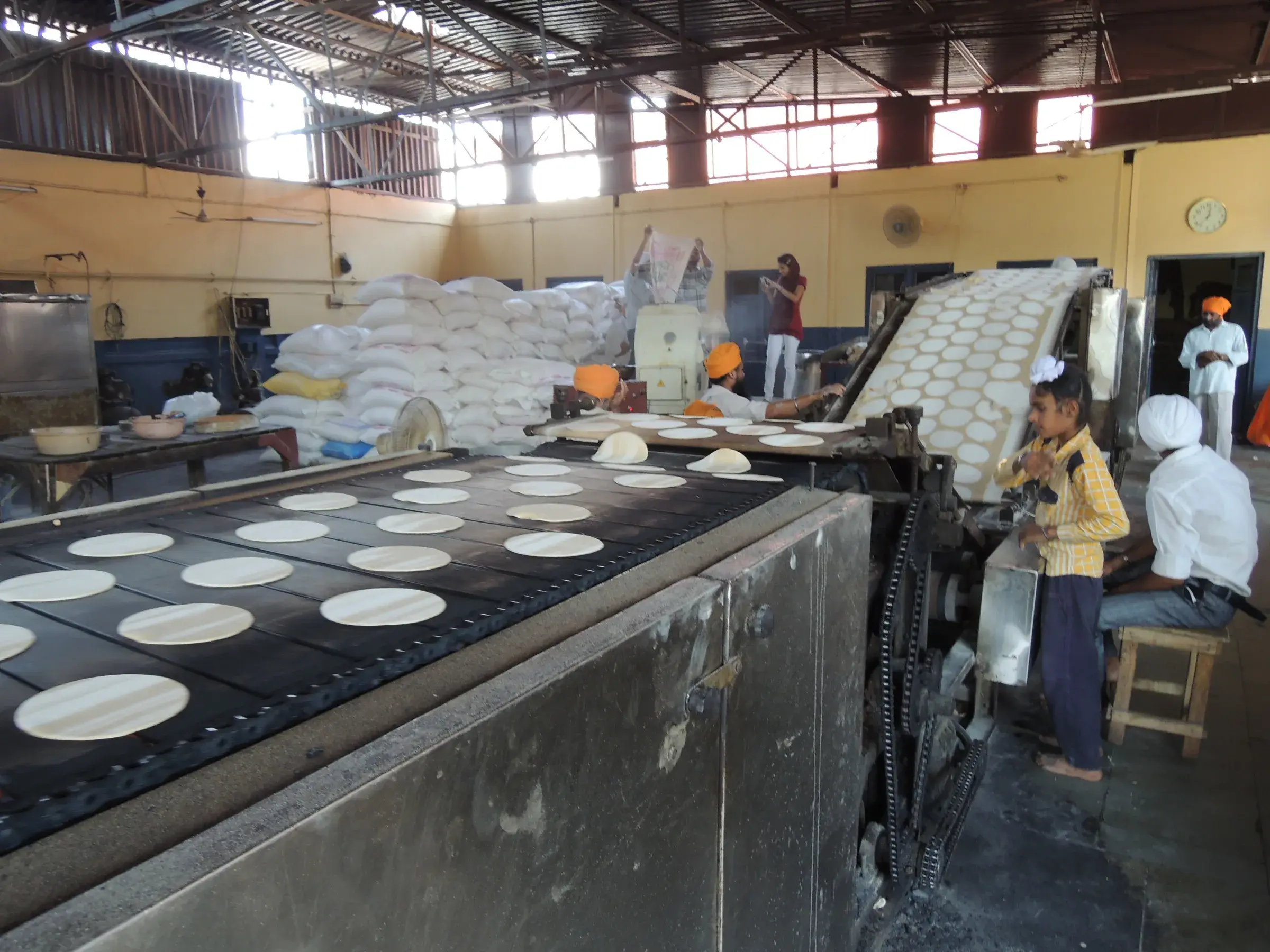
At the other end, the central kitchens of the NGO Akshaya Patra, which prepare up to 100,000 school meals a day per site, have run roti lines since 2002: ten thousand rotis an hour on the first machine, more than fifty thousand today 8. Its current lines claim 200,000 rotis from 6,000 kg of flour 9. At the Golden Temple in Amritsar, an automatic machine keeps the langar, the free meal served to every visitor, running; a photograph from 2013 already showed it at work.

The missing layer
Between the kitchen robot and the factory line, one gap remains: the point of consumption. A factory line makes bread in the morning for the whole day, exactly what the physics of chapati forbids. A Rotimatic assumes a kitchen, ingredients, someone to refill it.
That is where Soi positions itself: a chapati machine inside the canteen itself, kneading, flattening and puffing to order, around the clock, with pickup in under a minute through colour-coded slots 1. The description mentions food-grade materials, NFC-controlled access, IoT monitoring for maintenance and "patented technologies" 1. If the project delivers on its promise, Rotimatic and Akshaya Patra have already automated the gesture. What Soi adds happens downstream: fresh on demand, where people actually eat, with no pile of chapatis stiffening while they wait for noon.
No prototype yet
What the machine is actually worth is another matter, and the Dezeen page says almost nothing about it. The text is partnership content supplied with the university 1, the images are renders, and nothing indicates that a physical prototype was ever built. The real throughput, in rotis per hour, is not published. The "patented technologies" cannot be verified anywhere, and the course's 2026 exhibition page is not online yet; only previous editions are 2.
That is the normal pace of a final-year project: a sixteen-week major project according to the course's own presentation, a well-argued concept, clean renders 2. But between the concept and the canteen lies everything: the reliability of a mechanism handling living dough, cleaning under food-safety rules, the cost per chapati against a canteen with a simple griddle. Soi has ticked the right box: fresh on demand, at the point of sale. The next box is called a prototype.