Soroosh Riazi Isfahani began where many recycling projects begin: he shredded used tennis balls, mixed the fragments with natural rubber and turned the compound into an outsole. The experiment worked well enough to teach him something awkward. By making the waste easier to process, he had destroyed the properties that made a tennis ball interesting in the first place.1
A tennis ball is more than a quantity of yellow rubber. It arrives as a curved shell with rubber and felt permanently bonded together, carrying thickness, resilience, seams and evidence of use; after shredding, all of that engineering becomes granulate that needs another manufacturing process before it has useful geometry again.
SLICE therefore moves in the opposite direction: reuse the geometry instead of recycling the material first.
Wrong shredder
The project, a 2026 James Dyson Award entry from the Royal College of Art and Imperial College London, grew directly from that failed direction.1 Isfahani says the shredded-rubber outsole taught him about the material but required more energy and removed the ball's original character, so he stopped treating the sphere as feedstock and began treating it as an existing structure.
On paper the pivot changes one verb, from shred to cut; in the workshop it changes almost every operation that follows. The first route runs ball → shredding → mixing → new material → new shape, while SLICE becomes ball → cut → component and skips the stage where useful geometry is deliberately erased before somebody has to manufacture geometry again.
To be sure, no life-cycle assessment accompanies the project, so an energy-saving percentage would be fiction. The evidence is narrower and more useful: the documented prototype keeps the bonded composite intact while Isfahani’s process description removes shredding, heat and chemical adhesives from this assembly route.1
Useful sphere
A sphere is awkward waste when the next factory wants identical flat sheets, but the cost of forming that curve looks different once the next object also has to wrap around a foot.
Designboom describes the cuts as releasing curved bands and deeper cup-like pieces, with broad sections crossing the forefoot and narrower strips following the sides.2 Geometry that would normally complicate recycling therefore starts acting like a preform for footwear.
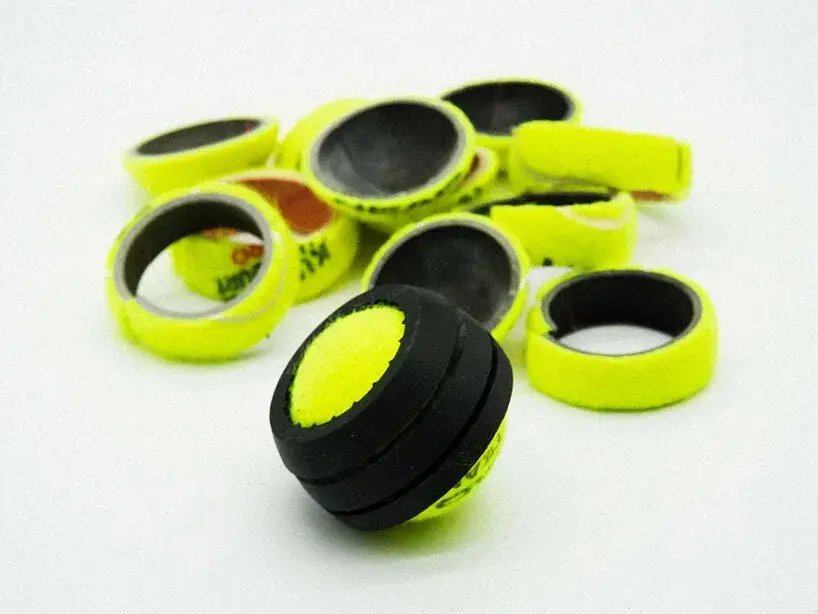
The problem is consistency. A used tennis ball is hardly a precision component with a drawing and tolerance sheet, and a shoe cannot be assembled reliably if every cut invents a new part, so Isfahani tested several patterns to find sections that repeated well, held the foot shape more effectively and allowed either felt or rubber to face inward or outward in different zones.1
3D printing enters at a less photogenic point in the process: it makes the cutting tool, not the yellow shoe shell.
Printed guide
Custom 3D-printed guides hold the ball and define a cutting path. On the current prototype Isfahani still cuts by hand, following the guide with a scalpel and knife,1 which means additive manufacturing makes the tool that converts irregular waste into repeatable parts rather than making the shoe itself.
That may be more useful than printing another novelty sneaker. The guide can be redrawn for another shoe size, another product or, in Isfahani’s future plans, bags and sporting accessories; the waste object stays geometrically fixed while the rule for dividing it becomes editable.1
The project begins to look less like a new recycled material and more like a small manufacturing system. Tennis balls are inventory; the guide file carries the conversion strategy.
No glue
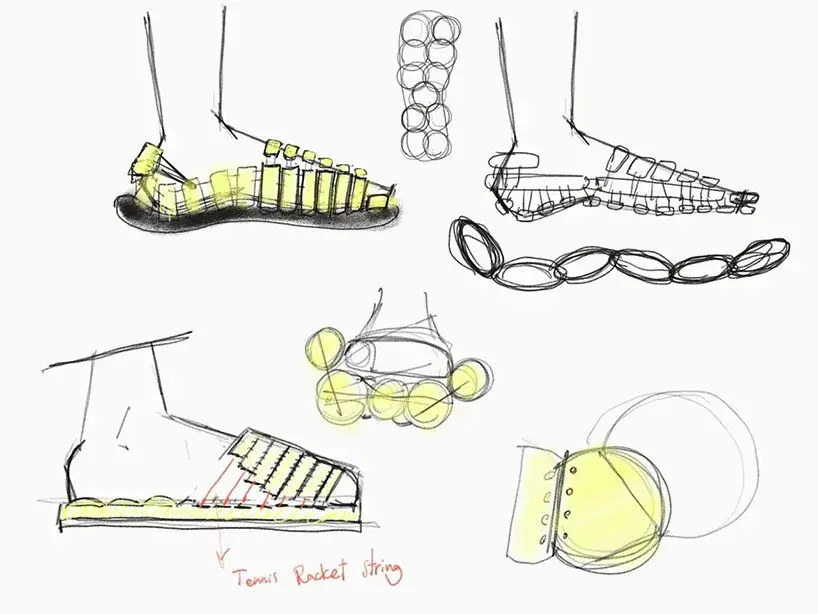
Cut sections are shaped around a shoe last and sewn together using discarded tennis-racket strings, keeping a second material from the same sporting environment in the prototype.1 In the documented construction, stitching joins the sections without chemical adhesive.
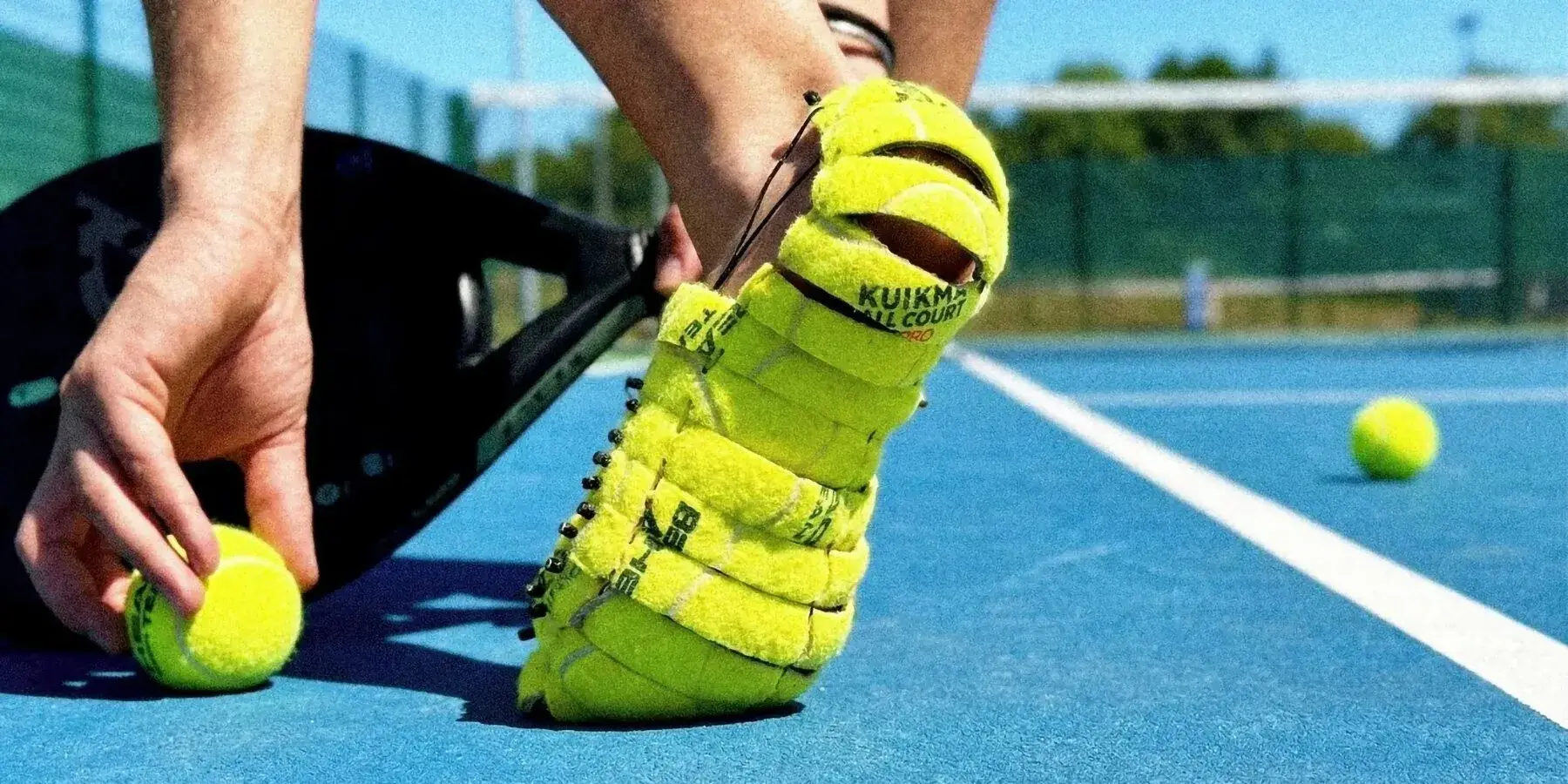
Isfahani is not trying to hide provenance. He cites Freitag bags, whose truck tarpaulins keep marks, colours and history from their first use, and SLICE likewise leaves logos, white seam lines, faded felt and court wear in view.1
Shredding would make those sources interchangeable. Cutting lets each fragment retain evidence of where it came from and what condition it was in before becoming part of the shoe.
300 million
The James Dyson Award entry gives an estimate of around 300 million tennis or padel balls produced worldwide each year.1 Several secondary stories around SLICE repeat 400 million; this article uses the 300-million figure supplied directly by the designer's competition entry because the project does not provide an independent industry source supporting the larger number.
The limits matter because this remains a process prototype, not a miniature recycling industry. SLICE publishes no cutting throughput, unit cost, reject rate or full energy balance, and there are no standardized results for traction, water uptake, repeated flexing or abrasion of the assembled footwear.
Designboom makes a similar distinction: photographs show the prototype being worn on a tennis court, while long-term performance remains outside the available project information.2 Felt condition varies, rubber can differ between brands and each batch arrives with a different history. Those differences are attractive provenance; they are also manufacturing variables.
Wear survives
The project becomes more convincing when it accepts that variation instead of disguising it. Conventional recycling often shreds, melts and mixes until one batch resembles the next; SLICE lets one badly scuffed ball remain visibly different from its neighbour and standardizes the cut and connection points instead.
Over the last few decades, recycling has often been discussed as a material problem first, yet many waste streams arrive with expensive geometry already built in: tubes, shells, profiles, laminated textiles and moulded parts. Even if these shoes remain an odd prototype, SLICE points at the same accounting problem in each case: pay once to erase the existing shape, then pay again to manufacture a replacement.
SLICE suggests asking a different first question: before asking what the waste is made of, look at what it already knows how to be.
For a tennis ball the answer is a curved, resilient rubber shell covered in felt. Isfahani’s useful move comes when those properties stop looking like obstacles to recycling; the genuinely new tool is neither the material nor even the shoe, but a guide that lets a blade divide the old object without throwing away geometry somebody already spent energy making.