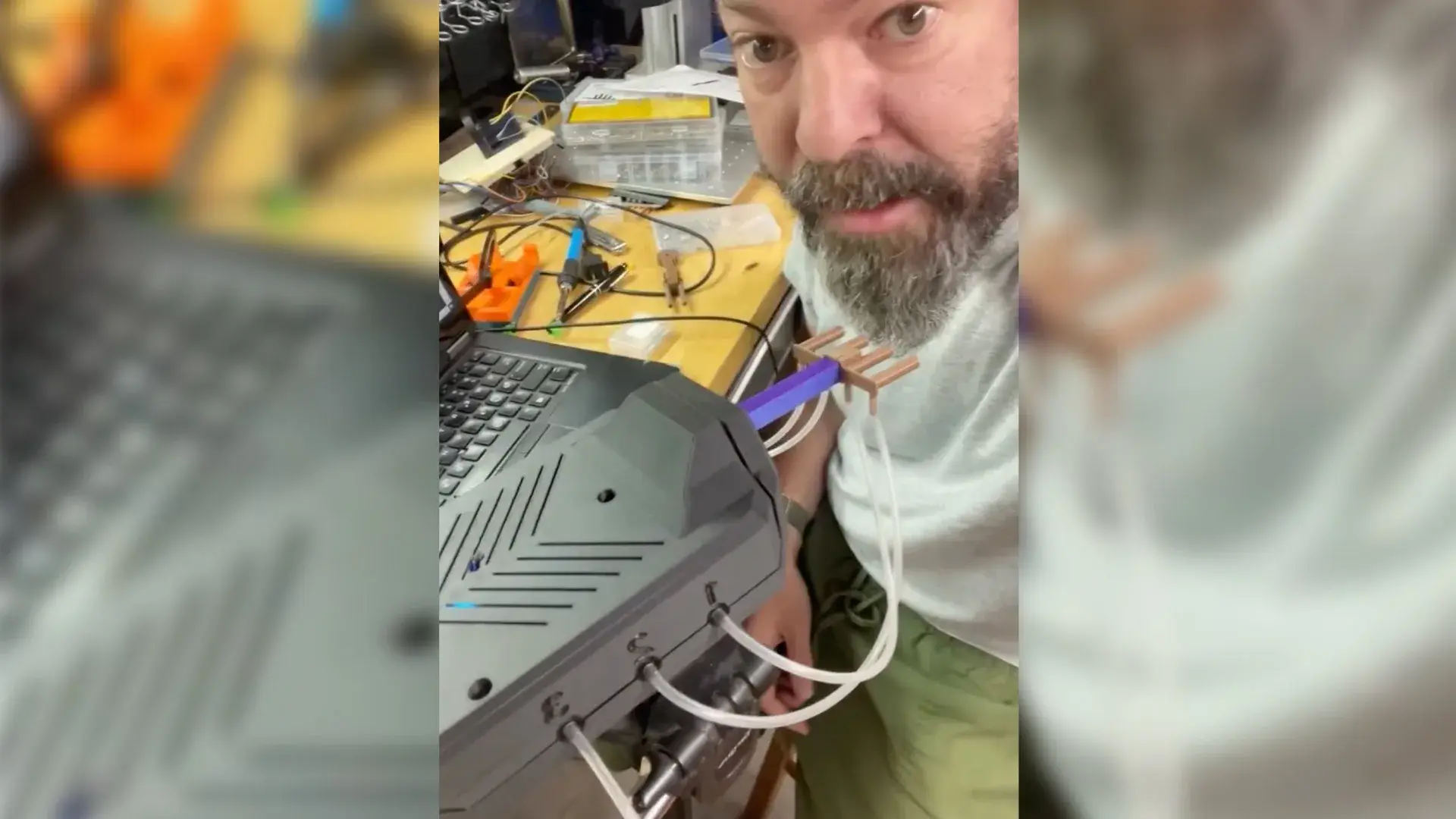
The project first catches attention through one number: about forty dollars in components.
According to Caleb Kraft, that is roughly the component cost of the sip-and-puff prototype he is developing through The Controller Project.12 The parts list updated August 25 includes six pressure sensors, an ESP32-S3, a prototyping board, a thumbstick and a round display.1
A commercial QuadStick currently starts at $449 for its Original and Singleton models and $549 for the FPS version.4
The gap with a commercial device is hard to miss, but the two prices describe very different stages of maturity.
The $40 demonstration proves something narrower: electronics that translate breath pressure into rich game controls can be assembled from ordinary components. It does not yet demonstrate a complete, rugged, mountable, hygienic and user-tested controller that can be delivered for $40.
Twelve air commands
Sip-and-puff is established technology. A sensor separates the positive pressure of a puff from the negative pressure of a sip, yielding two inputs.
Kraft uses six HX710B sensors, producing twelve sip/puff inputs before the thumbstick or touch inputs present in the firmware are counted.1
The downloadable Arduino source confirms that the ESP32-S3 presents itself to the host as a USBHIDGamepad. Each sip or puff can map to a button, repeat action, latch, button combination or analog axis.
The controller stores up to eight profiles. Each threshold is adjustable, and resting pressure can be recalibrated without reflashing firmware.
The embedded architecture matters more than the tube count. It avoids requiring a permanent translation application on the PC; control mapping lives on the device.
Forty hertz, not 25 ms
The firmware also documents an approximately 40 Hz sample rate for the HX710B sensors. Each input caches its latest value when a new reading is not ready.
Turning 40 Hz straight into “25 ms latency” would make the code claim a measurement it never made.
Forty hertz means a fresh sensor reading typically becomes available every 25 ms. Perceived latency also depends on thresholds, filtering, USB, the game and, importantly, the human gesture. The current code applies an eight-sample moving average to analog pressure modes.
The project currently publishes no mouth-to-visible-game-action latency measurement.
This is a good example of what source availability provides: the signal path can be inspected without inventing performance numbers nobody measured.
The prototype lists its flaws
Make quotes Kraft describing the current state as “usable but untested.”2
He also says the enclosure is poor for wiring and assembly, that using a standard thumbstick with the mouth may prove to be a bad idea, and that the lifetime of the inexpensive sip/puff sensors is not yet known.2
Those flaws affect use directly rather than just enclosure polish.
For daily use, required force, threshold drift, moisture, cleaning, mounting and behavior after thousands of cycles matter as much as the microcontroller choice.
Testing starts now
On August 27, Kraft said he had shipped the prototype to Aaron at AbleGamers for testing.3
Shipping it to a tester marks the shift from bench demonstration to something that must survive real use.
The bench proves that a sensor and firmware can work together. A regular user reveals whether thresholds are tiring, certain combinations are impractical, profiles need to change mid-game or the enclosure can actually be mounted in the required position.
Kraft says the viral videos have already produced more than twenty requests. His stated goal is to clean the design up enough that volunteers can build units.3
At this point, getting someone else to build a working unit matters almost as much as shaving dollars off the BOM.
QuadStick is not merely expensive
QuadStick is a useful reference only if its several-hundred-dollar price is not reduced to markup against a $40 BOM.
The $549 FPS model combines four sip/puff pressure sensors, a lip-position sensor and a mechanical joystick. Mappings can change while playing, and profiles exist for games with complicated mode changes.45
The company also offers different joystick spring forces, replaceable mouthpieces, mounting arms, console adapters, configuration software, a one-year warranty and a return policy.4
A 2021 adaptive-esports study describes players with spinal cord injury using QuadStick setups and adjusting sensitivity and mappings to individual capabilities.5
Those hundreds of dollars also pay for mechanics, years of compatibility work, accessories and a support organization.
The useful question for Kraft's prototype is not “can it be eleven times cheaper?” It is: which parts of that stack can remain simple without making use fragile?
Published source, unclear license
Make calls the project open source.2 The Controller Project does indeed provide raw Arduino source and a flashable binary from its project page.1
However, the downloadable zip inspected by IRZ on August 28 contains no LICENSE, COPYING or explicit license header in the main source files.
The code remains visible and downloadable. It does make reuse and redistribution rights less explicit than they should be for a project hoping to spread through volunteer builders.
Publishing an explicit license would cost almost nothing and immediately clarify what volunteers may copy or redistribute.
The real cost threshold
For more than a decade, The Controller Project has already relied on volunteers to print and deliver controller adaptations.1 That history is why a low-BOM electronic device is interesting: there is already a human infrastructure for distributing files and fabricating locally.
The decisive number will appear later than the BOM.
It will be the cost at which another volunteer can build a unit without Caleb Kraft standing beside them, calibrate it for a real person, replace worn parts and achieve predictable behavior for hours of play.
The prototype already shows that capable sip-and-puff electronics need not cost several hundred dollars.
The next stage must show that savings on parts do not reappear as difficult assembly, missing testing or burdens shifted onto the user.