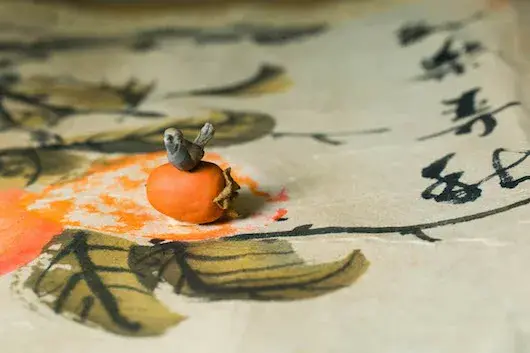
Most of the time, erasing is a way of going backwards.
A wrong line, misplaced word or graphite trace disappears, while the grey curls accumulating under the hand usually head for the bin or the edge of the desk until somebody finally sweeps them away. Saya Irie has built a practice around refusing that final step.
She erases an image, collects the eraser residue coloured by what it removed, then works that malleable material into a three-dimensional reconstruction of the motif that has just disappeared from the paper.1
A persimmon and sparrow leave a hanging scroll and reappear beside it as small sculptures, a book illustration becomes a figurine, and a portrait disappears from a banknote before returning as a tiny volume.1 The process looks like a material trick until its mechanics are examined closely: Irie uses the subtractive gesture to manufacture material for the additive gesture that follows, while the residue keeps a physical trace of the damaged image.
Two erasers
The first useful detail is that no secret glue holds these sculptures together.
In a 2016 interview describing her working method, Irie recommends two types of eraser, one ordinary and another made without petroleum materials and labelled “Non-PVC”.1 Residue from the two can be worked into a malleable eraser “clay”, a behaviour she says she discovered by happenstance with erasers already around her rather than through a material designed for modelling.1 That accidental compatibility then became a technical condition of the whole process.
The sculpture therefore begins before the image is erased, with the choice of erasers capable of producing a cohesive residue.
Colour migrates
It helps to be precise about what actually passes from image to sculpture.
To be sure, the mass of the figurine does not come from ink alone. Consumed eraser supplies most of it, so claiming that the entire image literally becomes the sculpture would be a pleasing sentence and poor material accounting. What erasing does carry away is colour.
Irie says the idea began when she erased a blue region of a newspaper advertisement and noticed that the resulting residue was blue.1 She later tried kneading residue produced by red lettering on a supermarket flyer.1
The eraser behaves almost like a sampling tool, picking up pigment as it wears away and producing material whose colour comes from the disappearing region without requiring Irie to paint the sculpture afterwards.1 That constraint connects source and final volume directly because the artist cannot simply choose a colour from a box of clay, she has to manufacture it by erasing the right place.
The surface resists
Not every image can enter this loop because the process depends on how the motif was made and on whether its colour can actually be removed.
Irie notes that fabric in a hanging scroll does not erase like paper and that laser printing on paper is easier to remove than inkjet printing.1 Depending on the source, erasing the image may take longer than sculpting its three-dimensional version.1
That constraint reverses the normal hierarchy. A conventional sculptor might begin by choosing material appropriate to a desired volume, while here whether the motif can be rebuilt as sculpture already depends on its printing process. The image also becomes a material deposit whose surface, ink and substrate determine whether usable coloured residue can be extracted, so paper, toner and eraser form a small manufacturing system together.
Avoid the fingers
Once the material exists, handling introduces another problem because hands change it: Irie explains that kneading the eraser clay directly with fingers darkens the colour, so she uses a small pestle and avoids direct contact as much as possible during shaping.1
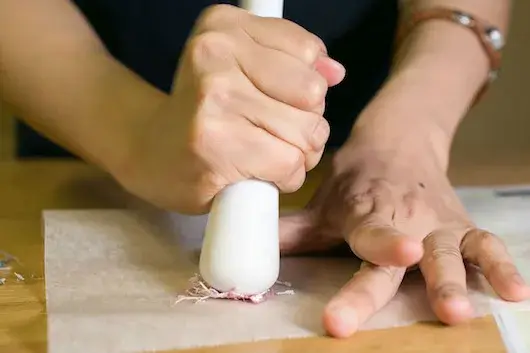
The sculpting tools themselves become tiny: a cutter knife, crochet hook, needle, toothpicks and similarly fine instruments are used to push, trim and detail the material.1
The novelty of the medium therefore hides a fairly recognisable sculptor's problem, with colour, texture, tool marks and pressure still needing control in a soft material whose available stock was generated by the previous operation and is not completely interchangeable.
If one region produces too little material of a particular colour, opening a matching tub of compound would break the logic of the work.
Invent the back
Moving an image into sculpture creates another problem that the eraser cannot solve. By contrast with the single view supplied by an image, a sculpture needs a back and sides that the source may never show.
Irie describes the unseen side of a figure as a specific challenge of the process.1 She tries to imitate the original picture closely but has to use imagination for everything the two-dimensional source never documented, because erasing supplies material and a visual reference rather than complete geometry.1 Moving from 2D to 3D therefore requires interpretation rather than a simple extrusion of pixels into depth.
The sculptor has to decide what the rear of a profile-view animal looks like, how drapery continues outside the depicted view or what thickness to give a shape that had no depth on paper.
Reconstruction manufactures missing information as well as form.
Twenty erasers
The technique looks almost necessarily miniature until some of Irie's larger work is considered, particularly a sculpture of the bodhisattva Kannon made from an image on a hanging scroll for which she says she used 20 erasers and spent about half a year, including the search for a suitable scroll.1
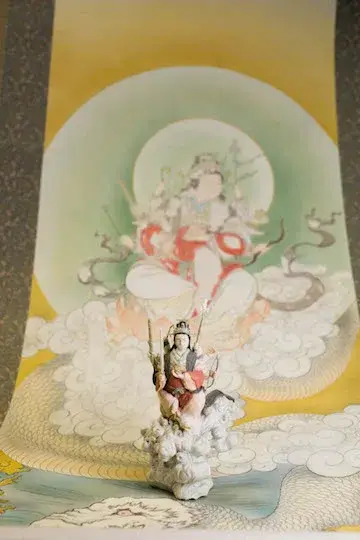
Scale reveals another side of the process. As the figure grows, erasing is likely to become a substantial production phase in its own right: enough material has to be generated, colours preserved and a substance never intended as conservation-grade sculpture has to remain workable. The apparent “waste” therefore costs time to manufacture, and in some cases the extraction stage takes longer than shaping the figure.1
Destroying value
One of Irie's early important works began with a banknote.
For her graduation project, she erased the printed portrait and sculpted the represented person from the resulting residue.1
That choice introduces another transformation, this time economic, because the damaged note loses its monetary function while the resulting figure enters an art market with a different kind of value. Irie even recalls that someone from the Bank of Japan came to inspect the work at the exhibition and that she was relieved to learn her intervention did not create the legal problem she had feared.1
The anecdote keeps the series from collapsing into a pleasant story about recycling. Material moves through several statuses, from office eraser to waste, sculpting compound and artwork, while the substrate moves from illustration to erased object and sometimes to an object that can no longer fulfil its original function. The process produces shifts in value as well as volume.
Erase, then add
Sculpture is full of useful practical oppositions: carving stone removes material, modelling clay adds and moves it, casting reproduces a form, and assembly combines existing components. Irie's process couples subtraction directly to addition because the first operation creates the stock required by the second.
A text published on Irie's own site about Ebisu Dust makes a similar point: erasing a two-dimensional image and producing a three-dimensional object creates both a shift in representation and a shift in value, from residue treated as waste towards artwork.2
The concept remains legible because the material is never arbitrary. A fish sculpted from random eraser crumbs might still draw attention, but the loop would be broken. In these works, the fish is made by erasing that fish, so the source has to lose something for its three-dimensional double to exist.
Process first
This is why the sculptures survive the usual trap of “art made from a strange material”: the first response may be to lean closer and wonder whether the figure is really made from eraser residue, but that surprise lasts only a few seconds.
The rest lies in the relationship between stages: the image supplies colour, disappearance produces material, that material has to be handled without losing the colour, and the sculpture must invent what the drawing never showed.
The final object becomes almost evidence that the whole sequence took place.
This traffic between paper, image and volume also makes Irie's recent selection for Women to Watch 2027: A Book Arts Revolution at the National Museum of Women in the Arts coherent with her practice, even though her work extends well beyond the conventional artist's book.3
Her work asks what printed matter can become once it stops being treated as an untouchable surface.
Irie is therefore doing more than recycling crumbs, she has designed a chain in which the disappearance of a representation manufactures the material conditions for its return, and that loop matters more than the novelty of the eraser itself.