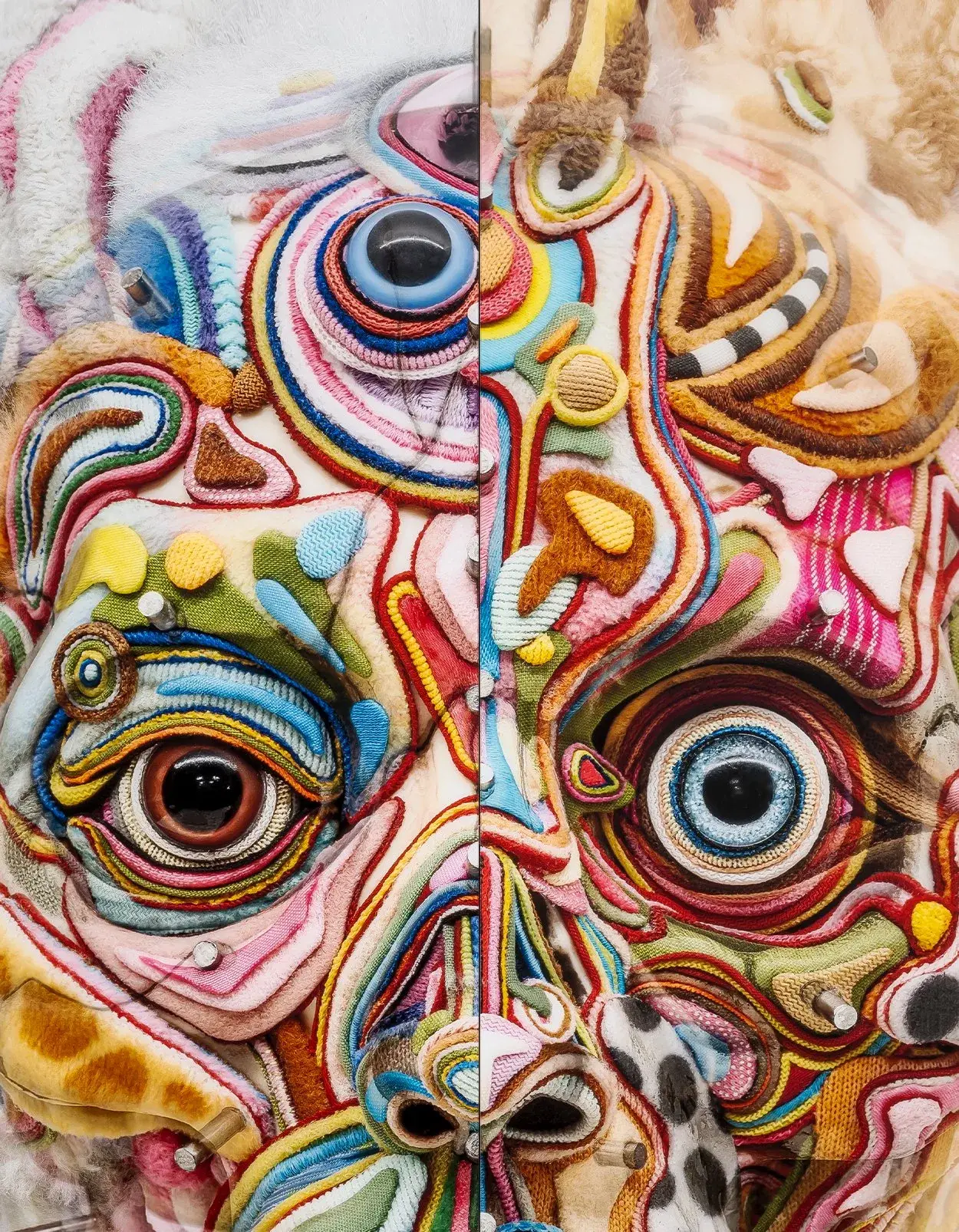
A discarded plush toy has already lost its first purpose. Sungho Bae is not particularly interested in restoring it.
In Apotropaia, his current exhibition at 4th Ward Project Space in Chicago, he retrieves stuffed animals from waste-disposal sites, takes them apart and rebuilds them over armatures.1
He adds waste leather, feathers, taxidermy eyes, clay and materials associated with ritual objects. Enough of the toy survives to remain recognisable, but not enough for it to stay comforting.1
Reassemble instead of restore
The method extends a practice Bae has developed for years: collecting, dismantling and recomposing.2
In Homo Derelictus Retextus, he was already using plush fragments and skull replicas in reconstructed bodies. His portfolio also documents discarded stuffed animals retrieved from a construction and demolition recycling facility in Philadelphia.3
The distinction from conventional repair matters. Bae is not trying to recover the original object. He uses its destruction as starting material.
Waste keeps its memory
The works borrow from anatomical models: skeleton, muscle, skin, eyes. But each layer comes from somewhere else. The gallery describes the resulting objects as new surrogates, rebuilt into watchful guardians for the world that discarded them.1
It is a very literal form of reuse. The material is not scrubbed of its history until it becomes a neutral new surface. You are supposed to see that it was loved, abandoned, opened and stitched into something else.
For makers, it is almost the opposite of clean, invisible upcycling. The transformation becomes interesting because the old object refuses to disappear completely.