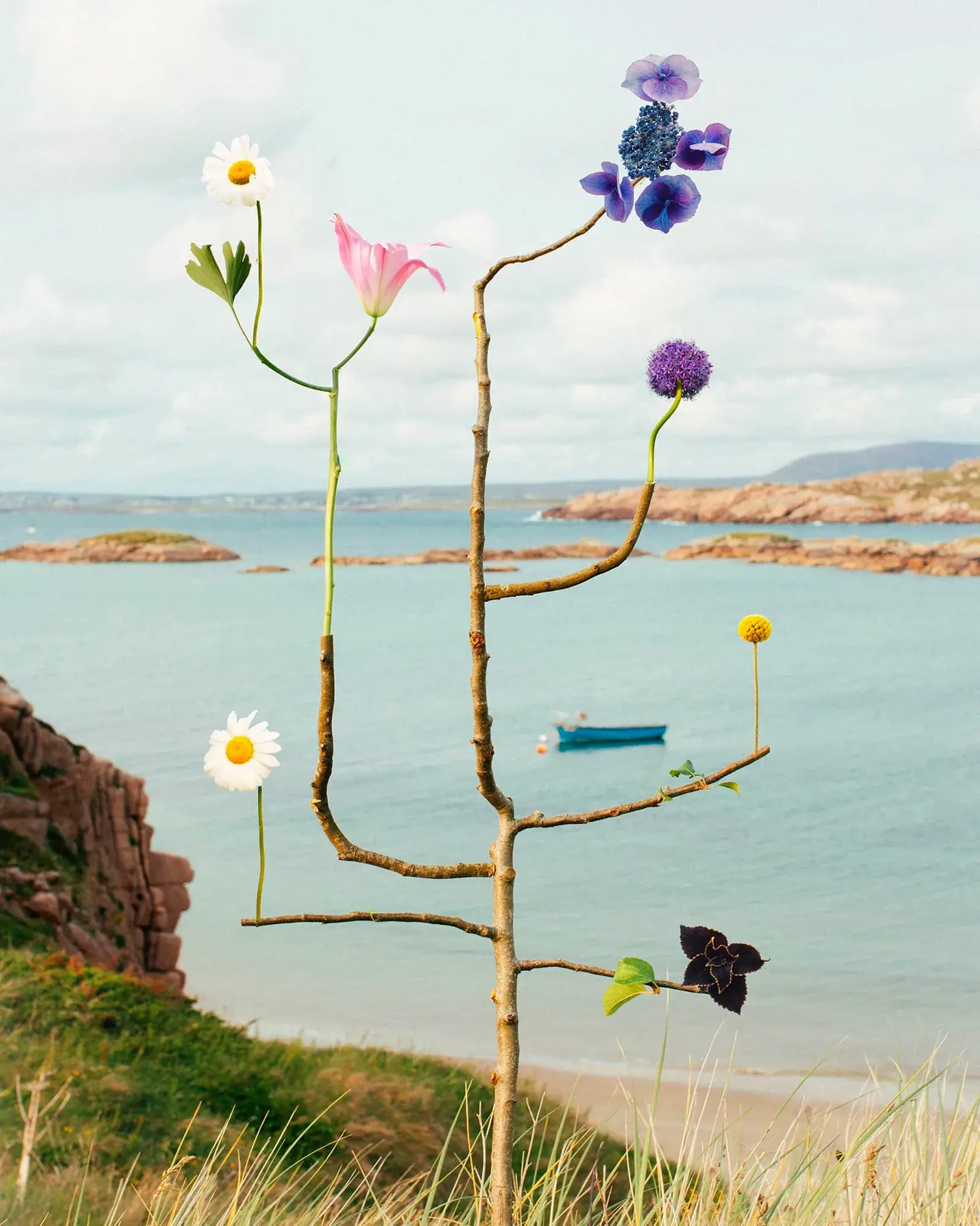
Jennifer Latour's flowers look as if they were assembled after the photograph was taken. That is exactly what she avoids.
For Bound Species, she physically joins several flowers into one structure. She makes holes in stems, plugs them into one another, corrects the weight and starts again when the whole thing collapses just before the camera is ready.1
Photoshop would be the efficient option. Efficiency is not really the point.
From prosthetics to stems
Latour has spent years working in special-effects makeup for film and television. Sculpting, moulding, painting, hair work and fabrication gave her what she describes as an intuitive understanding of how to manipulate flowers according to their shapes and weight.1
The series began during the 2020 lockdown. With her usual work interrupted, she started constructing imagined species from locally sourced flowers and plants.2
She photographs them in the studio or outdoors. Colossal's latest feature shows newer pieces placed in landscapes where a single impossible flower appears to grow directly from a tree branch.3
The constraint is alive
The material sets its own clock. A flower wilts, a stem bends, wind moves the composition. Latour says weight matters as much as colour when she chooses flowers, and she sometimes has to rebuild parts of a branch simply to make them lighter.1
That mechanical constraint may be what makes the images feel plausible. The invented creature still has to obey many of the same physical problems as a real plant.
The jump from movie prosthetics to flowers is therefore smaller than it looks. In both cases Latour builds a character from fragile material, then has to convince the eye that the seams are no longer there.