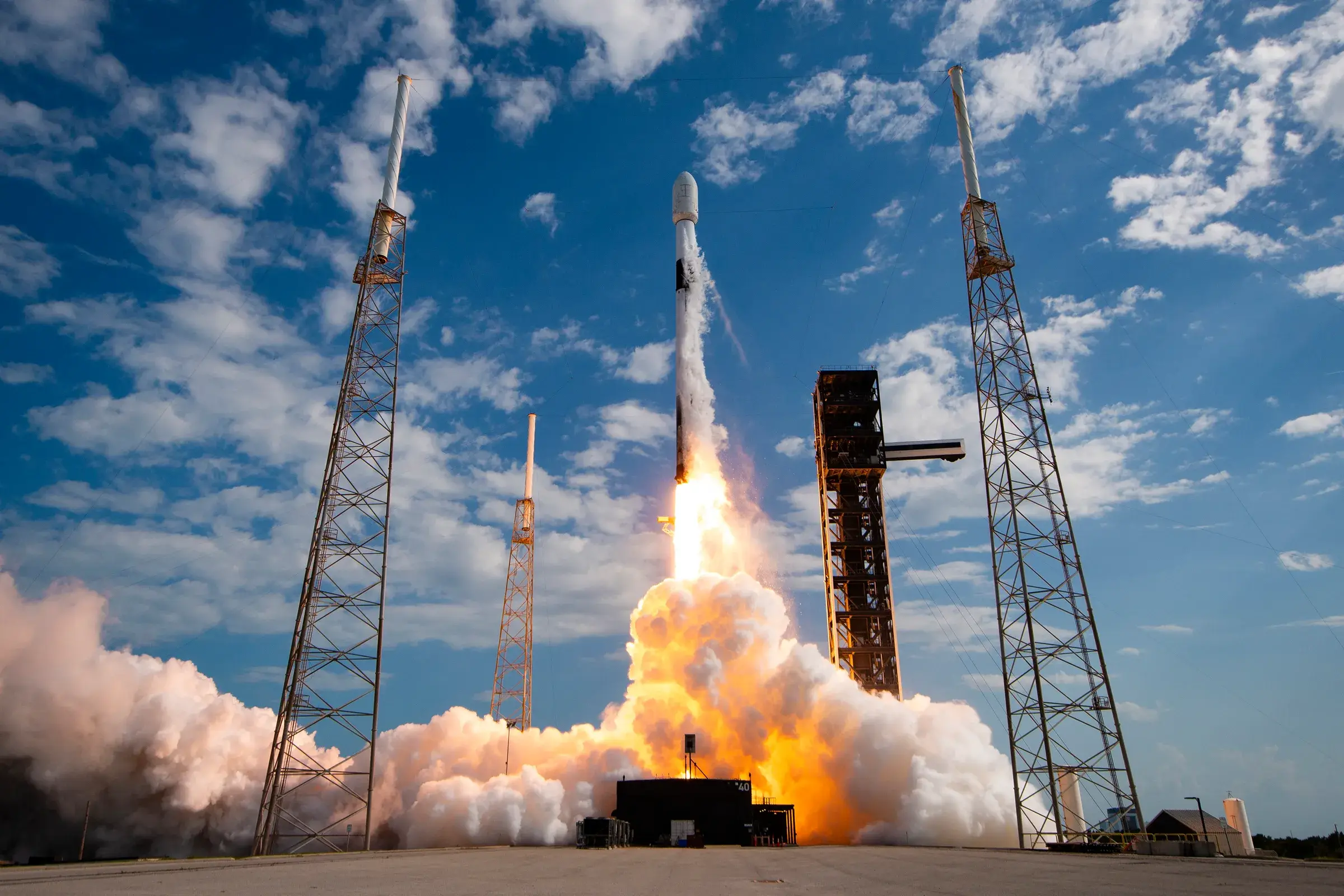
Roughly 36,000 kilometers overhead, in geostationary orbit, hundreds of satellites relay communications, weather and national-security services2. No human has ever gone up there to fix anything: the distance makes inspecting a failed component impossible, let alone replacing it2. On July 21, 2026, a Falcon 9 lifted off from Cape Canaveral carrying a machine meant to change that: Northrop Grumman's Mission Robotic Vehicle (MRV), hosting the robotic payload of the NASA-supported RSGS program1. For the first time, a multi-mission vehicle equipped with two dexterous robotic arms will operate in geostationary orbit with a stated ambition: inspect, repair, upgrade — and make things last.
Satellites condemned by their tanks
The problem RSGS attacks is economic first. A GEO satellite costs hundreds of millions of dollars, and its lifespan is measured in years of propellant: when the tanks run dry or the payload becomes obsolete, still-functional spacecraft are retired12. NASA states it plainly: many fully operational satellites are decommissioned early because they run out of fuel or their equipment ages1.
Since no one can intervene once a spacecraft is in orbit, manufacturers overdesign: redundant systems, maximum fuel capacity — hence added complexity, mass and expense2. It is the classic circle of inaccessible hardware: you pay dearly at launch for what you can never correct afterwards. DARPA sums up the program's goal in one sentence: transform GEO operations from unreachable to reliably serviced, unlocking years of additional value for each mission2.
The architecture: a workshop spacecraft and its pods
The MRV was born from a division of labor between agency and industry. DARPA developed the robotic payload — hardware, software and interchangeable tools — while Northrop Grumman supplied the host spacecraft; the result is owned and operated by a commercial company, not a government2. The twin dexterous arms come from the U.S. Naval Research Laboratory, which designed and tested them, including inside a cryogenic thermal vacuum chamber in October 202412. Each arm offers seven degrees of freedom, validated by a full-range exercise called the "Gauntlet"3.
Its first commercial job is installing Mission Extension Pods: small propulsion modules described by Northrop Grumman as jetpacks, grafted onto fuel-depleted satellites to add roughly six years of service each3. Unlike previous life-extension vehicles, the MRV is designed to be refueled in orbit thanks to the Passive Refueling Module, the first refueling interface standard approved by the U.S. Space Force3. And its ambitions go beyond towing: detailed inspection, repair, upgrades, relocation, debris disposal and in-orbit assembly are all explicitly on the spec sheet13.
What the MEVs already proved
RSGS does not start from zero. Northrop Grumman's SpaceLogistics subsidiary remains the only company ever to dock with an operational satellite in geostationary orbit for a servicing mission3. MEV-1 attached to Intelsat 901 on February 25, 2020, served five years, then moved on to dock with a second client in May 2025 after a first-of-its-kind commercial undocking in GEO3. MEV-2, launched in August 2020, latched onto Intelsat 1002 in April 20213. Together these vehicles total more than a decade of combined life extension3.
The difference lies in the gesture: MEVs attach with a docking system purpose-built for it, using the client's apogee motor as a grip point. The MRV manipulates with arms — meaning it can work on objects never designed to be grasped. That is the gap between towing a car and opening its hood.
What the mission still has to prove
DARPA's stated objectives remain ahead. The program must demonstrate safe, reliable, useful and efficient operations in GEO, on operational satellites, with commercial and government operators — with enough flexibility to vary missions2. The vehicle must also carry sufficient propellant and payload capacity to chain dozens of interventions over several years; otherwise the model's economics never close2.
NASA brings a specific heritage to this demonstration: the Hubble servicing missions, where astronauts swapped instruments in low Earth orbit, and the Robotic Refueling Missions conducted from the ISS. Its contribution to the MRV includes dynamic simulation and analysis tools, software analysis for performance verification, and above all a team of flight robot operators to support procedures in orbit1. One unknown remains inherent to any pioneer: remote robotic manipulation over long communication delays, on clients whose grasp points were never digitized. The program frames this as a technology bet, not a certainty.
Designing satellites to be serviced tomorrow
The most interesting consequence of RSGS is not the mission itself but what it changes upstream. If geostationary orbit hosts accessible workshops, satellite design can evolve: less defensive redundancy, less launch-priced onboard fuel, more modularity — docking interfaces, grasp points, replaceable pods12. NASA explicitly talks about enabling "more innovative and cost-effective" mission designs1.
It is the pattern behind every infrastructure story: making maintenance possible transforms the design of maintained objects. Roads made carts repairable, power grids standardized appliances — and perhaps GEO will get satellites conceived as modular assemblies rather than gilded coffins. The demonstration starts now, 36,000 kilometers from the nearest screwdriver.