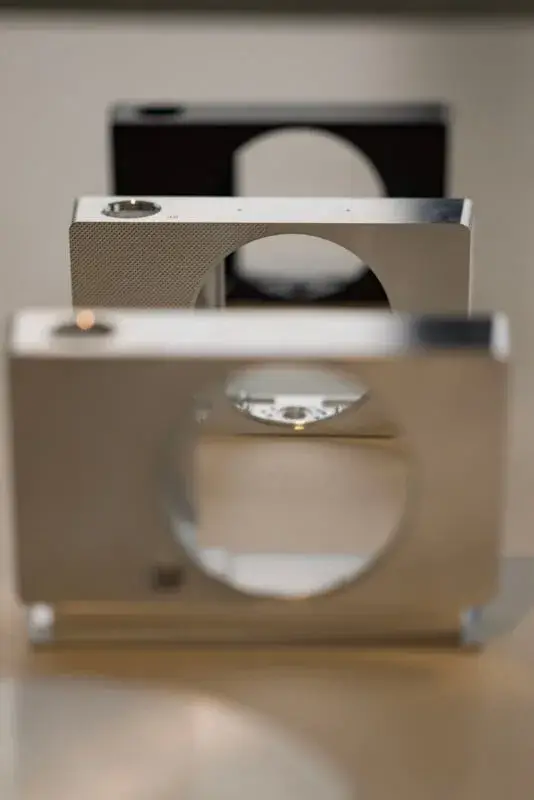
Removing features from an industrial product is supposed to be free. That is the entire pitch of minimalism: fewer buttons, fewer menus, less plastic. The Sigma BF, a full-frame mirrorless camera launched in spring 2025, shows the equation runs exactly the other way. Its unibody demands seven hours of machining per unit, six brand-new machining centers and a robot-linked production line running twenty-four hours a day to output, at best, a few hundred bodies per month12.
Seven hours inside an aluminum block
The principle fits in one sentence: the BF's body is carved from a solid block of aluminum, with no attached parts and no visible fasteners. The idea did not come from engineering — it came from the product designer, who wanted a solid body. Sigma's engineers initially opposed it: too slow, they said, unrealistic in production2.
The numbers vindicate both camps. Seven hours of five-axis machining per body, confirmed during a PetaPixel tour of the Aizu factory1. At the initial ramp-up pace — six new machines working in pairs — Sigma was producing just nine cameras a day, roughly 1,500 units accumulated over five months before launch, and likely fewer than 2,000 available for the entire global market by April1.
The unibody complicates assembly too
The natural intuition — one-piece body means fewer parts to assemble — turns out to be wrong here. Speaking to Imaging Resource, CEO Kazuto Yamaki explained that the narrow opening cut into the block forces technicians to insert electronic components through a tight space. Assembly is harder and slower than on a conventional camera, where organs slide into an open chassis that then gets closed up2.
It is the exact inverse of the automotive gigapress logic, where casting a single part eliminates hundreds of operations. At Sigma, the monobloc is an aesthetic choice whose cost is paid twice: in machine time, then in assembly labor. The BF launched at $1,999; Yamaki confirms that price absorbs both the machining and this assembly overhead2.
Making the absurd producible: robots between machines
Faced with his engineers' refusal, Yamaki did not arbitrate between designer and factory floor. He asked his plant manager to contact the machine-tool maker and design a custom system: multiple machining centers linked by robots, able to run day and night without operators2.
The most interesting detail in the interview concerns actual throughput. The seven hours are the machining time for one body, not the exit interval: as on any line, several blocks advance simultaneously at different stages. Hence an output far above one camera every seven hours — Sigma reported 200 to 400 bodies per month as of spring 2025, and was already considering a second line given demand2. For perspective: the same Aizu plant produces up to 75,000 lenses per month and 1,000 camera bodies per month at peak1. The BF therefore consumes a tiny fraction of the company's capacity, devoted to a product its own leadership calls "beautiful foolishness"1.
What minimalism actually removes
The BF's simplicity is not just skin deep. Its interface also starts from zero. Yamaki owns a criticism rarely heard from a manufacturer: the mode dial inherited from film cameras makes no sense in digital. In the film era, sensitivity and color rendering were fixed by your choice of stock; the body only controlled shutter speed and aperture. In digital, all four parameters should be treated equally — yet current menus keep shutter and aperture at the top of the hierarchy and bury color deep in submenus2.
So the team rebuilt the interface for a nearly buttonless body, prototyping first on an inert aluminum block and screen mockups. Yamaki admits he was not fully convinced, but pushed his UI engineer all the way through the radical overhaul2. Same logic on storage: no SD card, 230 GB built in and a 10 Gbps USB-C port — a choice designed for a generation raised on phones, defended despite online pushback23.
"By simplifying and stripping away all excess elements," Sigma summarizes, this camera "redefines the process of taking a photograph as a natural act"3. The Iwasaki Design Studio claims inspiration from the camera obscura and a stated goal: the easiest camera to use3. Yamaki frames the same ambition from the user's side: an object beautiful enough to bring to restaurants, bars, museums — almost a fashion accessory that makes you want to go out and shoot2.
Durable object or industrial cost turned into aesthetics?
One question remains that marketing glosses over: what are we actually manufacturing, when seven hours of CNC and a robot line are needed to produce a camera with no memory card and no mode dial? Two readings coexist.
The first sees deliberate waste turned into a signature: structural scarcity — nine cameras a day at the start — becomes proof of craftsmanship, and industrial cost transmutes into a selling point. The second reading is more generous, and probably closer to the truth: in a contracting camera market where smartphones absorbed everyday use, Sigma chooses to survive not through volume but through desirable, durable, repairable objects, made in a vertically integrated factory where many steps still require human hands12.
Both readings converge on one fact: minimalism is anything but a shortcut. It is among the most expensive manufacturing decisions possible — and Sigma made it producible precisely by automating what made it absurd. The project, started about three years earlier, was actually slowed less by machining than by a processor change that forced a full firmware rewrite on a new operating system2. Simplicity, here, is a complex artifact.