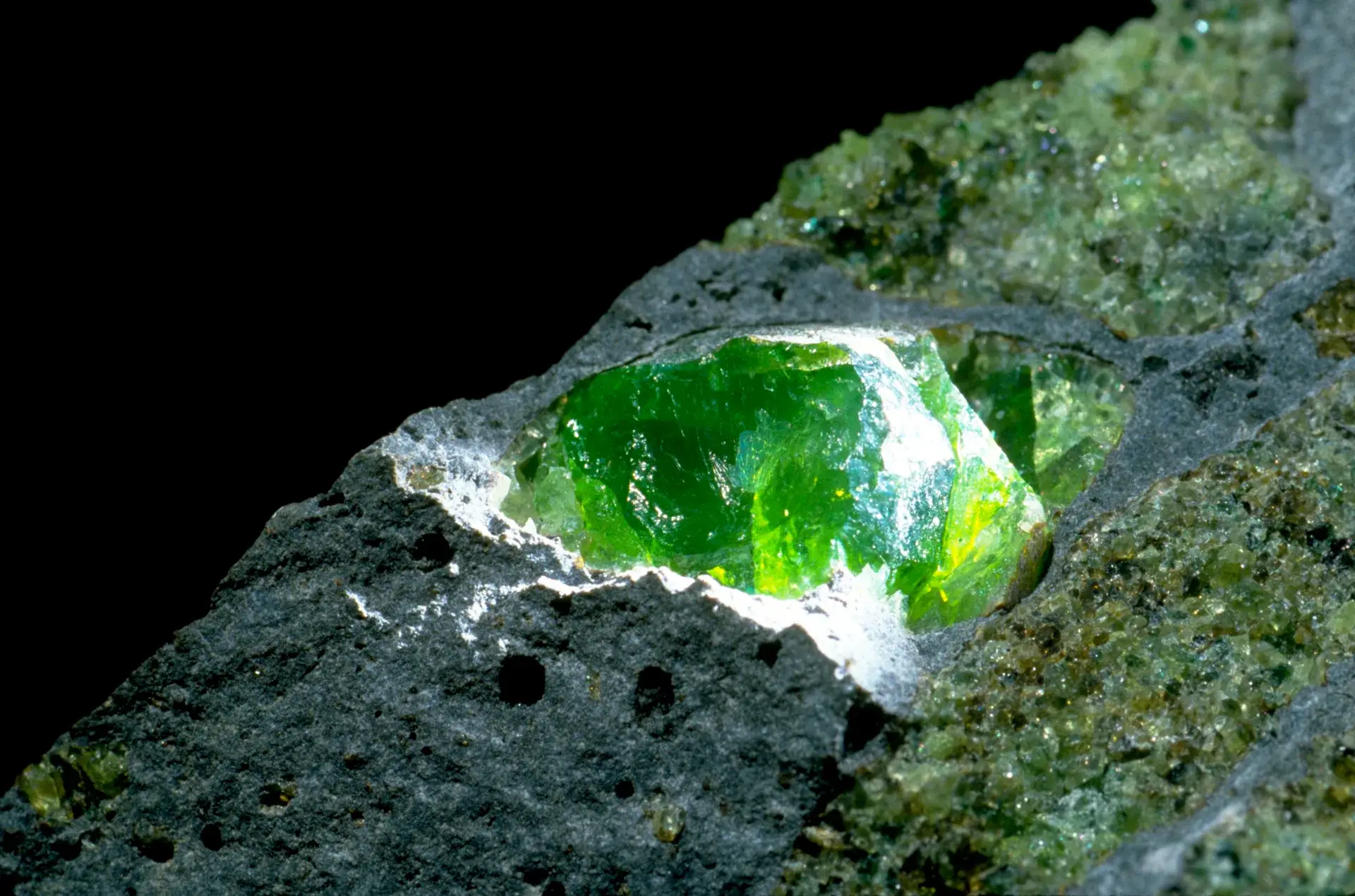
“Geologic hydrogen” can describe two very different stories. In one, companies search for hydrogen that has already accumulated underground. In the other, rock becomes a reactant: water is injected into iron-rich formations and mineral reactions are accelerated until they release H₂.4
Several teams are now trying to industrialize that second route. The labels vary — stimulated hydrogen, engineered mineral hydrogen, sometimes “orange hydrogen” — but the engineering problem is the same: keep enough water in contact with reactive minerals, for long enough, that a real well produces useful flow.46
IEEE Spectrum follows Eden GeoPower, which attacks that problem by electrically fracturing rock, and compares it with approaches from Vema Hydrogen and Koloma that lean more heavily on the chemistry of the injected fluid.1
It is tempting to summarize the whole field as “zap rocks, add water, collect hydrogen,” which is catchy and also skips the difficult part: keeping the underground reaction useful after the first fresh mineral surfaces have reacted.
The reaction
In ultramafic rocks containing reduced iron, water can drive alteration reactions that oxidize iron and release molecular hydrogen. Serpentinization is one of the best documented natural mechanisms.4
Sandia therefore separates natural hydrogen, already generated and possibly accumulated, from stimulated hydrogen, produced in an engineered system that accelerates or reproduces those reactions.4
That distinction changes the resource problem. A natural reservoir requires a favorable geological combination: source rock, migration path, porous reservoir and a cap able to retain the gas. Stimulation potentially widens the search because iron-rich rock itself becomes feedstock.1
A reactive sample in the lab is still a long way from an underground factory, because water needs access to sufficient surface area, the reaction must remain fast enough, H₂ must escape the place where it forms, and the pathways cannot simply clog as new minerals precipitate.
Break it first
Eden GeoPower does not claim that electricity directly makes hydrogen. Its Electrical Reservoir Stimulation first changes rock permeability: electrical pulses create networks of microfractures so water can circulate across more mineral surface.2
Its ARPA-E-backed work targets peridotites in Oman’s Samail Ophiolite, with the idea that mechanical stimulation raises reactive surface area while local heating can also move conditions toward faster hydrogen-producing reactions.5
The development path already includes a useful failure. According to IEEE Spectrum, Eden initially tried steady DC power in hard rock and obtained too little fracturing. It switched to pulsed power and then tested the approach on hard formations. In 2025, a trial in an abandoned Colorado mine increased the permeability of a hard igneous column tenfold.1
That result measures fracturing rather than commercial hydrogen production. In laboratory samples, Eden reports up to four times more H₂ from rock treated with pulsed power than from unfractured samples,1 but the important next experiment is a field pilot where fractures, water injection, chemistry, gas recovery and reservoir ageing all operate together.
Speed it differently
Vema Hydrogen almost reverses the problem. Its concept depends on formations permeable enough to avoid fracturing; the company wants to inject heated water carrying proprietary catalysts to accelerate water-rock reactions.13
Scientific work by Florian Osselin and coauthors had already argued in 2022 for “orange hydrogen” made by stimulating naturally occurring reactions in ultramafic rock.6
In 2026, Vema says it is running reservoir simulations that combine geochemistry with multiphase flow, identifying pilot locations and preparing water-and-catalyst injection permits.3 IEEE reports that pilot wells have begun drilling in Canada and that Vema expects commercially useful rates without fracturing.1
“Expects” is the important word, because Vema advertises a production target below US $1 per kilogram of H₂,3 while Sandia separately cites broad estimates of $0.5 to $1/kg for geologic hydrogen and explicitly frames the economics of stimulated systems as an open research problem.4
Those numbers are therefore not observed industrial prices. No large stimulated-geologic-hydrogen facility has publicly demonstrated that it can maintain such a cost in a real reservoir.1
Surface runs out
The common problem appears once the reaction is accelerated.
Texas A&M researcher Rita Esuru Okoroafor, quoted by IEEE Spectrum, says her laboratory data and models suggest that fracturing, catalysts or CO₂ injection alone may not sustain production at commercial rates for the long term.1
The reason is material: reduced iron exposed at the surface is consumed, mineral precipitates form, and useful pores or fractures can clog, so a method that accelerates reaction strongly may also accelerate the moment when the exposed surface stops producing.1
At that point the project looks less like an electrolyzer and more like geothermal reservoir management or mining. Reservoir management matters as much as reaction efficiency.
Sandia accordingly lists reservoir modeling, stimulation methods, sensing, drilling, techno-economic analysis and leak monitoring among the major R&D needs.4
A working well may therefore require restimulation as the reservoir evolves, changes to fluid chemistry, continued management of flow paths, and then the ordinary surface work of separating hydrogen from other gases, compressing it and connecting it to a customer able to justify the infrastructure.
Count the chain
That is also why comparing only the energy used by Eden’s pulse generators with an electrolyzer would be misleading.
IEEE reports that Eden’s generators consume relatively little power between pulses and that labor time dominates the cost of its current fracturing tests.1 That is encouraging for the “make fractures” step, but it is not a complete cost for delivered hydrogen.
An industrial calculation has to include drilling, electrodes or injection equipment, water, possible heating, catalysts, restimulation, produced-fluid handling, gas separation, compression, monitoring and the actual recovery rate.
DOE is funding this field precisely because that accounting is not settled. In 2024, ARPA-E committed about $20 million across sixteen projects covering stimulation, recovery and reservoir management.5
A slow factory
Geochemistry has known for a long time that rock can make H₂; the new ambition is to turn that slow, distributed and site-dependent reaction into a controllable process.
Eden tries to make rock accessible to water. Vema tries to make the reaction faster. Other teams work on acidity, gas recovery or reservoir monitoring. None of those pieces yet proves that the full system will behave like a profitable energy factory.14
The decisive metric will therefore not be hydrogen yield after one electrical pulse or from one laboratory sample. It will be the production curve of a real well: how much H₂ arrives each day, how long that flow survives, how often the reservoir must be restimulated, and what every kilogram costs after the whole operation is counted.
If that curve stays healthy for years, “add water to rock” may become an industry. If it collapses once the first reactive surfaces are spent, the subsurface will have delivered a very impressive prototype instead.