A statistic of 1.9 m² is easy to read and remarkably difficult to feel.
Riksbyggen and BBDO Nordics chose to build it instead.
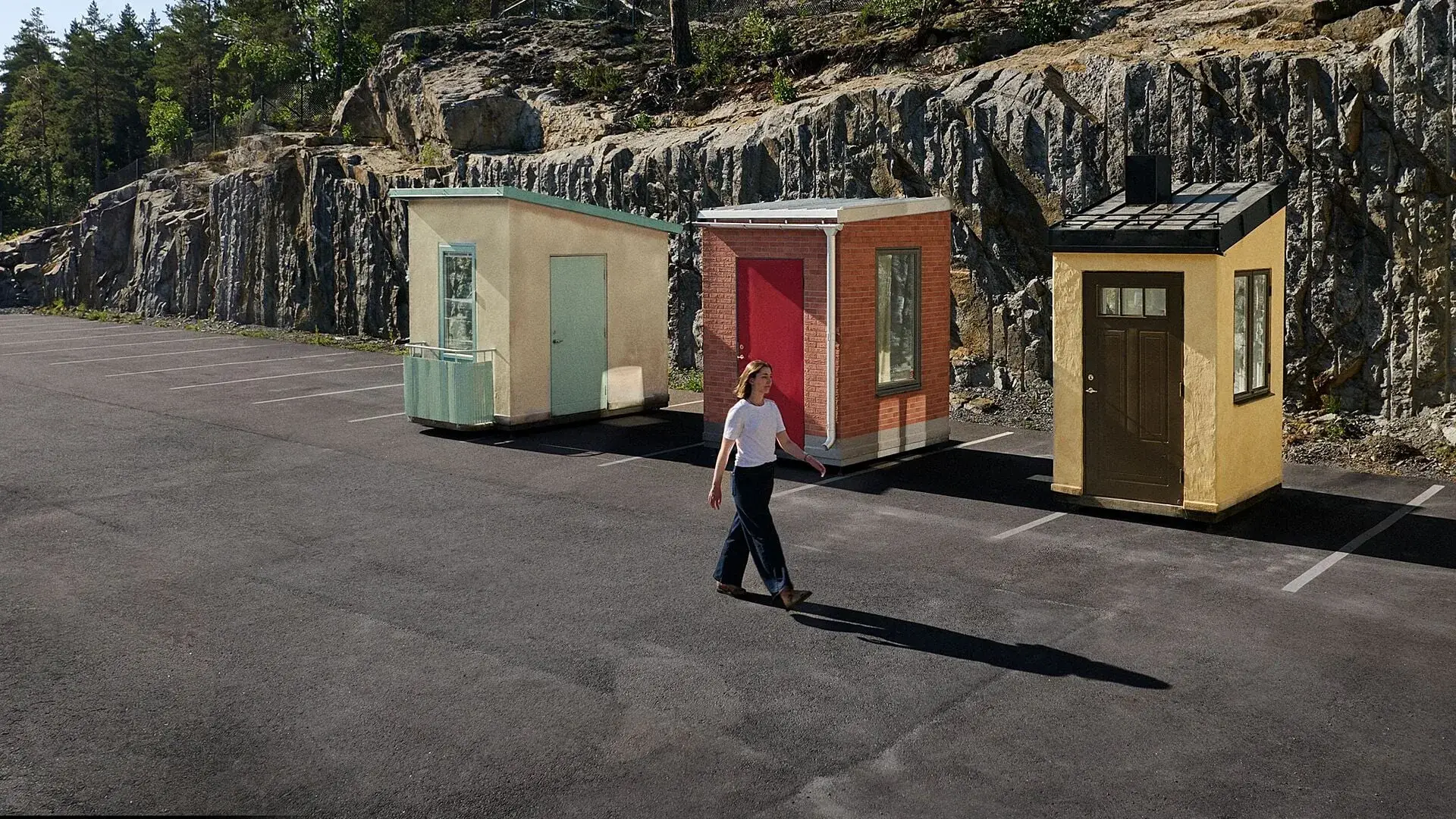
Their Visning av verkligheten installation turns three values from a housing index into three full-scale homes: 1.9 m² for Stockholm, 3.1 m² for Gothenburg and 4.5 m² for Umeå. Riksbyggen calculates that an average 25-year-old can currently finance only that amount of floor area when buying in each city.12
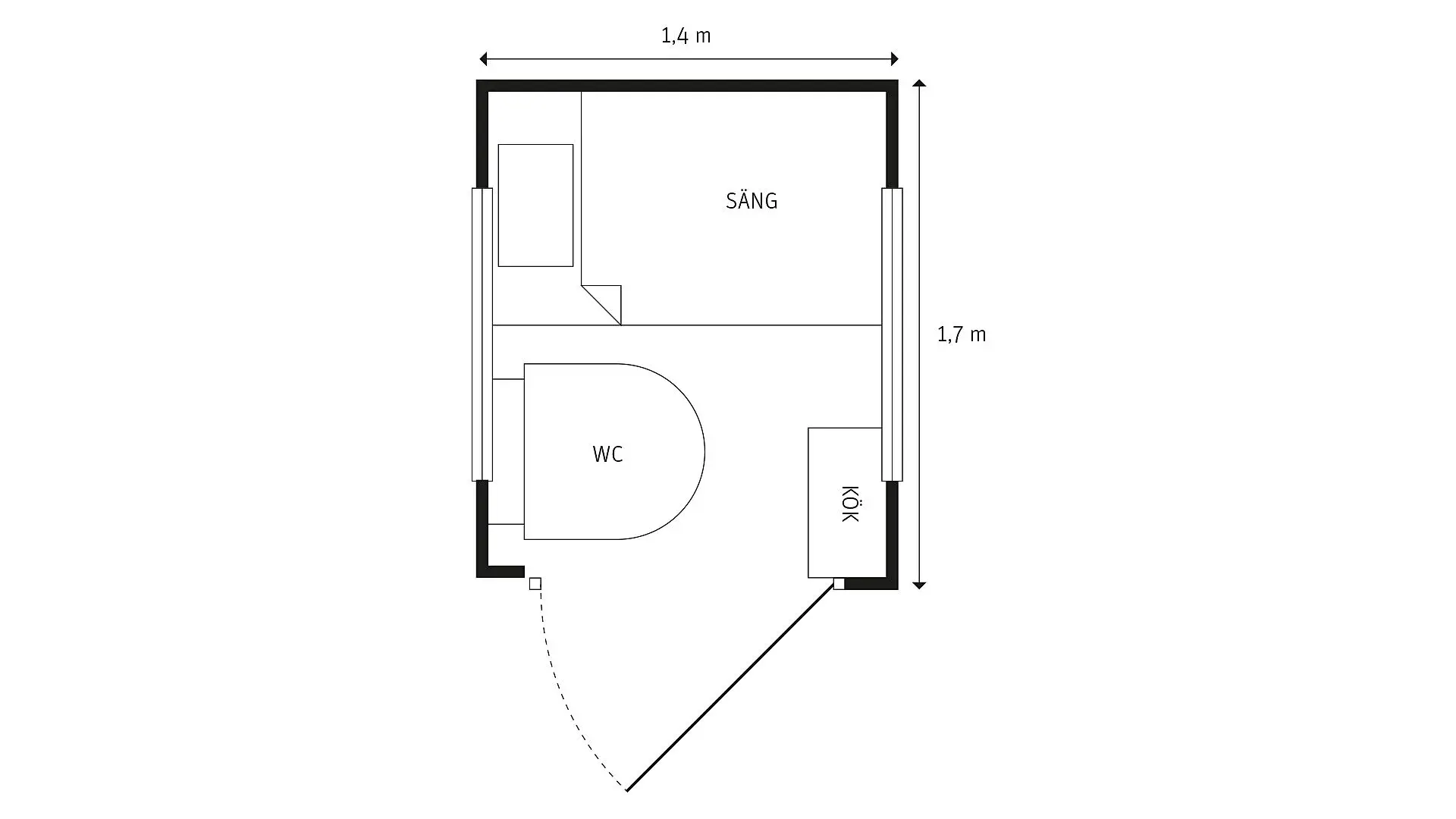
In Stockholm, 1.9 m² is only slightly larger than the footprint of a 90 × 200 cm single mattress. The figure stops behaving like a statistic once a bed, cooking space and toilet have to share it.
1.9 m²
The project depends on a simple decision, which is to stop illustrating the number and obey its area instead.
All three structures are built at 1:1 scale. Each borrows from a different architectural period, with turn-of-the-century styling in Stockholm, contemporary housing in Gothenburg and functionalism in Umeå.14
Inside, the campaign borrows the comforting language of property listings and compresses it until it becomes absurd: Stockholm advertises bedroom, living room, kitchen and bathroom functions inside 1.9 m², Gothenburg gets 3.1 m², and Umeå reaches 4.5 m² with even the suggestion of a balcony.1
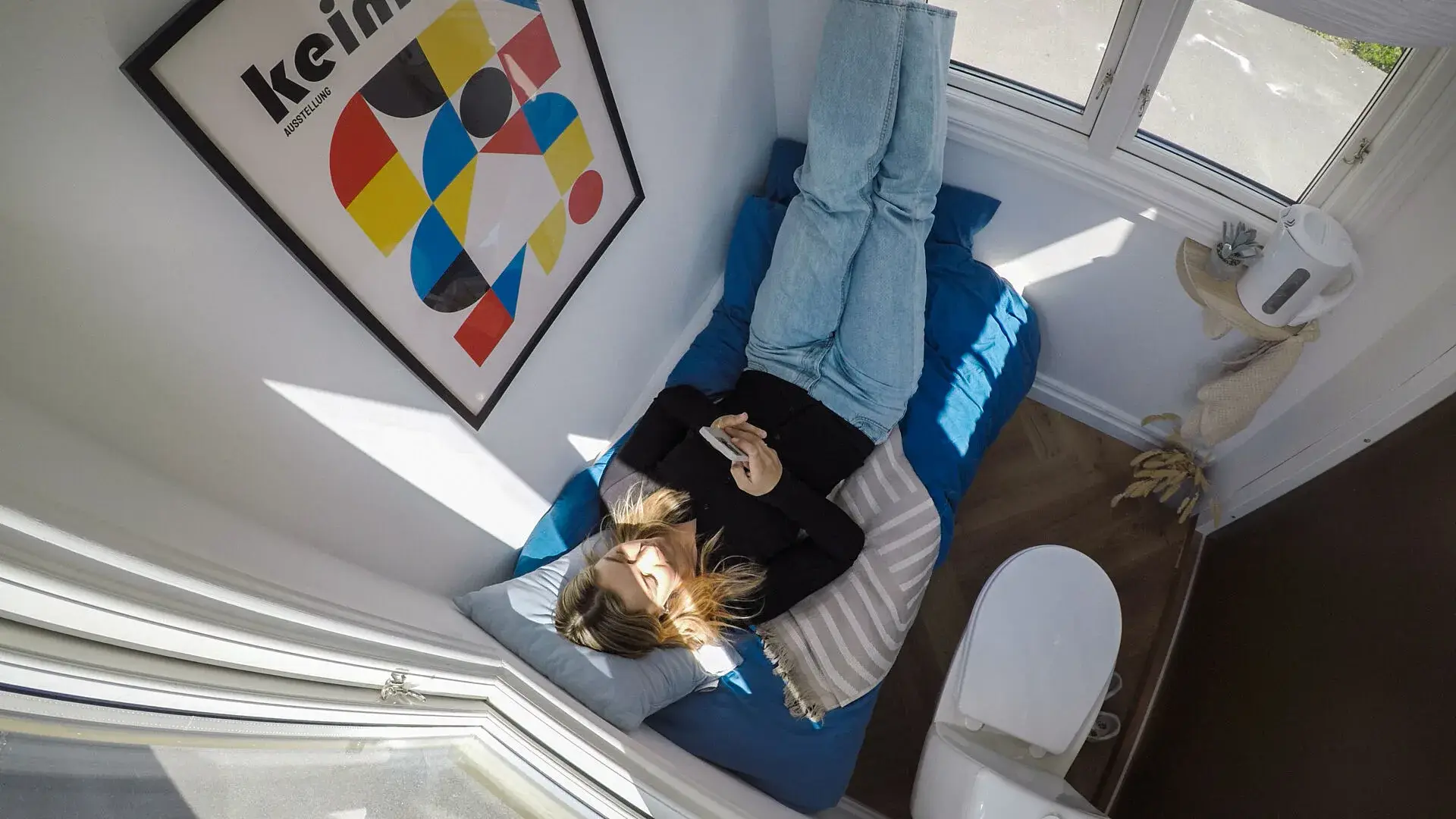
The installation points away from tiny-home optimism and toward the opposite conclusion: the area a buyer can afford may be too small to function as a credible home.
The calculation
Riksbyggen calls its indicator the Kvadratmeterindex. It estimates how much floor area an average 25-year-old can buy from income, available savings for the deposit, mortgage conditions and local prices per square metre.2
The sharpest result is Stockholm at 1.9 m², followed by Gothenburg at 3.1 m² and Umeå at 4.5 m². In 111 Swedish municipalities, the result falls below 10 m².2
The denominator needs care. Sweden has 290 municipalities, but Riksbyggen says comparable housing and price information was available for 209 of them.2 This means the 111 municipalities below 10 m² account for about 53% of the places actually covered by the calculation, rather than 111 complete measurements out of 290.
This correction leaves the argument intact, but it makes the campaign claim easier to read accurately.
Bodies understand
The Stockholm plan is probably more effective than any chart because, while 1.9 and 4.5 look only 2.6 units apart on a screen, at body scale that gap becomes a question of posture, circulation and domestic functions colliding with one another.
The transferable lesson sits in the scale: spatial information becomes much harder to ignore once it is rendered at the same scale as the person who has to understand it.
A designer can specify a 55 cm passage, a workshop can calculate that an operator walks 800 metres a day between two stations, and a physical interface can document an 8 mm touch target. On paper these values remain strangely polite, but tracing them on the floor, building them to scale or testing them with a body makes the constraint harder to ignore.
Not the whole story
The installation remains a campaign by a housing company which also advocates specific policy reforms, including public financing mechanisms and starter loans for young buyers. This political purpose matters when reading what the installation claims.1
The index measures home purchase, but this leaves renting, flat-sharing, student housing, second-hand contracts and family assistance outside the square-metre figures used by the campaign.
European figures provide a useful contrast to this purchase-focused picture: in 2024, young people in Sweden left the parental home at an average age of 21.9, among the lowest within the European Union, while 13.5% of Swedish people aged 15-29 lived in households where the cost of housing exceeded 40% of disposable income.5
The issue shown by the installation is therefore more specific than “young people cannot live independently”: it concerns the economic threshold for housing, particularly ownership in expensive cities.
Riksbyggen also commissioned a Kantar Sifo survey of 1,099 people aged 18-34 in May 2026. More than half said their housing situation prevented them from taking important steps in adult life, while four in ten believed they could not buy a first home without financial help from parents or relatives; Riksbyggen explicitly links that blockage to mobility in the labor market as well as to personal plans.3
Build the data
Visning av verkligheten works less like a statistical proof than a prototype for understanding.
The index should be challenged, unpacked and compared with other measures, but once the number exists, building it at full scale does something a chart cannot do as directly: it asks the viewer to decide where their own body would go.
That design technique is useful enough to separate from the political message carrying it.
For numbers that describe distance, area, weight, time or volume, this suggests another option: stop at representation, or go on to build the quantity itself.
In Stockholm, that produces a 1.9 m² home whose scale makes the problem stop looking small as soon as someone walks inside.