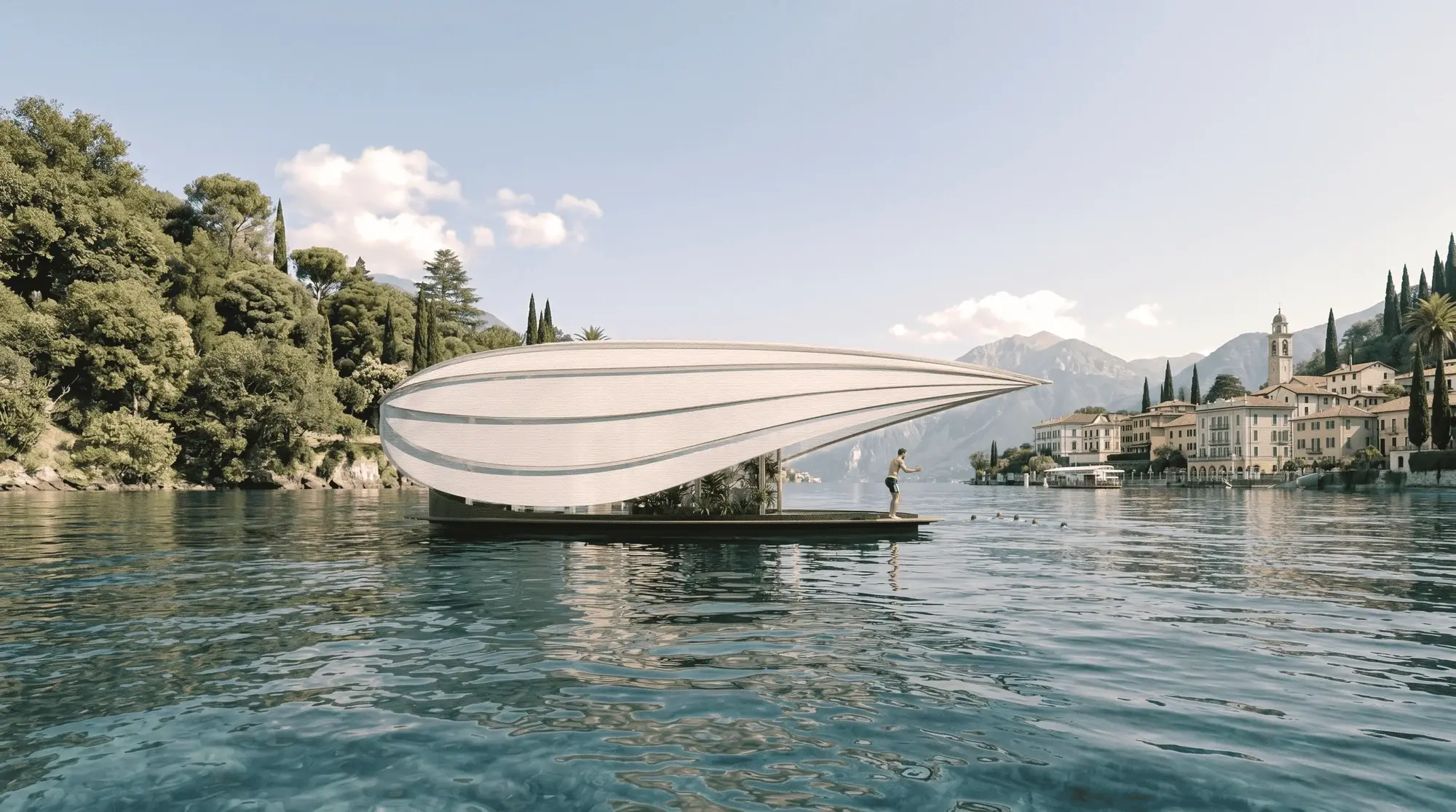
In UAU Studio's renderings of Lucia, the roof carries much of the architectural idea: closed, the white canopy gives the 25 m² interior a firm edge and a sheltered character, while folding it back makes that boundary recede until Lake Como dominates the room.13
For a floor plan this small, changing exposure can do work that extra area normally does, yet the studio's own project page also supplies the label that keeps those seductive images in proportion: Lucia remains a Concept.1 What exists publicly is therefore detailed enough to discuss as architecture, while the evidence needed to judge it as a working vessel has not been published.
Twenty-five square metres
UAU describes Lucia as a 25 m², single-level retreat for a young couple, with multipurpose furniture and wheelchair-accessible circulation; there is little room for spaces that perform only one job, so the same interior has to change with the occupants.12 The studio borrows the name and imagery of Lake Como’s traditional batèl, then shifts its role from moving people and goods toward short-stay hospitality.1
Roof as interface
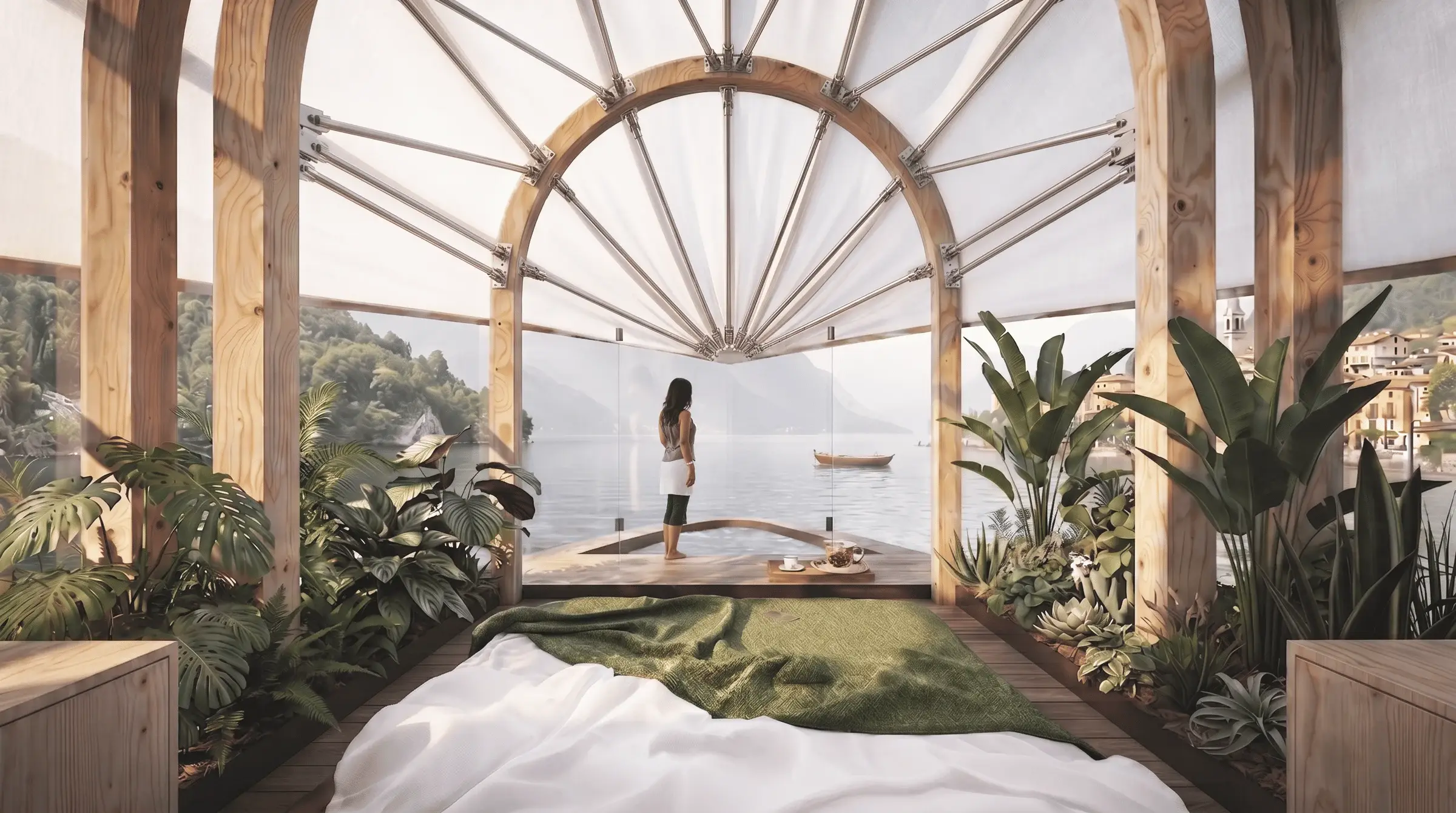
The folding canopy is the clearest device in that strategy, because UAU describes it as an adaptive roof that changes the available views while preserving privacy, and designboom likewise presents it as a mechanism for moving between openness and enclosure.13 In the closed position the edges of the room read more strongly and the interior feels protected; open it, and the lake occupies a much larger share of the visual field than it could through an ordinary window.
Nothing has been added to the 25 m², but the perceptual boundary has moved, which is a useful distinction in a micro-home where a square metre is expensive and the surrounding landscape is effectively free. UAU pairs the moving envelope with adaptable furniture, allowing one layer to alter use while another changes how exposed or enclosed the room feels.1
Then comes wind
The architectural argument is easy to follow from the drawings; the naval questions are harder, because a large moving canopy places material above the waterline and presents surface to the wind, while the consequences depend on hull geometry, total mass and centre of gravity rather than visual elegance.
UAU's public material gives none of the figures required to test that relationship: we found no displacement, roof mass, centre of gravity, freeboard, stability curve or design wind load, and neither the actuation nor the locking of the canopy is explained as an engineering system.123 Those absences do not show that Lucia would fail; they simply mark the point where the published concept stops and a naval design dossier would have to begin.
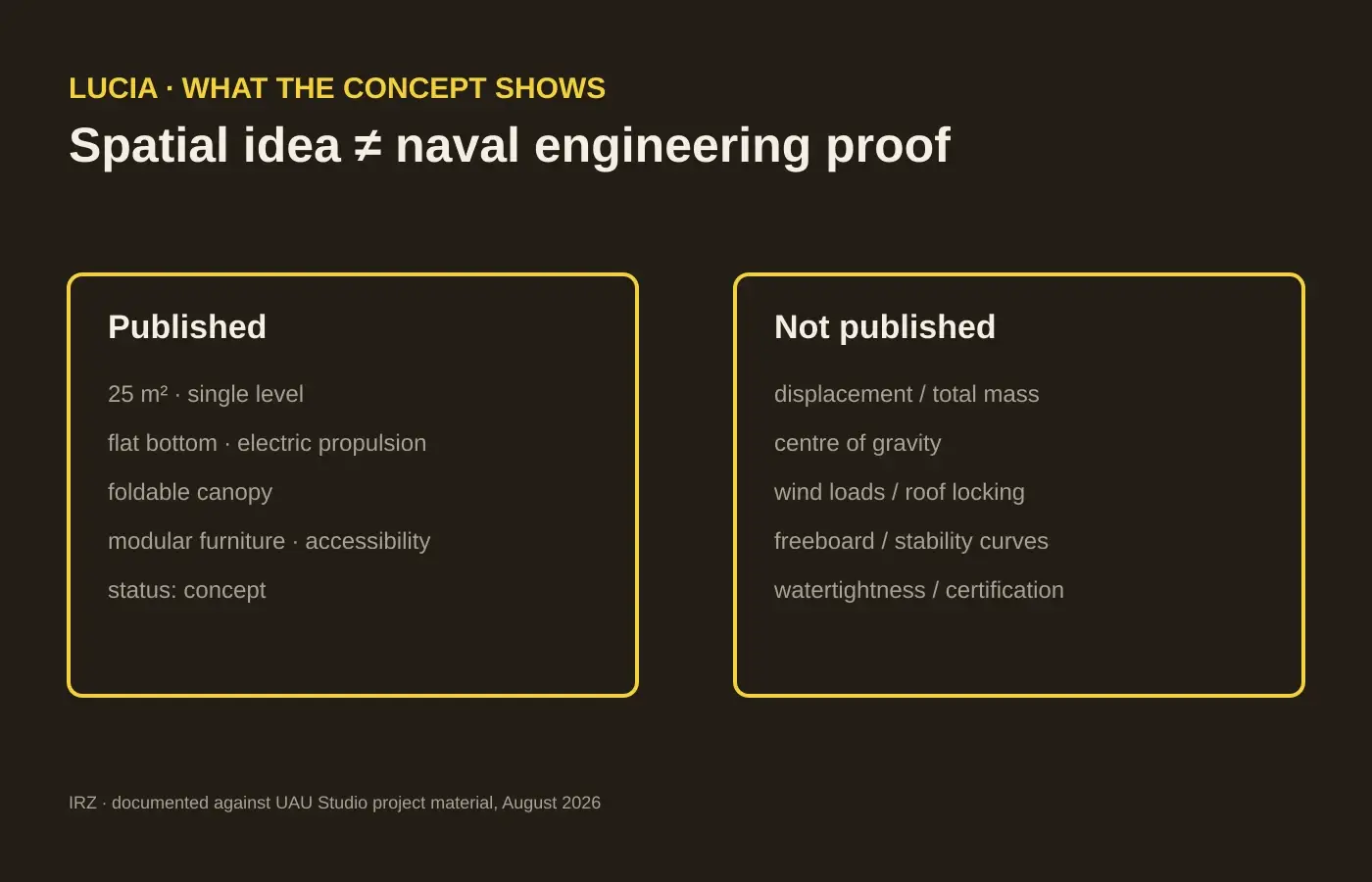
The flat bottom and electric propulsion belong to UAU's proposal and may prove entirely workable, but without a prototype or test data they remain specified intentions rather than measured performance.1
More than one render
UAU has at least published material beyond the familiar exterior hero image, including an exploded view of the volume, interior perspectives and descriptions of the intended fit-out; the studio also names multilayer birch plywood and material recovered from the lake among the proposed interior choices.1
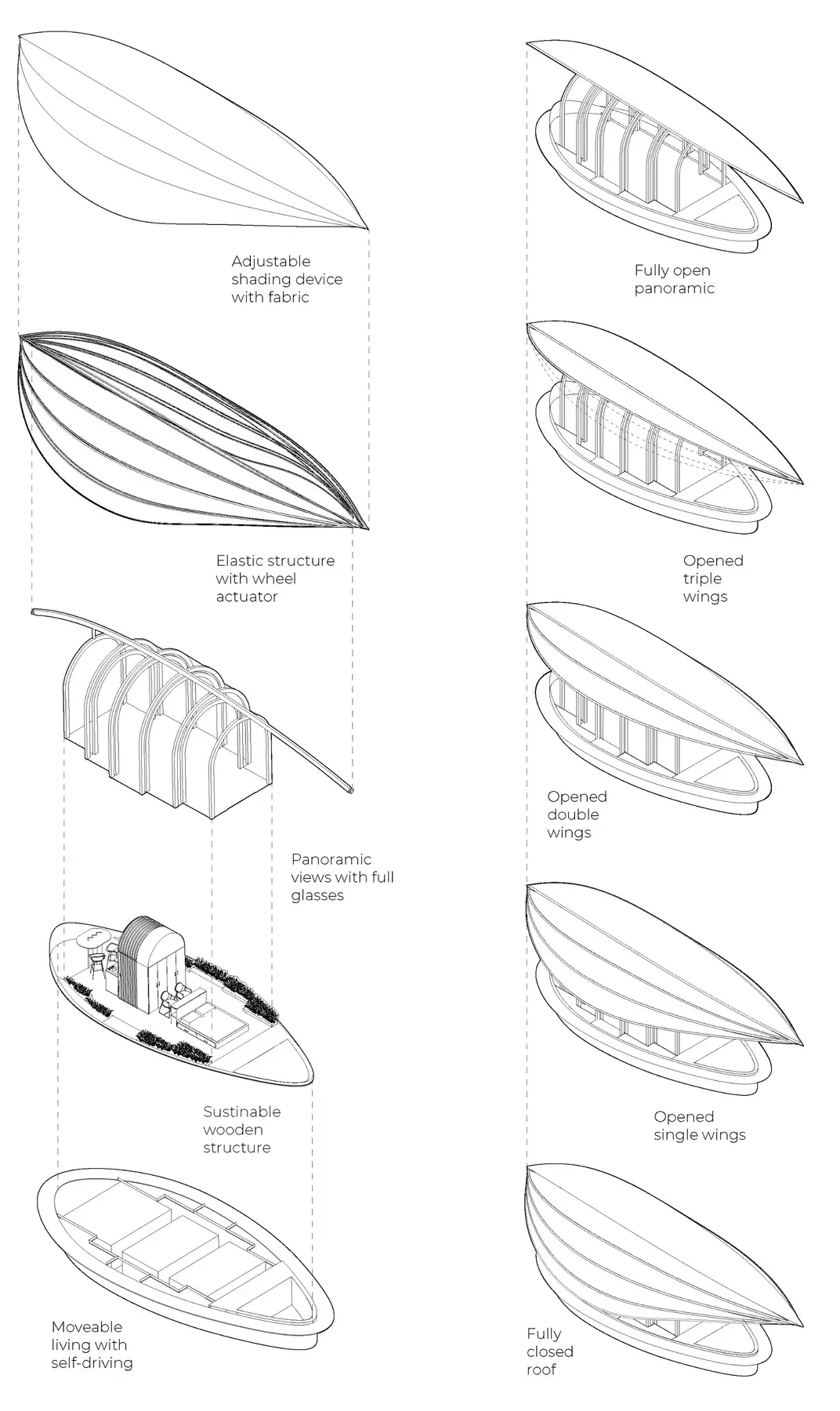
That documentation makes the architecture easier to read, although an exploded presentation drawing cannot tell us the scantlings, stability or roof loads of a finished vessel. My Modern Met reports the interior as 269 square feet, essentially the same 25 m² figure, while Architizer usefully keeps the project filed under “Concept”.45
Across the sources we reviewed, there is no completed Lucia, documented lake trial or certification record, so the public story currently ends before fabrication and testing.
The missing shore
UAU's proposal becomes more convincing when it reaches the shore through Darsena Link, a conceptual network of docking points with solar charging, markets, gathering areas, water-sport access and planting.13 Floating-home imagery often erases this mundane dependence on fixed infrastructure, even though mobility requires places where energy, people and supplies can cross between water and land.
An electric vessel needs energy, guests need places to arrive and leave, and water, waste, supplies or maintenance eventually have to cross that boundary; distributed docks give those exchanges somewhere to happen. Darsena Link remains a proposal, yet its presence makes the wider idea more coherent by pairing the freedom to move with a plan for stopping.1
What is already useful
No public evidence yet demonstrates that this particular 25 m² form can cruise Lake Como comfortably with its folding roof, and doing so would require information on mass, stability, wind behaviour, watertightness, propulsion, endurance and safety followed by trials on a physical vessel.
The architectural observation requires much less faith: within a tiny plan, a boundary that moves can matter more than another square metre, because closing the canopy produces a compact refuge while opening it hands a large part of the room back to the landscape.
Lucia is therefore more interesting today as a clearly drawn spatial experiment than as either a product supposedly waiting around the corner or a render to dismiss outright. UAU has made the first half of the proposition visible; the harder half, the one that must float, survive weather and age on a lake, still needs public engineering evidence.