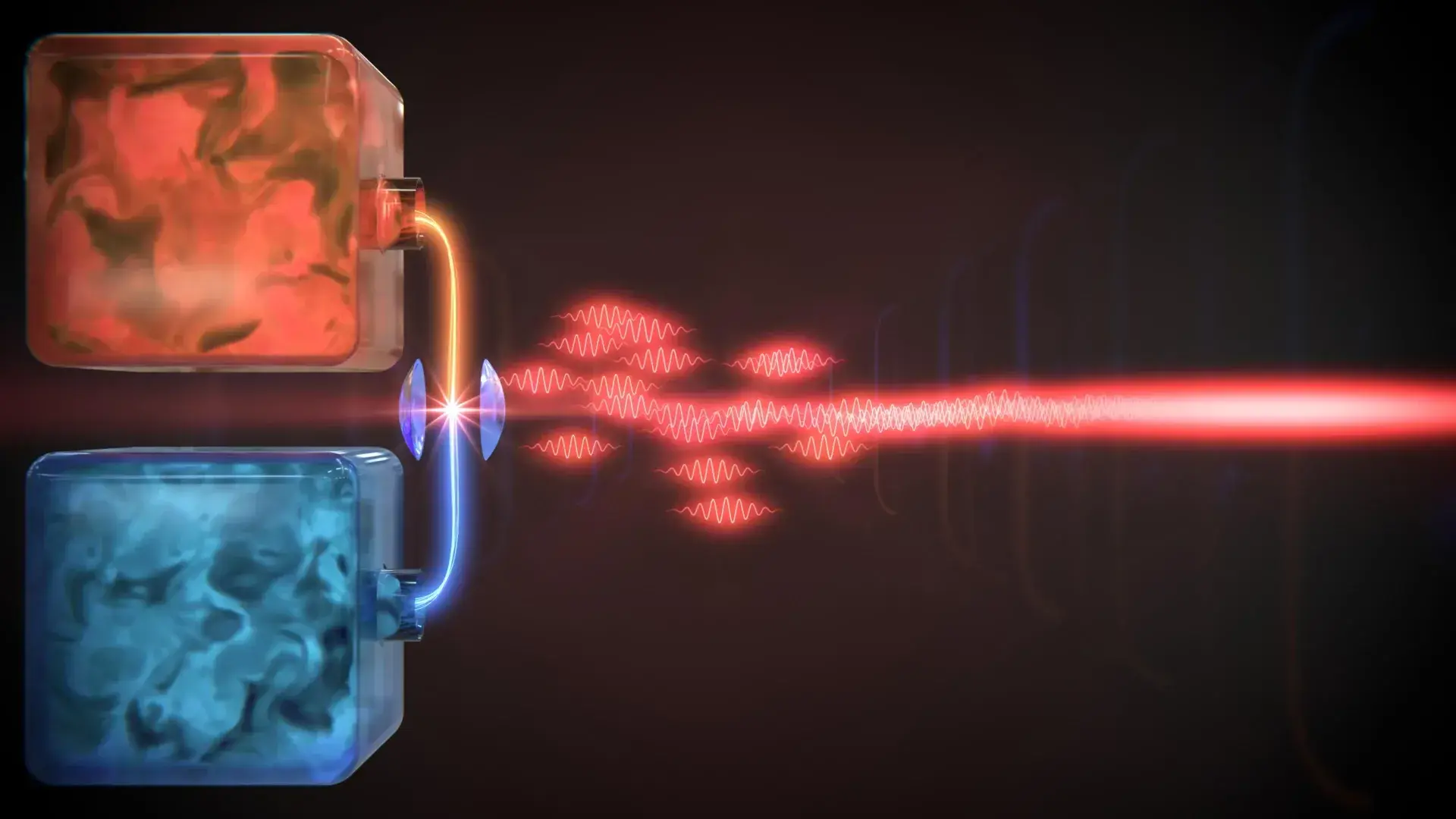
In the 19th century, thermodynamics was born to understand steam engines. In the 20th, quantum physics was born to understand atoms. In 2026, the two branches find themselves forced to coexist inside a machine the size of a few photons: an atom trapped between two mirrors, absorbing laser light and re-emitting part of it. A team at the University of Basel has just shown that, in this tiny engine, deciding what counts as “waste heat” is no accounting detail — it determines whether the theory stays consistent.1
An engine without a piston
The setup is a lab classic: an optical cavity formed by two partially reflecting mirrors, with an atom inside. A laser injects photons continuously; some light escapes through the mirrors. The system receives energy while simultaneously losing it to the environment — physicists call it a “driven-dissipative” system. In this configuration, the atom behaves like a miniature heat engine, a “light engine”.1
The question posed by Marcelo Janovitch, first author of the study published in Physical Review Letters, sounds simple: what happens to the energy of the photons that leave? The answer isn't. Two accountings are possible, and both are theoretically valid: treat the entire outgoing flux as waste heat, or recognize that part of that light can still deliver useful work to another quantum system.2
Patrick Potts' group had already shown that escaping photons don't automatically deserve the waste label. Their new study goes further: it uses the semiclassical limit as arbiter.12
The classical crossover as a consistency test
The semiclassical limit is the regime where the atom is treated quantum mechanically — its energy levels stay discrete — but light can be described as a classical electromagnetic wave, its quantum effects negligible. It's an indispensable bridge: any serious quantum description must naturally join classical physics as you scale up.
The study's result is sharp. If part of the outgoing photon flux is classified as a useful power source, the thermodynamic description crosses into the semiclassical regime without a hitch. If all outgoing energy is counted as heat, the transition fails. In other words, between the two equally permissible accountings, only one survives the passage from quantum to classical.12
The paper states it in technical terms: violations of the thermodynamic uncertainty relations are recovered in the semiclassical limit only by the framework treating part of the photon flux as a power source, illustrated on a three-level system coupled to a driven cavity.2
Fluctuations as a resource
The second lesson is more surprising: the calculations correctly describe how quantum effects reduce fluctuations in the emitted light. Fluctuations are precisely what plague quantum technologies — heat creates noise that makes systems hard to control. Under the right conditions, that noise can become a resource: producing particular states of light useful for ultra-precise measurements in quantum metrology.[1](#ref-1]
Why this isn't a magic battery
Be clear about what this study doesn't say. This is a theoretical framework, not a machine: no watt was recovered, and nothing suggests we can power anything from a cavity's lost light. The first law of thermodynamics stands — energy is conserved, and neither accounting creates any.1
What the Basel work changes is conceptual yet durable: the boundary between heat and work isn't written into nature; it depends on the chosen level of description. And for emerging quantum technologies — sensors, metrology, future photonic machines — knowing that part of what looked lost can be counted as a resource, backed by a theory that formalizes it cleanly, is exactly the kind of foundation you need before building anything useful.