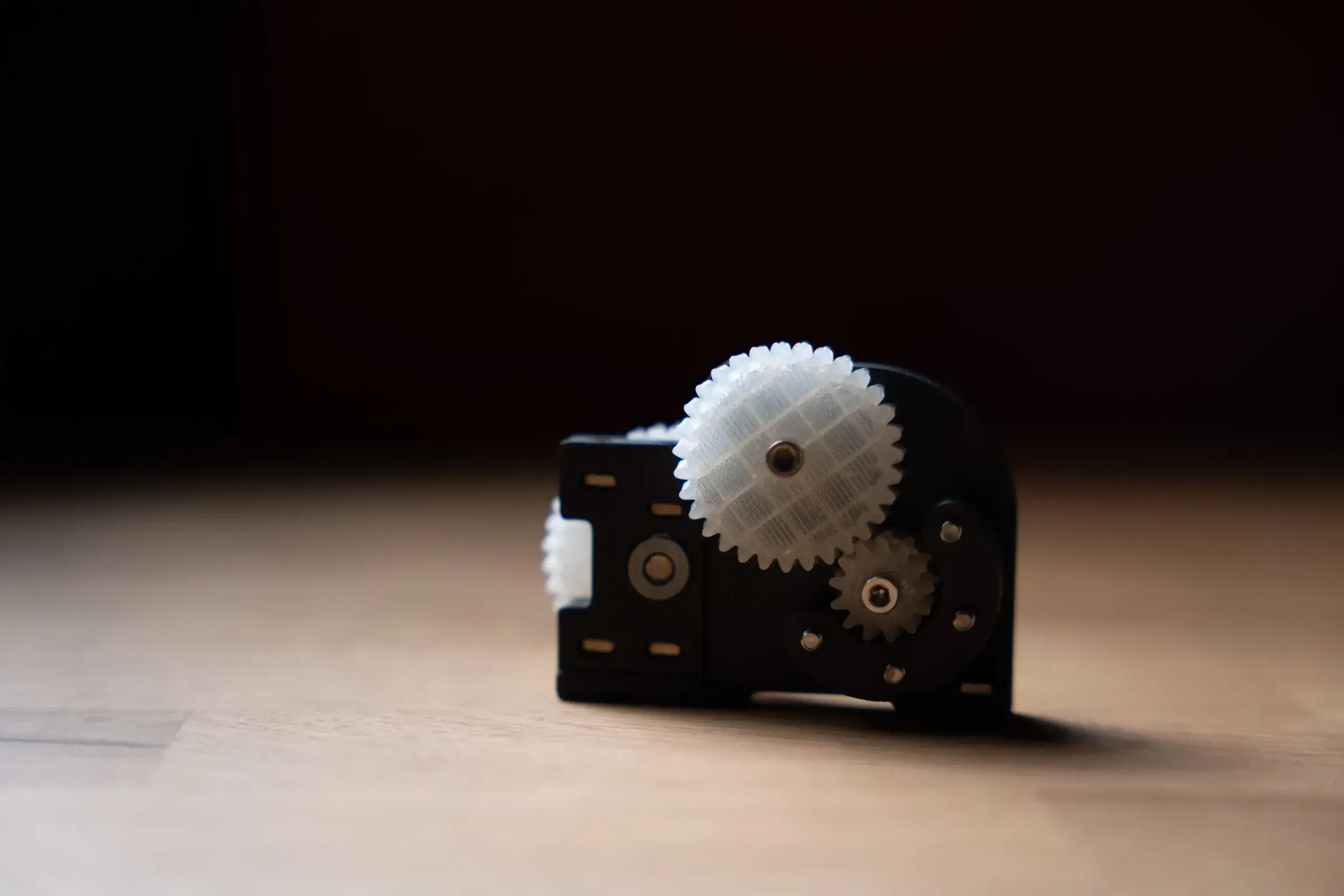
Gears are where 3D printing filaments go to die. PLA snaps clean at the first overload, PETG wears into powder, and carbon-fiber-filled nylons — however rigid — slide poorly against themselves. That is precisely the use case for which Prusa is reviving a pure material: Prusament PA11 Natural, a polyamide derived from castor oil, introduced on July 23, 2026.1
The paradox deserves a closer look: the fiber-free version costs about the same as the carbon one (€107 per 800 g), demands an enclosed, heated printer, and yet it's the one the manufacturer recommends for moving parts.12
Why printed gears eat their materials
A gear tooth subjects its material to three simultaneous trials: repeated contact under load (wear), impact at every tooth engagement (toughness), and stresses in every direction — including across print layers. Most filaments fail on the third point: interlayer adhesion remains FFF's weak link.
That's where choosing pure PA11 makes sense. Without fibers, layers chemically weld to each other; with fibers, they slide around a rigid skeleton. The number that captures this difference is the tensile strength anisotropy coefficient: r = 0.84 for this PA11, the highest of any Prusament, versus 0.60 for PLA High Speed and 0.33 for standard PLA or PC Blend. The closer r gets to 1, the less load direction matters — a printed gear can then be oriented for accuracy rather than for print survival.1
Castor oil, friction and fatigue
PA11 isn't just another nylon. Chemically, its chain counts eleven carbons versus twelve for PA12, and crucially it comes from castor oil: Arkema has produced it for over 70 years under the Rilsan name, for applications as demanding as fuel lines.3
Three properties matter for a moving part. First, sliding: polyamides offer low friction on contact, and Arkema reports better abrasion resistance for PA11 than PA12.3 Second, impact: PA11 stays resilient at low temperature, up to twice as tough as PA12 at −30 °C in a notched Charpy test.3 Third, moisture: short-chain nylons like PA6 swell and lose properties as they absorb water, while PA11 ranks among the least hydrophilic in its family.3
The honest caveat comes from academic research: a PA11/PA12 comparative study published in Polymers measured similar water saturation (~1.5 wt% after two months) for both polymers, and notes PA12 absorbs the least water of the whole polyamide family. PA11 wins on impact and bio-based origin, not systematically on humidity.4
The price of heat: mandatory annealing
Straight off the nozzle, PA11's weak point is thermal: under a 1.8 MPa load it deflects starting at 58.7 °C. Printing doesn't leave the polymer time to fully crystallize. The remedy is a controlled anneal: ramp to 110 °C at 1.5 °C/min, hold six to eight hours, cool at the same rate. Result: 122.5 °C heat resistance, a 63.8 °C gain — at the cost of a slight yellow tint.[1](#ref-1]
On the printing side, constraints remain real: drying at 90 °C for six to eight hours before use (the material is hygroscopic), a heated enclosed chamber — CORE One+, CORE One L or HT90 on Prusa's side — active filtration recommended since molten polyamide emits ultrafine particles, and a dedicated PA Nylon plate washed with water only, never alcohol.1
When does a printed moving part become credible?
With these properties, the territory where a printed part replaces a machined or molded one genuinely widens: reduction gears, UV-exposed hose connectors, automotive components in contact with oils and fuels, solvent-resistant lab equipment. PA11 resists bases, alcohols, toluene, acetone, motor oil and diesel.13
The limit stays economic: at €107 per kilo plus a few hours of annealing, you print a moving part when the series is small, the geometry complex or the lead time critical — not when producing a thousand identical gears. But for the maker who has already snapped three PLA gears, the argument is simple: the material finally exists, provided you own the machine that goes with it.