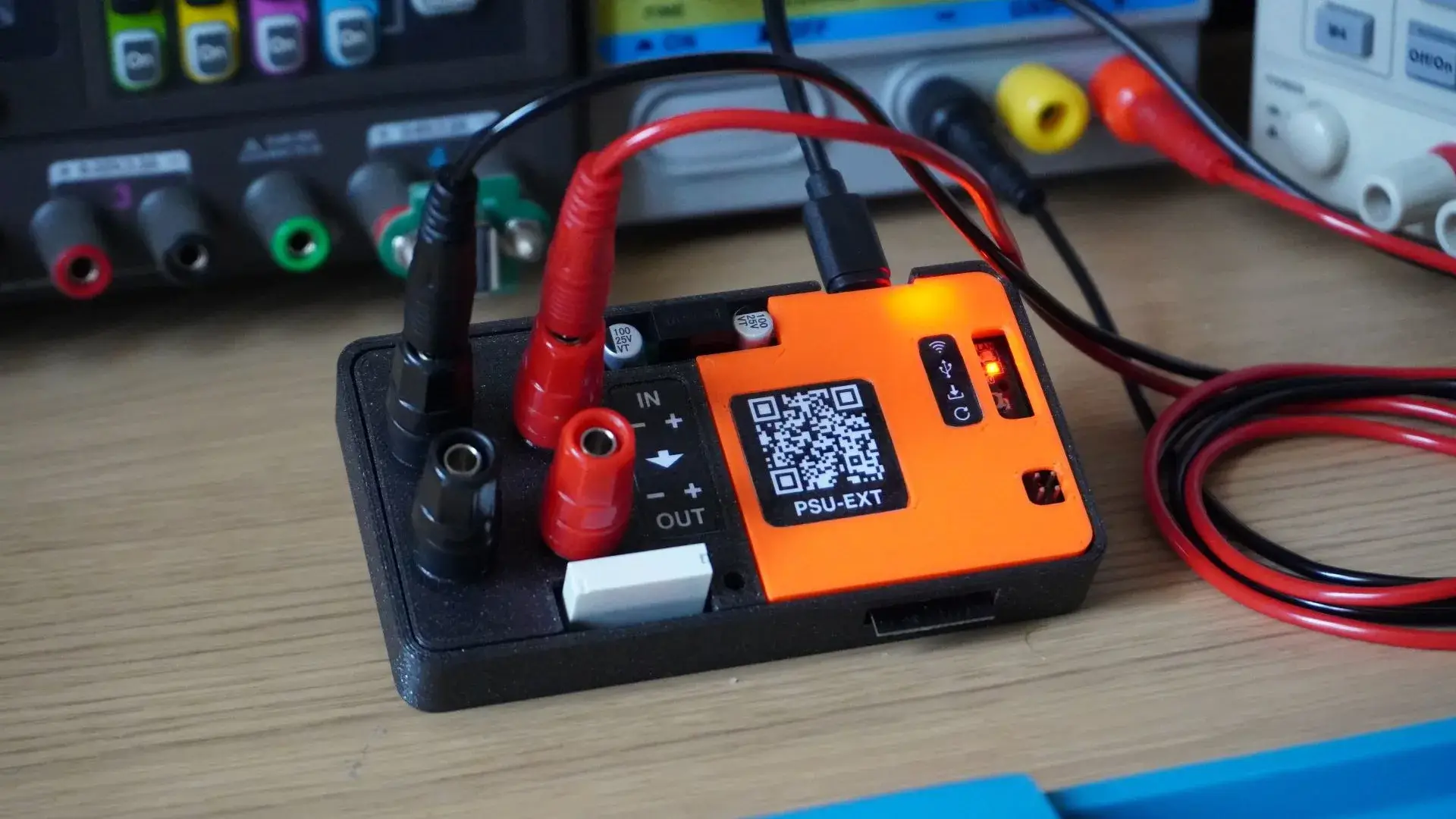
Bench supplies have an odd way of becoming obsolete while still working. The transformer is fine, the knobs are fine, regulation is fine; what is missing is everything around them that newer instruments take for granted: logged measurements, scripts, network control, sometimes any communications port at all. PSU-EXT approaches that problem from the outside, sitting between the supply output and the circuit under test rather than asking anyone to open the case.1
Nothing inside the old supply suddenly becomes digital. Its power stage and front-panel setpoints remain exactly where they were. PSU-EXT watches the downstream voltage and current, adds a switched output path, protection, measurement history and SCPI commands, leaving the original instrument to do the part it was built to do.
In the middle
According to the published hardware documentation, the current prototype handles 0 to 25 V and up to 2.5 A on a 100 × 50 mm board. An ESP32-S3 runs the control side, while an ADS1115 and INA240 form the measurement chain; isolated I²C and an isolated DC-DC supply separate measurement from the controller domain.1
The output path also goes through a relay, which starts in the off state after boot. Firmware can switch it, watch over-voltage and over-current thresholds, react to two external trigger inputs and execute a small queue of timed transitions.2 If a test needs power for thirty seconds, a pause, another cycle, or a hard stop after a threshold is crossed, that logic no longer requires building a second controller around the power supply.
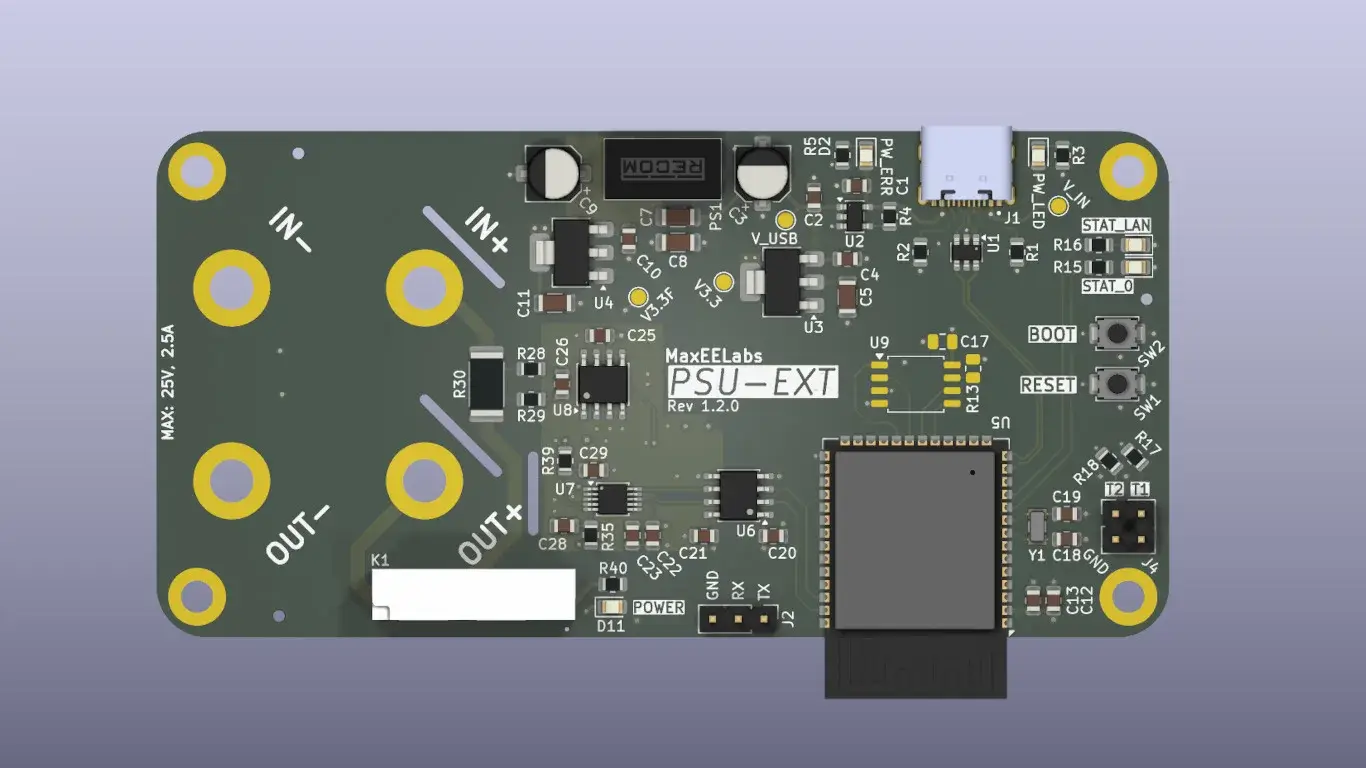
The limitations belong in the same paragraph as the specifications. The repository calls this hardware an EVT prototype, an engineering-validation design rather than a finished or certified consumer instrument. It has no reverse-polarity protection. The 25 V and 2.5 A figures describe this board's intended range, not permission to put it in front of arbitrary supplies and loads.1
Speaking SCPI
Wi-Fi makes for an easy feature bullet, but SCPI is the more useful decision. It is the old, deliberately boring language that lets laboratory software ask an instrument for a reading or tell it to perform an action without depending on whatever interface its manufacturer happened to draw.
Here it runs over USB CDC or TCP port 5025.2 The published command set already covers measurements, relay state, OVP/OCP protection, triggers and timers, and measurement-history queries can return as many as 600 stored samples. These are inspectable implementation details rather than a feature list waiting for future firmware: the reference and corresponding handlers are in the repository now.
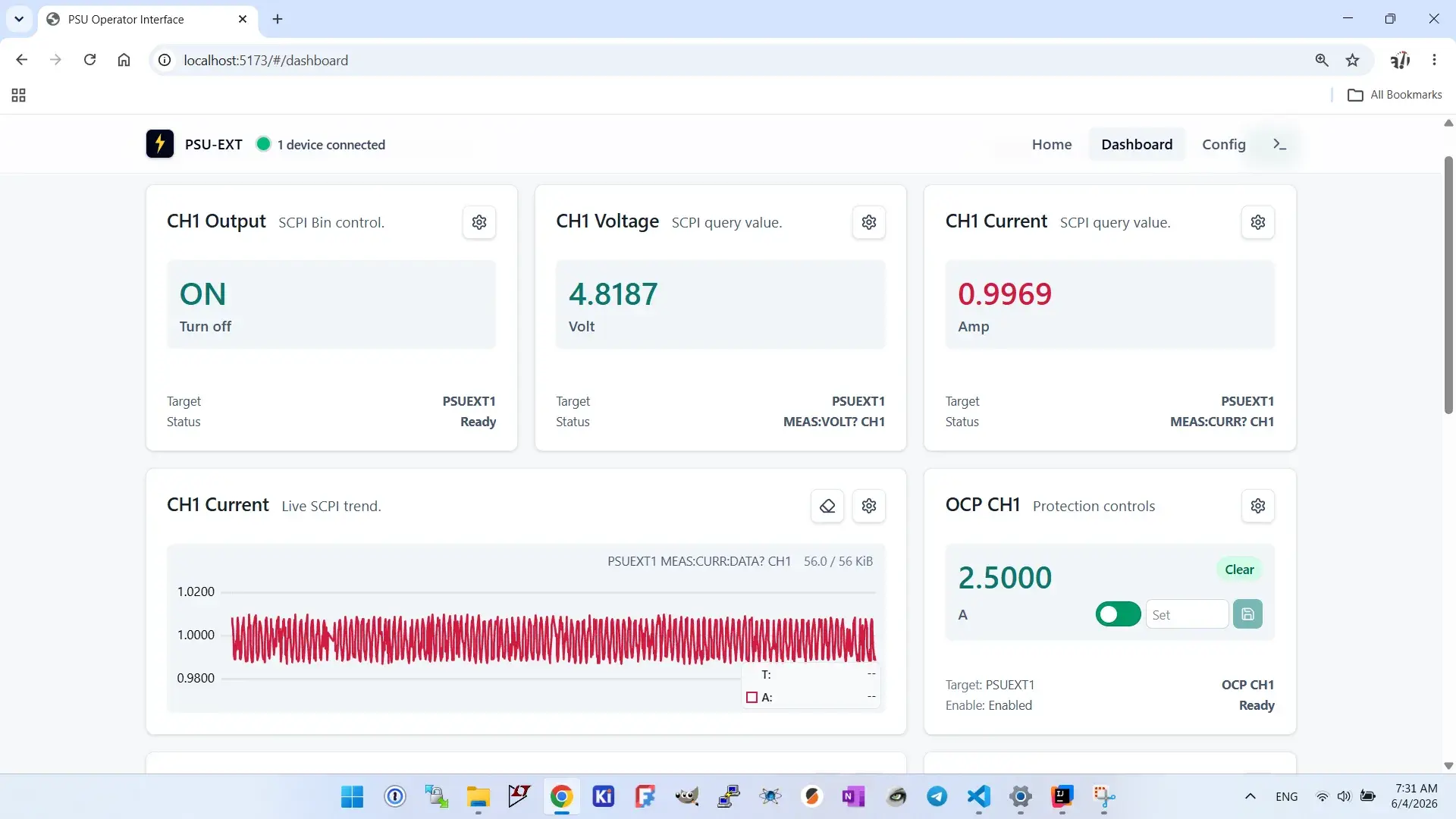
The PC software expands the idea. A Java/Spring proxy bridges SCPI devices to a React browser dashboard, while a separate Script Runner handles automated sequences.3 Project documentation even shows how to configure two third-party TCP instruments, a Siglent SPD4323X supply and Rigol DM858E multimeter.4 The software layer is therefore already broader than the PSU-EXT box itself: it can serve as a small common front end for instruments that speak SCPI.
Files before sales
As of August 22, 2026, Crowd Supply still lists PSU-EXT as Coming Soon among its pre-launch projects.5 The project is nevertheless more than a render. Its hardware repository contains editable KiCad schematics and PCB files, a FreeCAD enclosure, Gerbers, a BOM and CPL placement data needed for assembly.1
The firmware repository contains the ESP-IDF application, components and tests. Control software is also public, including the frontend, backend, installers and already tagged software releases.23 The original hardware design is published under CERN-OHL-S v2; firmware and control software use Apache 2.0.
A developer involved with PSU-EXT says the production files went public before crowdfunding so prospective supporters could inspect the design, point out faults or try building it themselves.6 Whether openness helps the campaign is still speculation. What can be checked today is much narrower: those production sources are public while the campaign itself has not yet opened.
Keep the instrument
Retrofits have an obvious boundary: the original device has to be worth keeping. A recent professional supply often has Ethernet, USB or RS-232 and speaks SCPI already, in which case putting another box in series can add complexity rather than remove it. In the developer discussion, the project is framed more toward people who own a decent but non-programmable supply; the creator also acknowledges that its single measurement range will not cover every precision use case.6
The limitation also defines the useful idea behind the project. Plenty of laboratories have no reason to add PSU-EXT, but a working instrument does not have to be discarded just because its control interface is old. The familiar transformer, knobs and regulation stay on the bench; software-readable measurement, programmable protection and scripting arrive as a separate layer around them.
GitHub cannot answer the remaining questions: production calibration, availability, price, long-term reliability and behavior after months on a real workbench. While the campaign has yet to start and the hardware remains at EVT stage, those are open questions. The line between the future product and the present project is unusually easy to draw: the first is still a promise, while the second already exists as files anyone can inspect.