A Geiger counter is already a peculiar digital object: the world speaks in ionisation events, and the machine answers with pulses, clicks, tiny yeses.
What Ludens changes is the last step in that chain. Instead of sending the count to a microcontroller and a screen, his portable counter for low-level radiation moves a needle, while a single AA cell feeds the whole circuit and a Chinese J306β tube almost 20 cm long sits above the case.1 Hackaday picked it up as a deliberate analog build.2
The choice sits in a longer Ludens thread, because an earlier page describes a quick counter around a surplus JAN5890 tube, built after Chernobyl memories made background radiation feel measurable again.3 This time, though, the Cold War atmosphere is secondary. When you're sweeping an area for a weak source, a moving needle can be more useful than a number that jumps around on a small display.1
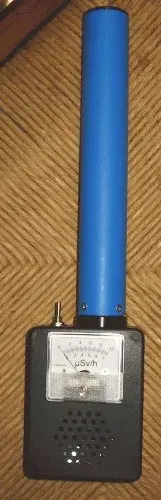
Large tube
The design starts with the tube. Ludens points out that a small Geiger tube produces very few counts per minute at normal background levels, which means a long wait before the reading settles; a larger tube catches more events from the same radiation field, giving the analog meter enough material to work with.1
According to the specifications Ludens cites, the J306β should produce 88 counts per minute at average background radiation and 8 counts per second at 1 µSv/h. The tube is almost 20 cm long and about 18 mm in diameter, so the counter gives up pocketability in exchange for something more useful here: enough counts to average without waiting forever.1
The finished counter has two ranges, 1 µSv/h on the low scale and 10 µSv/h on the high one, plus the kind of note that belongs in a workshop manual: if anything drives the high scale to the end, Ludens would rather run than keep measuring.1
Two voltages
The supply is where the build stops being merely a meter bolted to a tube. One AA cell provides roughly 1.5 V, yet the logic ICs need 5 V and the Geiger tube needs about 400 V.1
For the 5 V rail, Ludens uses a tiny ready-made boost converter, while still publishing its internal circuit for builders who don't want the module. The 400 V rail is more personal: a pulse-frequency-modulated flyback converter, driven by a CMOS Schmitt-trigger inverter and a MOSFET.1
Regulation on the high-voltage side comes from three reverse-connected 1N4148 diodes used as avalanche diodes around 390 V, a choice nobody would mistake for a laboratory reference. That's also why it belongs in this build: the feedback path draws very little current while keeping the tube supply stable enough for the job.1
The result is frugal in a way that changes the object. Ludens reports about 1.1 mA at 1.5 V, with both converters staying in regulation down to roughly 0.8 V; on his calculation, one AA cell can run the counter for more than 2,000 hours.1
Charge and needle
Because the tube never hands the circuit a smooth value, the measurement has to be made from pulses. The circuit shapes each pulse with the Schmitt trigger, makes the speaker click, and drops a defined amount of charge into a capacitor; the voltage across that capacitor and the meter then follows the pulse rate, which is the relative radiation intensity the instrument can show.1
The averaging times change with the range, from 4.4 s on the low range to 0.44 s on the high range. That split is sensible: background readings need a calmer needle, while sweeping a suspect area needs a response that feels almost immediate.1
The click remains, but Ludens is careful about what it can tell you. Since Geiger events are irregularly spaced, a moderate rise in count rate is hard to judge by ear; for scanning, the meter is the interface that matters.1
Not a standard
The important limit is calibration. Ludens doesn't have a radiation source with precisely known activity, so he leans on the published J306β tube specification: disconnect the tube, inject an 8 Hz square wave into the circuit input, and set the meter for full scale on the low range.1
That leaves the instrument in a useful but narrow lane. It can compare samples, find hot rocks, or show that a bag of potassium nitrate sits above local background, but Ludens says the meter is currently good for relative measurements, not certified dosimetry.1
That honesty is the best part of the project. Ludens doesn't dress the counter up as a radiation-protection instrument; he lets the parts say something plainer, that a discrete signal, a large tube, a very frugal high-voltage supply and a needle can become a tool you read at a glance.
The obvious modern version would count pulses with a microcontroller and print a number. Ludens keeps the question closer to the hand: can I see the zone change while I move the tube?