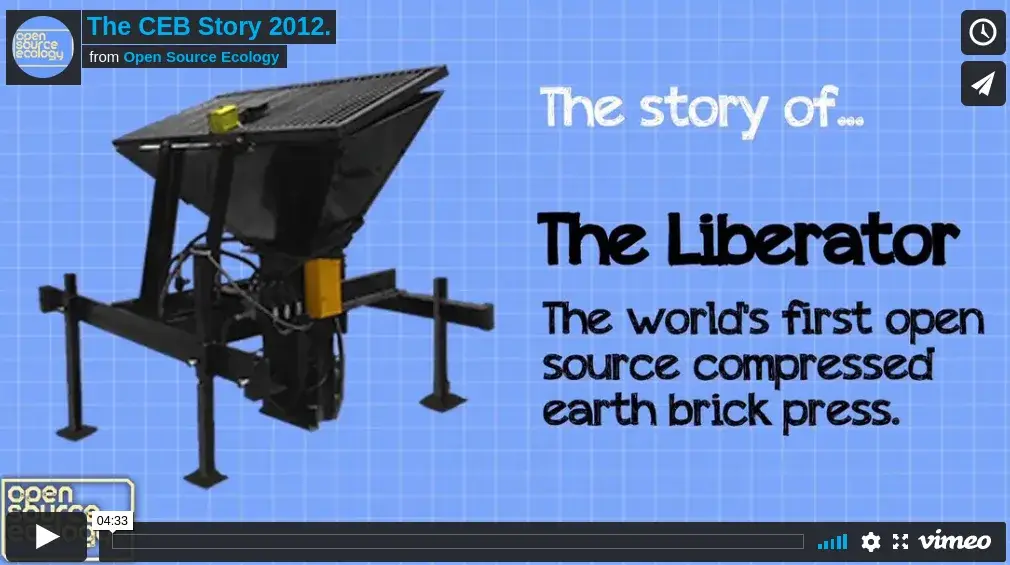
From a distance, a compressed earth block looks elemental: soil, a mould, pressure, then a wall. Open Source Ecology's press tells a much more industrial story.
OSE documents an automated hydraulic machine that can produce six 4 × 6 × 12 inch blocks per minute with the appropriate hydraulic flow.2 In 2021 the organization announced a return to compressed earth blocks for its Seed Eco-Home while US lumber prices were soaring.1
The instinct is obvious: replace purchased material with soil from the site and push wall cost down.
At six blocks per minute, the press finishes its own job fast enough to expose everything around it.
The press is too fast
OSE's documentation quickly breaks the image of a small press fed by two people with shovels. Its production notes are much more revealing.
To sustain six blocks per minute, the organization estimates roughly two cubic yards of soil per hour must reach the machine through a loader, while three people collect and stack finished blocks on pallets.2 Without a mechanical loader, OSE estimates that around thirty people with shovels and buckets would be needed merely to keep up with the press's demand for soil.2
Compression is automated far enough that the bottleneck moves before and after the machine.
That shift makes the project interesting. The earth remains local; production becomes a logistics system.
5,400 blocks
OSE's wall workflow arrives at roughly 5,400 compressed earth blocks for the Seed Eco-Home.3 The count uses 27 wall sections at around 200 blocks each.
At the nominal six-block-per-minute rate, pressing 5,400 units would represent fifteen hours of continuous machine cycles in theory. That is a production bound, not a build time: it ignores soil preparation, interruptions, quality checks, transport and laying.
The distinction matters more than it first appears.
At hundreds of blocks an hour, the price of one block no longer describes wall economics. They depend on how many people are needed around the press, how far soil, machine, pallets and wall are from one another, then how quickly the stacks can become a building envelope.
OSE acknowledges the problem in its own build notes. After several rapid CEB builds, the team records that string levelling does not work well in an “extreme build” scenario and looks for faster laying methods.3
A faster press does not give the wall faster hands.
Soil is a feedstock
“Use dirt from the site” looks almost free on paper. It is also where the idea of a universal material starts to crack.
OSE states that block-height consistency depends on soil uniformity, with its dimensional tolerance assuming a consistent mixture.2 Mechanical performance likewise depends on particle distribution, clay content, moisture, compaction pressure and, where used, stabilizer dosage.4
An open, reproducible machine still does not make soil interchangeable.
The material still needs sampling, screening, sometimes pulverizing, moisture adjustment and a recipe stable enough for thousands of blocks.
The pattern is familiar from digital fabrication: making a machine reproducible does not automatically make its feedstock predictable.
Water decides
Another shortcut is treating earth as a wall material that needs no supporting system.
The 2025 review by Gharbage, Benmahiddine and Sebaibi notes that water exposure, whether rain or capillary rise, can weaken compressed earth blocks. Typical responses involve building geometry and material treatment: suitable foundations, overhangs, coatings or stabilization.4
Stabilization then changes the environmental balance the material was meant to improve.
Cement can raise strength and water resistance, but it also brings a higher-impact industrial material back into the mix. A 2026 study on ecological mix design for stabilized earth blocks frames the problem exactly this way: mechanical performance, water resistance and carbon impact have to be balanced, and different hydraulic binders shift that trade-off differently.5
The most “natural” block is not automatically the one that survives a given climate. The most durable block is not automatically the one that preserves the best carbon advantage.
An open machine
OSE's more distinctive move sits elsewhere.
The press is not only a way to make blocks: OSE publishes the mechanics, controller and substantial manufacturing documentation. The v17.08 specification records dimensions, hydraulic requirements, throughput and control logic.2
That openness enables something buying finished masonry cannot: move material production close to the build and modify the production tool itself.
It also requires real capital. In 2021 OSE advertised a fully automated press around $10,000, or roughly half that in materials for a self-build, without the hydraulic power source.1 OSE's specifications put the machine around 1,700 pounds and require a suitable tractor or hydraulic power unit.2
Local material therefore does not mean light infrastructure.
That is less romantic than “building with dirt.” For a builder, it is more useful.
What the press reveals
OSE's project is most useful when compressed earth blocks are read without nostalgia.
The material can be local. The press can be open. Throughput can be high. None of those facts cancels soil preparation, labour, laying quality, water detailing or stabilization trade-offs.
Instead, a very good machine exposes those constraints.
When the press is slow, the whole build waits for blocks. When it produces six every minute, it forces attention onto everything before and after the machine.
That may be the most useful lesson for a maker: speeding up one operation does not necessarily simplify a process. It simply reveals the next place where the process resists.