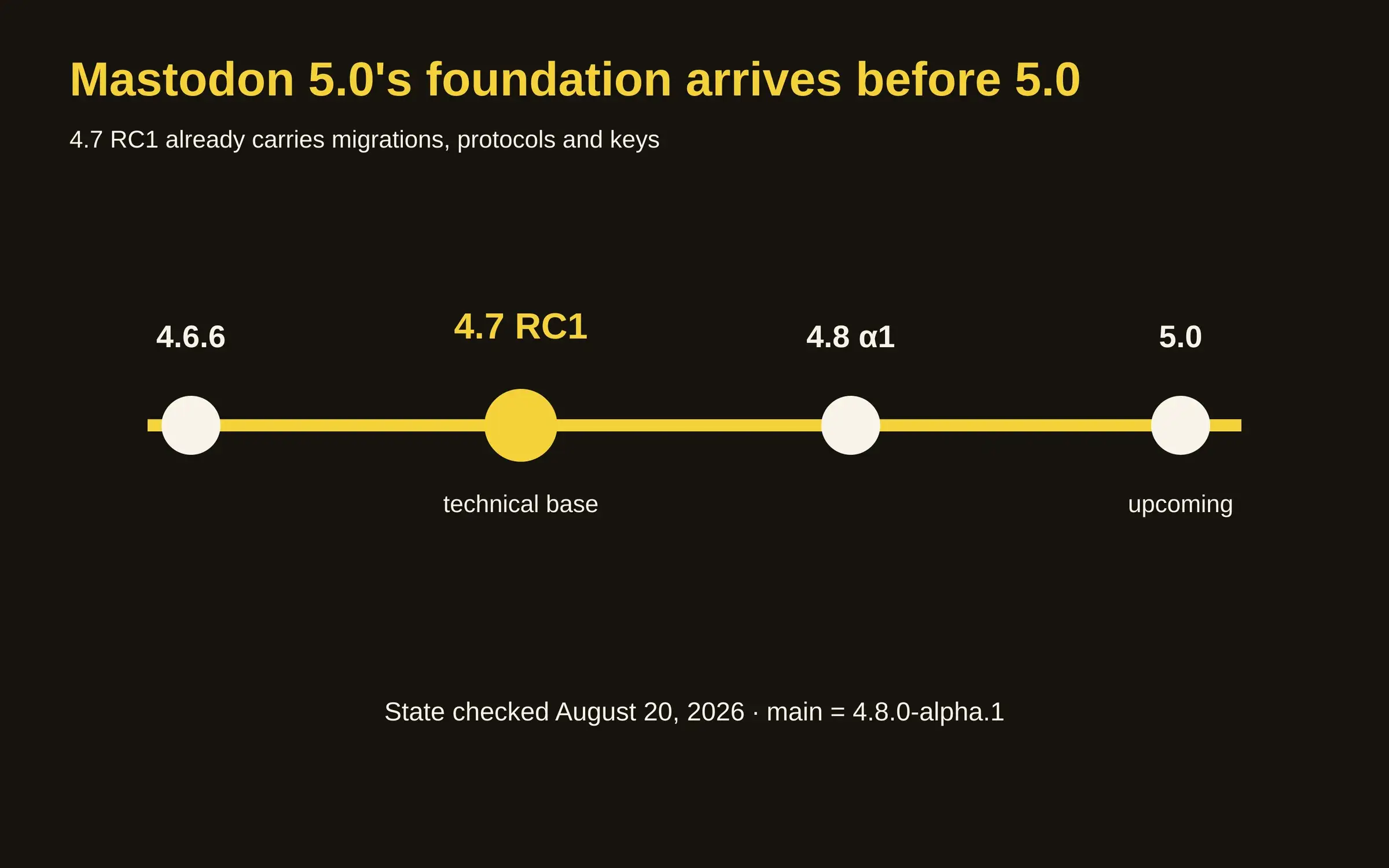
On August 18, Mastodon showed the public a first substantial glimpse of 5.0: a larger composer, redesigned navigation, “private mentions” presented as messages, clearer visibility controls and more room for each server to show its own identity.1 As of August 20, however, there is no Mastodon 5.0 release to install; the latest stable version is 4.6.6, the 4.7 line has reached its first release candidate, and the current main branch identifies itself as 4.8.0-alpha.1.345
That untidy sequence is useful because it shows how a large open-source project can prepare a major release. Some of the difficult engineering arrives under the old major number, while the new number becomes the name for a broader product change that is still taking shape.
Before five
The 4.7-rc.1 release notes are less photogenic than the 5.0 mockups, but they are much more consequential for anyone operating a server. Mastodon says explicitly that installing 4.7 will be required for a zero-downtime migration to the upcoming 5.0 release, and the candidate already requires asset recompilation, a streaming-server restart and database migrations that may take up to a few hours on very large servers.3
Its internal changes are equally concrete. Local account keypairs move into a dedicated table and private keys are encrypted at rest; Ed25519 support arrives for HTTP Message Signatures; Mastodon verifies newer Object Integrity Proofs, implements several ActivityPub FEPs and changes the way remote actors are identified so a changed handle no longer has to look like a different account.3 Much of what will make 5.0 possible is therefore landing in a version whose number still begins with 4.
Two projects
The public 5.0 post describes a different kind of foundation. Almost every example concerns how Mastodon explains itself: who will see a post, who can quote it, where a private conversation belongs, how a server identifies itself and how lists become easier to discover as “custom feeds”.1 Discovery Week, published two weeks earlier, gives the background: the team says it has accumulated thousands of GitHub issues and discussions and wanted a way to concentrate on confusion that affects ordinary users as well as people who already understand Mastodon's vocabulary.2
Private messaging is a good illustration. The underlying network does not suddenly become a separate instant-messaging system. What changes first is the presentation: a dedicated message composer, a clearer list of recipients and a Send action instead of Publish, all intended to reduce the chance that someone misunderstands the audience for what they are writing.1

Inside main
To see how far that visible redesign has already moved into code, IRZ compared v4.7.0-rc.1 with main at commit 60593f6 on August 20. The interval contains 79 commits across 261 files, with 10,133 added lines and 4,336 removed. Of those changes, app/javascript accounts for 189 files, +8,064 and −1,451 lines; controllers, helpers, services and Rails libraries outside JavaScript account for only 11 files in our grouping, at +25/−50 lines, and there is no new file under db/migrate in the comparison window.
Those numbers cannot predict what the final 5.0 upgrade will contain. They cover only the days after 4.7-rc.1 and therefore say nothing about migrations that might appear later. What they do show is much narrower: during this slice of development, the large visible movement is in the interface rather than another round of database work.
Not 5.0 yet
There is another reason to resist treating main as a preview package for 5.0. The redesign pull requests we sampled — covering the composer, visibility menu, navigation, replies and messages — are merged, but none of the eight sampled PRs carries a 5.0 milestone, while the branch itself reports version 4.8.0-alpha.1.5678
The repository proves that work matching the public prototypes is well under way; it does not tell us which exact commit will become 5.0. Mastodon's announcement makes the same distinction by describing its screenshots and mockups as work in development whose final form may change.1 For an operator, that means the blog post is useful for understanding direction, whereas upgrade planning still belongs to release notes.
Actual cost
A small instance cannot meaningfully budget a “5.0 migration” from the August 18 article because 5.0 upgrade notes have not been published. The costs we can describe today belong to 4.7, whose external requirements remain those of 4.6: Ruby 3.3+, PostgreSQL 14+, Redis 7+, Node 22+, libvips 8.13+, FFmpeg 5.1+, plus Elasticsearch 7.x or OpenSearch when full-text search is wanted.3
The operational work is more important than that list. Mastodon instructs administrators to take a database backup, run pre-deployment migrations, restart the Mastodon processes and then run the post-deployment migrations; it also warns that after moving to this candidate, a safe downgrade to the current stable releases cannot be assumed.3 On a small server the migrations are unlikely to resemble the multi-hour extreme cited for very large installations, but the sequence of work remains the same: backup, read the notes for every skipped release, migrate, restart and verify.
That is one of decentralization's ordinary costs. Mastodon GmbH can ship the code and documentation, but each independent administrator still owns the moment when their server crosses from one version to the next.
Local identity
The 5.0 interface work also tries to make that decentralization more visible to users. In Mastodon's mockups, the server name and optional icon occupy a prominent place in navigation, while the software brand is reduced to a smaller “Powered by Mastodon” label.1

That visual decision fits the rest of the redesign. Mastodon has historically asked newcomers to understand several concepts at once — the server they joined, federation, post visibility, private mentions, lists, local feeds and federated feeds — even when only one of those ideas matters for the task in front of them. The Discovery Week work and the 5.0 prototypes leave those concepts in place but try to reveal them at a more useful moment.12
Major version
Why call the eventual result 5.0 rather than 4.8? There is no definitive public technical explanation yet. The repository says 4.8 alpha, the product blog says 5.0, and the 4.7 release notes explicitly describe preparation for a future 5.0 migration.135
Taken together, those facts suggest a broader role for the major number. It need not identify the commit containing the hardest database migration; it can also mark the point at which a product changes the way it presents its own concepts. In Mastodon's case, some of the underlying protocol and data work arrives first, while the announced 5.0 experience is being used to rethink how people compose, message, navigate and understand the server they are using.
For admins
Administrators of small instances therefore have two different things to watch. The first is 4.7, because its published release notes already contain the schema, key-management and protocol work described as preparation for 5.0.3 The second is main, especially for anyone maintaining a theme, integration or custom interface, because the composer and navigation are changing quickly there.5678
What they do not have yet is an operational 5.0 release. The August 18 article is a statement of product direction and a collection of prototypes, so treating it as an upgrade plan would turn a useful preview into a schedule Mastodon itself has not published.1
For now, that is the interesting inversion: part of Mastodon 5.0's foundational work is happening before Mastodon 5.0 exists as a release. The number can arrive later; migrations, signatures and hundreds of interface changes are already moving.