A conventional synthesizer begins by presenting a convention. Low notes sit on the left, high notes on the right, and twelve pitches repeat from octave to octave. Even when the panel is covered in knobs, the keyboard makes the first move fairly obvious: press a key.
Los Aparatos' Auduina MK2 starts somewhere else: a player can touch its sensor, clip its cable to a conductive object, move light across the optical sensor, inject control voltage or simply turn the knobs.12 The first question is therefore broader than "which note?" — what around you could become a musical gesture?
Mateo Carabajal has explored that question in Tucumán, Argentina, since long before the current Auduina. Drawdio makes a graphite line audible when the body closes the circuit; CoyuyoC turns a 555 timer, light sensor and two interacting oscillators into an unstable drone; Theremingo measures a hand moving through an electromagnetic field. Los Aparatos now describes its own territory with four inputs: light, touch, movement and control voltage.1
Taken together, those four inputs move the center of the instrument in the same direction: the control can leave the panel and reside in a property of the outside world.
No keyboard
Removing the keyboard does not remove musical structure.
The Auduina MK2 still organizes pitch when the player wants it to. Its official page lists major pentatonic scales in all twelve keys alongside a continuous free mode, which leaves a choice between a pitch grid and a region where pitch moves without strict quantization.2 Create Digital Music describes the current machine as a small granular synthesizer packed with sensors, including optical sensing, touch through a cable and CV input.3
What changes is where the gesture begins.
On a keyboard, the user learns a geography designed specifically for music. With Auduina, the geography might be a drawing, the palm of a hand, a metal object or the amount of light reaching a photoresistor. The synth keeps its internal rules, while the musician chooses part of the interface by connecting or illuminating something else.
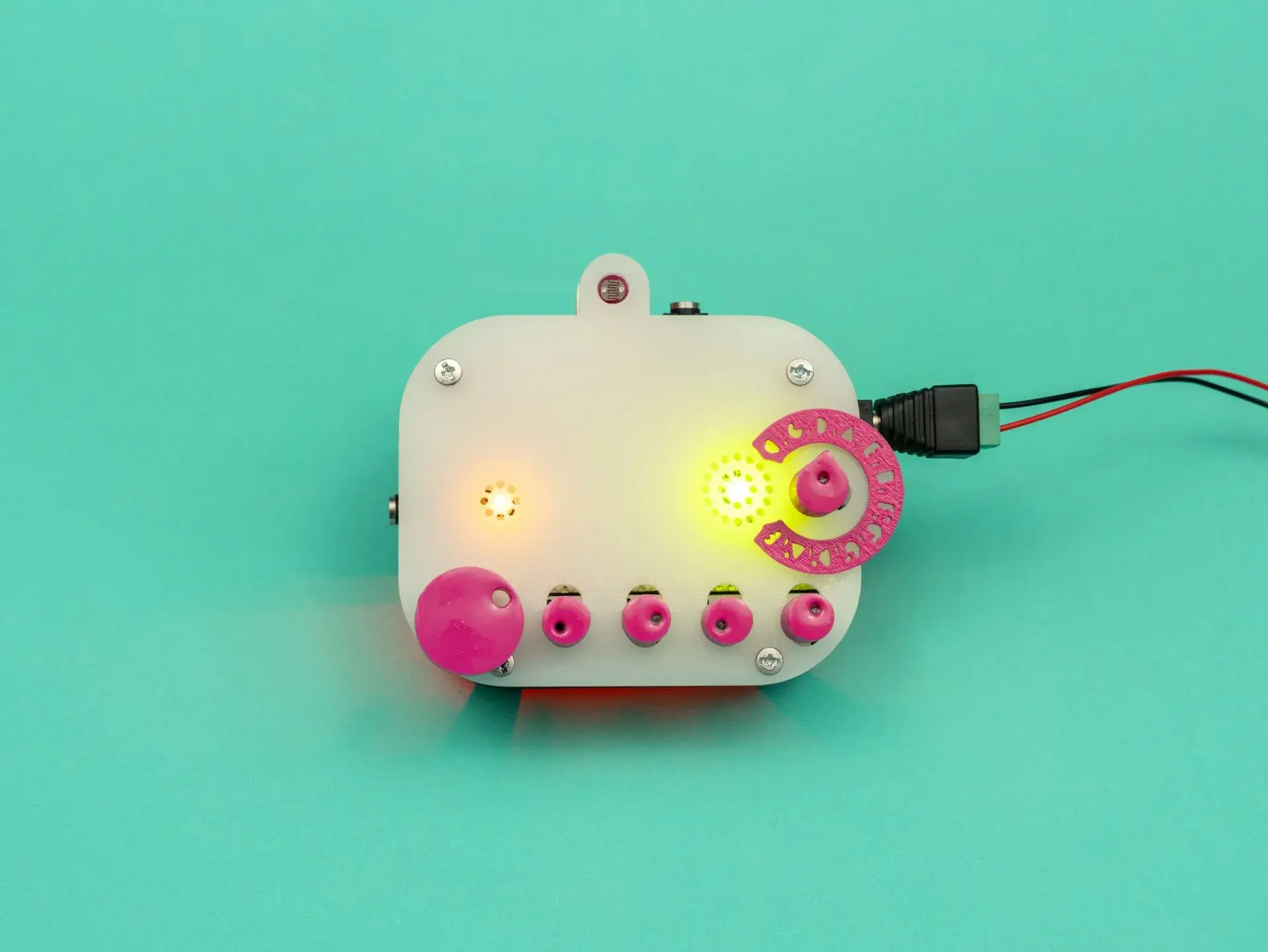
The electronic difference is small, while the behavioral one is substantial: a knob almost always says "turn me," whereas a pair of clips sends the player looking for something to connect.
Light plays
Auduina did not appear fully formed as the MK2.
In 2021, Carabajal was already presenting an Auduina at Maker Faire Shenzhen. That version was based on Peter Knight's Auduino project and incorporated modifications including work by Patrick Enright. It generated pentatonic scales from all twelve chromatic notes, with controls for grain duration, grain frequency, sweep between notes and overall tuning. An optional light sensor could control the notes.4
It would be careless to claim that the MK2 firmware is simply that old code inside a new enclosure; the public sources we found do not document the software lineage precisely enough. The continuity of the gesture, however, is easy to see. The earlier Auduina already offered a melodic structure played with light, while the current model adds touch, conductive objects and CV to the same idea.24
Light is an unusual controller precisely because no musical object is required. A hand can cast a shadow, a lamp can move, projected video can change, or something can pass between the source and sensor; the musician may manipulate the situation rather than the synthesizer itself, leaving the instrument to measure one consequence.
That changes improvisation because, instead of memorizing the exact position of a control, the player learns a physical response: brighter, darker, nearer, more conductive.
Close the circuit
Drawdio pushes the same logic further because its "interface" can literally be the drawing as it is being made.
The circuit relies on graphite conductivity. Touching the circuit and the drawn line brings the body into the electrical loop, and the resistance encountered changes the sound. Los Aparatos now suggests coins, plants, hands and almost any conductive object as ways to complete the circuit.1
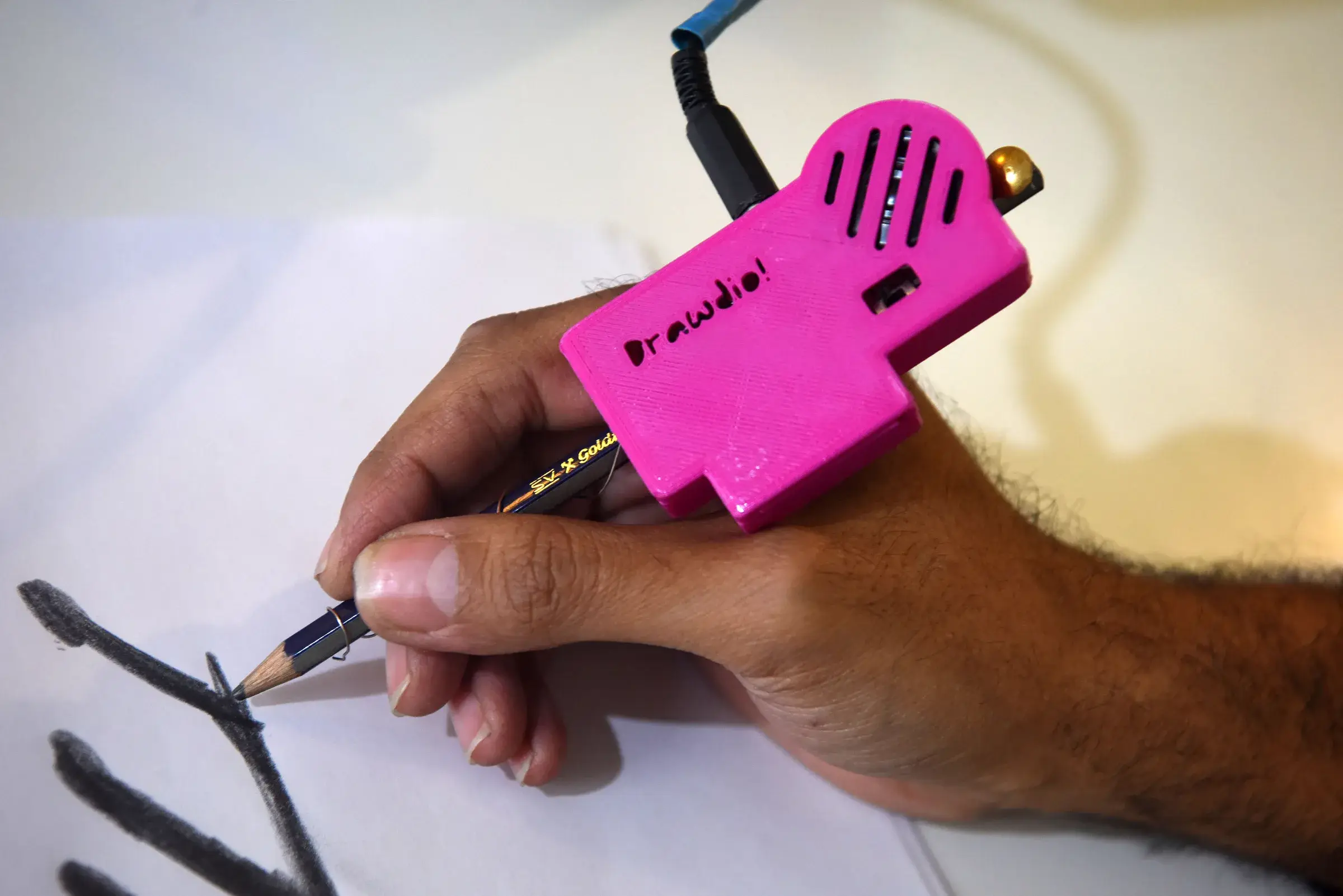
Carabajal was already teaching that relationship in workshops in 2022. La Gaceta described participants drawing on paper while the pencil produced sounds and the body closed the circuit. Carabajal framed the appeal as more than a toy: drawing and sound offered a route into physical phenomena and technical subjects that could otherwise feel forbidding.6
This is where Los Aparatos starts to differ from a purely DIY visual style.
The exposed circuit, clips, pencil and sensor do more than make the objects look handmade: they partly explain the instrument while it is being played. Moving a hand across the light and hearing the sound change is already an experiment, and touching a plant to close the circuit supplies another one.
A player can know nothing about Ohm's law and still discover that an electrical property has an audible consequence.
The 555 drones
CoyuyoC applies the same method to one of electronics' most ordinary components, the 555 timer.
Los Aparatos describes it as an analog drone synthesizer inspired by summer insects. Two triangle-wave oscillators interact constantly, producing drones and unstable harmonics, while patchable connections, a light sensor and CV input disturb the system.1
The project notes published on Hackaday.io explain that NE555 timers sit at the core and that capacitor charging and discharging shape the waveform, which can move from triangle toward ramp or more asymmetric forms as the circuit changes.7
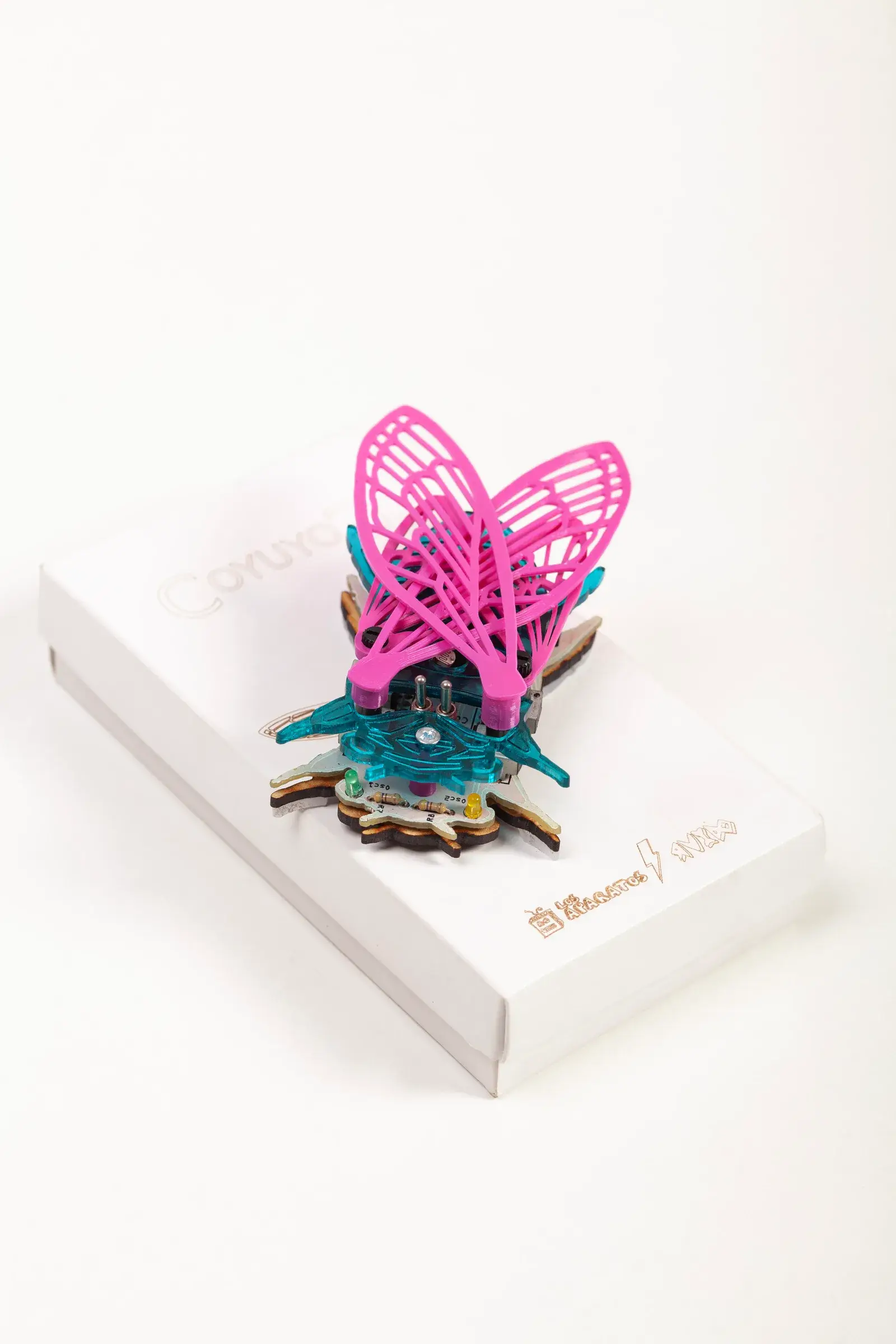
The result leaves the interface of a familiar instrument behind and brings instability forward. The player may search for a region of behavior — a beating pattern, an oscillator interaction, a point where the drone suddenly changes under the light — rather than for one correct note.
Even the name, borrowed from the local summer insect, suits the idea, with sound treated less as a row of pitches on a staff than as a system that can be excited and observed.
A long classroom
This fixation on making an instrument understandable through gesture predates the current products by years.
Back in 2012, La Nación described Los Aparatos as a project offering kits and manuals for building Theremingo and Drawdio. Carabajal said the aim was to let people build their own sound objects without suffering the frustrating first experience common to electronics beginners, a frustration he knew personally after burning through components before his first sound circuit worked.5
His career has mixed construction and teaching for just as long. The biography published for Maker Faire Shenzhen calls Los Aparatos a didactic electronics venture, mentions the Academia Mundial de Hacedores, and records four years coordinating Educational Robotics for Tucumán's Ministry of Education from 2015 to 2019.4
Seen against that history, the current catalogue looks less like a shelf of oddities and more like a compressed version of that teaching practice.
Theremingo reduces the theremin encounter to a pitch antenna and a simple analog voice, Drawdio makes conductivity audible, CoyuyoC exposes the interaction of two oscillators, and Auduina lets several physical phenomena take control of a digital sound engine. In each case a physical cause is easy to provoke and the result arrives quickly enough to invite another attempt.
Small batches
The project is no longer only a workshop or collection of tutorials.
Los Aparatos says its instruments are developed and assembled in small batches, combining analog and digital electronics.1 In August, Create Digital Music noted that Auduina MK2 could now ship internationally and argued that making the devices in Argentina matters in a market where imported music electronics can be punishingly expensive.3
Turning the experiment into a product changes one thing in particular: the experimental gesture has to survive repeated manufacturing.
An educational prototype can be temperamental when its maker is standing nearby to demonstrate the right motion. A small-run product has to arrive somewhere else, perhaps in another language, without the workshop surrounding it. The sensors therefore need to be legible and robust enough for curiosity to replace some of that spoken instruction.
That may explain why Los Aparatos interfaces remain so literal: a visible photoresistor invites light, an alligator clip invites an object and an antenna invites a hand. The shape gives the user a verb before the manual has to explain the entire circuit.
Gesture first
It would be easy to put these instruments in a comforting category: beginner toys.
That label misses their more interesting side, because Auduina has CV input precisely so another machine can drive it, CoyuyoC is patchable, and Auduina's continuous mode can leave the pentatonic grid; the systems remain open enough to join a more complicated setup.12
The approachability here is not a permanent simplification of the sound. It is a simplification of the first gesture.
A piano requires somebody to learn what the keys mean, while Drawdio accepts drawing as the first move; a modular synthesizer often assumes that the user knows where to send a voltage, while Auduina accepts a shadow and Theremingo accepts the simple act of moving a hand closer.
Only afterwards do pitch, frequency, modulation and voltage need names.
That reversal matters beyond music. Many creative tools require users to learn their vocabulary before producing anything interesting. Los Aparatos flips the order: it gives an immediate cause-and-effect relationship and lets theory catch up with experience.
To be sure, there is nothing wrong with the keyboard: it is a remarkably efficient invention for making complex pitches repeatable, although it also imposes a history and a grammar before the first sound.
The small machines from Tucumán show what happens when that obvious starting point disappears, because a sheet of paper, a lamp, a plant, a cable or a hand can suddenly occupy the place where a key was expected.
The outside world stops being what surrounds the instrument. It becomes part of the control panel.