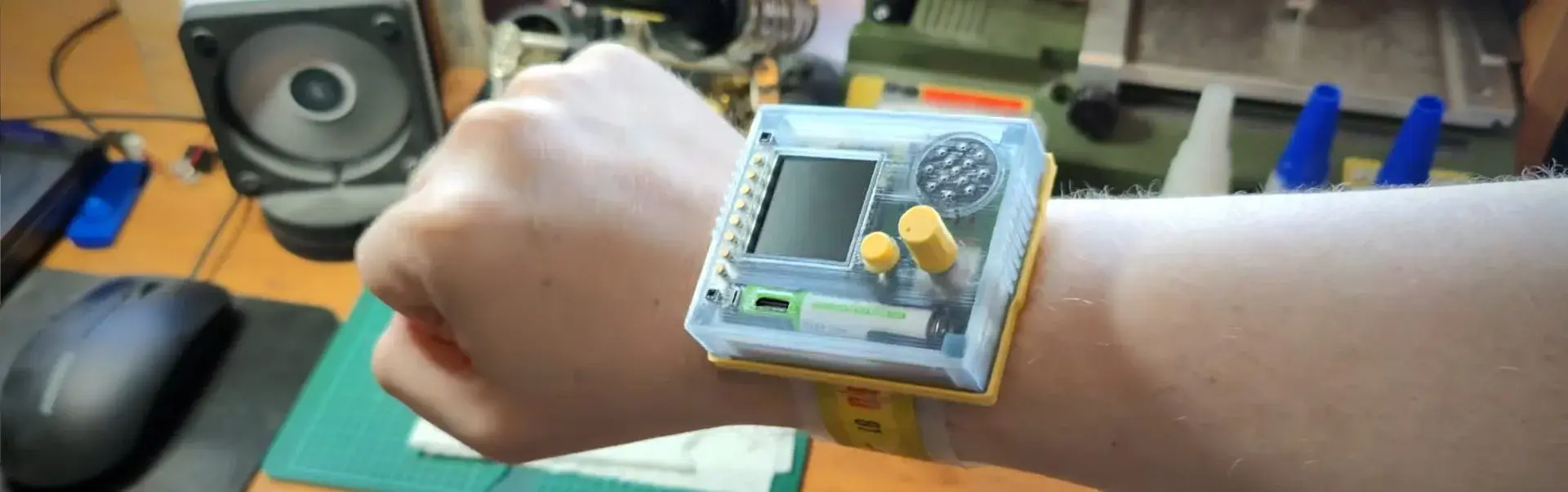
A sequencer can have a screen, buttons and a case. 3DSage's version does something more interesting: the fabrication choices become part of the interface itself.1
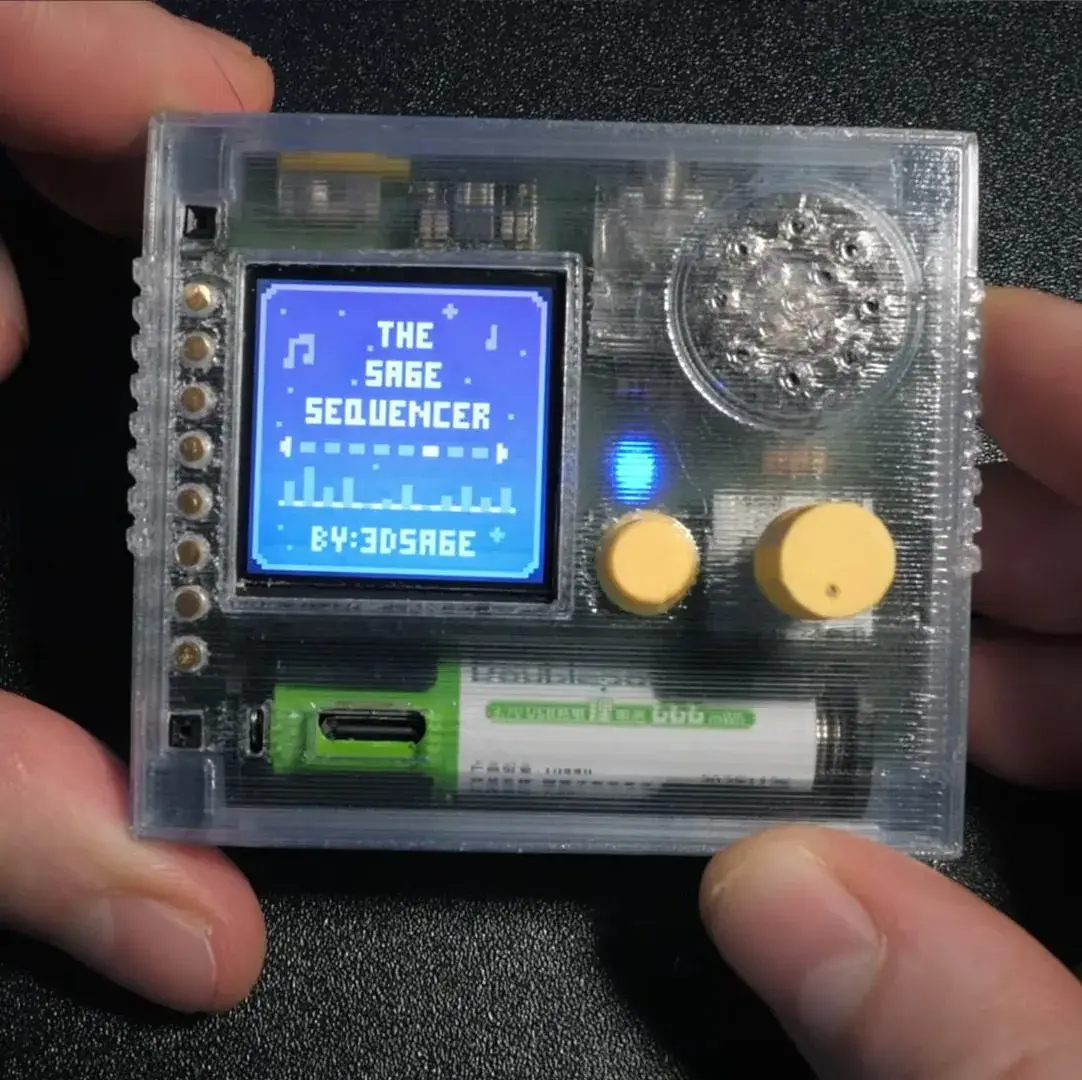
An ESP32-S3 module with a built-in display runs the device. A rotary encoder handles most navigation. But a row of brass rods along the custom PCB also works as a touch note input, closer to a tiny Stylophone than a conventional keypad. 3DSage fabricated that PCB with a fiber laser.1
Nothing stays hidden
The enclosure is printed in clear PETG. Getting useful transparency from FDM printing requires hotter, slower printing and carefully aligned extrusion paths. A clear enamel coat then fills some of the surface texture.1
That visual constraint reaches the components. The 3.7 V, 666 mWh lithium cell is packaged to resemble an AAA battery. In an opaque case, the joke would barely matter. Here the power source is visible, so it becomes part of the object language too.1
The same reasoning produces the project's strangest coherent detail: the sequencer becomes a slap bracelet. Its spring is not a bespoke mechanism. It uses a length of steel measuring tape, whose cold-worked curve already wants to wrap around a wrist, covered in clear tape so the wearable instrument is less enthusiastic about cutting its owner.1
The project does not prove that instruments should be transparent or wrist-mounted. It demonstrates something more reusable. When an aesthetic constraint arrives early enough, it can shape mechanics, components and gestures instead of becoming a skin applied after engineering is finished.
One machine, many gestures
The encoder is not the only input. Brass rods give direct access to notes while a separate button completes the controls. On the output side, the audio jack includes switching that routes sound to headphones or the internal speaker automatically.1 Each decision is ordinary in isolation. Together they keep every action from being forced through a menu on a tiny screen.
That distribution fits the object. A note benefits from an immediate gesture. A parameter can live behind an encoder. Listening can switch mechanically when headphones are inserted. The interface is not one rectangle that every part of the device has to obey.
The builder's video is the most direct primary source for assembly and operation, but its transcript could not be retrieved during this run. The details here therefore stay with what could be verified in Hackaday's description and visible demonstration, without manufacturing quotes or timestamps we could not check.12
The device also makes a useful distinction between retro appearance and retro construction. The visual references come from translucent consumer electronics and slap bracelets, but the implementation uses an ESP32-S3, a lithium cell, a custom PCB and modern additive manufacturing. Reproducing an old visual language does not require reproducing the old production stack. Here, the newer tools are what make the old-looking object practical to build in one workshop.1
The result looks Y2K, but nostalgia is not the useful part. The style stopped being graphic decoration and became a fabrication constraint.