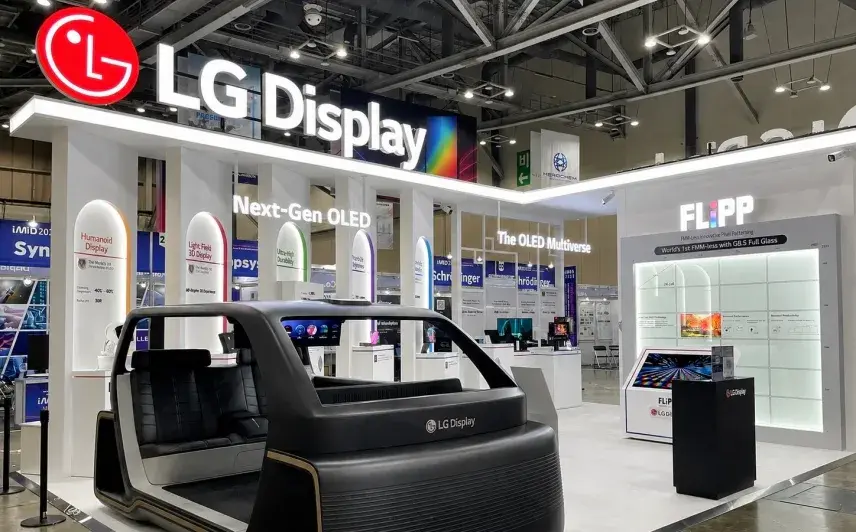
LG Display calls FLiPP a dream OLED technology, with suitably dramatic figures attached: 1.6 times the brightness, 2.4 times the lifetime and 13 percent less power.1 Yet photolithographic RGB OLED patterning already has a history elsewhere, from Japan Display's eLEAP to Visionox ViP and Applied Materials' maskless MAX OLED system.234
So what deserves attention here? A sheet of glass.
LG says it has made its FMM-free RGB OLED on a full Gen 8.5 mother glass, whereas the metal-mask route normally forces these large substrates to be divided before pixel deposition; that sounds less exciting than a new kind of pixel, but for a factory it may matter much more.1
The stencil
Conventional RGB OLED production needs separate red, green and blue organic materials in precise places. A Fine Metal Mask, or FMM, works as a stencil: an extremely thin metal sheet full of tiny openings lets organic vapor reach only the intended parts of the substrate.1
The method is established on smaller substrates, but increasing the size of the glass brings mechanics back into the problem: LG points to masks sagging under their own weight, complicating alignment and potentially mixing colors, while every new panel size or resolution also needs a suitably designed mask.1
Behind the manufacturing jargon sits a very physical size limit: eighth-generation mother glass is roughly 2.2 by 2.5 meters, larger than FMM “sticks” can conveniently cover, so the sheet is split before deposition and the stencil becomes the bottleneck.1
After deposition
FLiPP reverses the patterning logic. LG says the RGB materials are coated in sequence, secured in position, then patterned with photolithography using UV light and etching to erase unwanted areas.1
That description sounds familiar from semiconductor fabrication, but OLED materials make the transfer awkward. They are sensitive to water, oxygen and process conditions; Visionox specifically discusses UV sensitivity when explaining why its own ViP route needs protective structures and layers.2 Applied Materials likewise emphasizes depositing and encapsulating fragile OLED material without exposing it to the surrounding environment.4
LG's announcement stops before the most interesting process details. We know FLiPP combines RGB deposition with photolithography, while the public material leaves out the exact protection, resist, encapsulation and removal sequence that lets those operations repeat without damaging colors already on the glass.
That omission does not undermine the demonstration. It merely suggests the interesting know-how lives deeper than the word “photolithography.”
Full sheet
LG's clearest claim concerns scale: the company presents itself as the first display maker to manufacture an FMM-free OLED on a full Gen 8.5 mother glass, drawing on infrastructure developed for large Tandem WOLED production.1
With an FMM, the large sheet has to be divided. Removing that stencil lets LG pattern the whole glass first, and the company reports up to 64 percent higher mother-glass utilization efficiency for laptop panels of the same size compared with the divided-substrate processes in its comparison.1
That distinction matters because “64 percent more efficient” neither means the old process discarded 64 percent of its glass nor promises a 64-point rise in production yield; LG is reporting a relative panelization and substrate-utilization gain for one comparison, and without the cutting map, panel dimensions and defect rates, converting it into a cost per display would be guesswork.
Big numbers
The same caution applies to panel performance, where LG attributes an approximately 55 percent improvement in aperture ratio to FLiPP, meaning the portion of each pixel occupied by the RGB light-emitting regions.1
The wording is easy to misread: LG says the aperture ratio improves by roughly 55 percent, rather than giving a final aperture ratio of 55 percent. If a reference panel starts at A, the statement implies about 1.55 × A; the release never gives A, so neither will we.
More emissive area gives a panel designer room to trade among several objectives. In LG's same-condition comparisons, FLiPP can reach 1.6 times the brightness, 2.4 times the lifetime and 13 percent lower power consumption.1 Those remain manufacturer figures, with no independent high-volume production dataset attached to the announcement.
Those numbers should not be stacked into one miraculous retail panel, because extra emitting area can be spent on brightness, used to lower current density at the same brightness, converted into longer life or traded for lower power; a commercial product will choose a working point among those margins.
Already maskless
FLiPP did not appear in isolation. Japan Display describes eLEAP as maskless deposition followed by photolithographic pixel formation, claiming an aperture ratio above 60 percent for its 300 ppi reference.3 Visionox is more explicit about its ViP sequence: full-surface deposition, encapsulation, photolithography, then another cycle until all three colors have been formed.2
By contrast, Applied Materials takes another maskless path with MAX OLED, integrating selective deposition and encapsulation in a vacuum system intended to scale to Gen 8 substrates and beyond.4
Removing FMM is therefore an industrial direction, not an LG-only idea. Similarities at this level are also insufficient to declare FLiPP a renamed eLEAP, ViP or MAX OLED. OLED-Info noted in late July that any relationship between LG's process and eLEAP remained publicly unclear.5
The comparison is useful for a different reason: several manufacturers are trying to remove the same bottleneck, using architectures and equipment chains that cannot simply be treated as interchangeable.
Factory test
LG says FLiPP could theoretically cover displays from 1 to 100 inches, starting with tablets and monitors before expanding toward wearables, VR/AR and TVs.1 One piece of information still separates a successful process demonstration from an industrial revolution: when does commercial production start, on which line, at what yield and at what cost?
As of August 21, The Verge noted that LG had announced no production timeline or product release date.6 To be sure, that silence is normal for technology unveiled at an industry conference, but one successful mother glass still tells us nothing about daily yield or cost per finished panel.
This is why the sheet size makes a better story than “2.4×”: performance numbers can still shift with materials and operating targets, while full-sheet processing attacks the problem that FMM makes structurally awkward, producing many large RGB OLED panels with the same patterning tool.
If FLiPP survives the yield and cost test, the change will not first appear as a mysterious new setting on a television. It will show up in how a factory aligns, patterns and uses a sheet of glass several meters across. As manufacturing stories so often insist on demonstrating, the least photogenic part is usually the one that decides whether a dream technology leaves the exhibition booth.