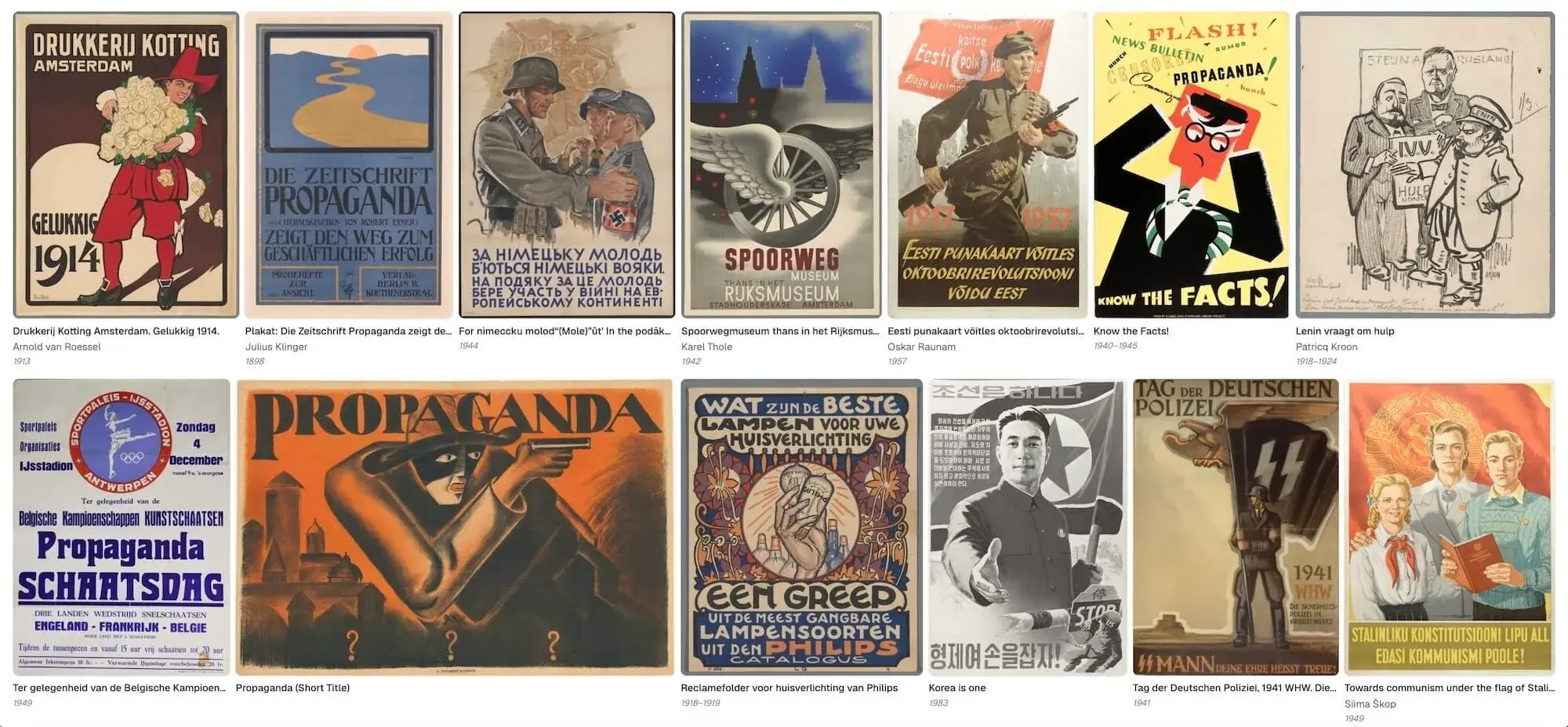
Searching a museum collection usually assumes you already know something: the artist’s name, the title, the period, the institution.
The Last Museum tries the opposite order.
You can give it an idea, a subject, a style or simply a description, then browse results across museum collections that do not all use the same catalogues or interfaces.1
The site says it currently indexes around five million artworks.1
One bar, thousands of collections
The Last Museum describes itself as a search engine for museum art. Its search is semantic: it accepts themes, styles, subjects, moods and free-form descriptions.1
For a creator, that changes the job.
A conventional search works very well when you already want “Hokusai Great Wave.” It becomes less comfortable when the query is closer to “tiny figures in enormous landscapes,” “red domestic objects,” or “hands making something.”
Those prompts look more like the beginning of a moodboard than a bibliographic search.
The institution list shows the scale of the aggregation. The British Museum, Rijksmuseum, Metropolitan Museum of Art, National Gallery of Art, Cooper Hewitt and many specialised collections appear inside the same index.2
Colossal reported more than 290,000 artists and 4,903 museums on August 11.3 Those numbers are moving targets, so they are better understood as a snapshot than as permanent constants.
Back to the museum
The Last Museum does not replace museum catalogues.
Each artwork links back to its original source when that source is available.1 That matters for two reasons: the institutional record is still what you should verify, and an image does not magically become reusable because a search engine indexed it.
The site says this explicitly. Many works are in the public domain, while others remain protected. Presence in the index is not permission to reproduce them.1
That detail matters for designers, publishers and tattoo artists who use public collections as visual research. “I found it on a free website” remains a spectacularly poor copyright licence.
Across the silos
Museums have already digitised enormous parts of their collections. The problem is not simply the absence of images.
It is fragmentation.
Each institution has its own categories, fields, search engine and sometimes its own naming or dating conventions. The Last Museum adds a common discovery layer across those silos.12
For academic research, you still need to return to the original records and precise metadata. For an exploratory creative phase, the shared layer can be much faster.
You no longer start by choosing the right museum.
You start with the idea you are looking for.
Only afterwards do you discover where the object has been catalogued for the last two hundred years.