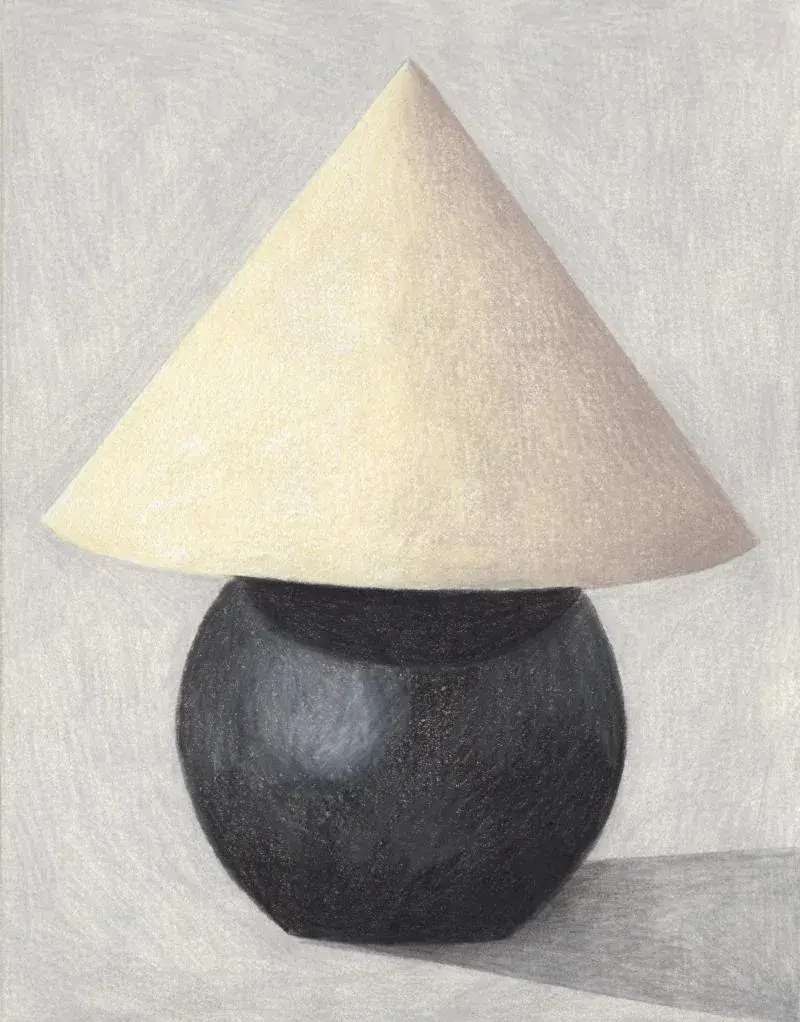
A clothes peg can receive the same attention as a collectible piece of furniture.
That shift runs through Julie Jonquet-Caunes's drawings. The Paris-based illustrator isolates envelopes, buttons, clothes and design objects, then treats them almost like portraits.1
The finished work looks carefully controlled. The process starts somewhere messier: a large folder of images.
Compose before drawing
Jonquet-Caunes says she gathers references from gallery websites, curiosity shops and social media. She then moves those images around digitally until shapes, colours and functions begin to respond to one another.1
Only then does the pencil take over.
It separates two problems that are easy to collapse into one: finding a composition and making the final image. Digital collage becomes a temporary assembly table. Drawing rebuilds the collection in one visual material.
Her portfolio shows that this approach crosses illustration, editorial work, identity and drawing.2
Clothes peg, design icon
Her Objets trouvés series makes the hierarchy especially visible. Clothes pegs, buttons and envelopes appear alongside objects by Charlotte Perriand and Jacques Adnet.1
The ordinary object suddenly gets the time usually reserved for the signed one.
That attention also has a biographical source. Before going freelance, Jonquet-Caunes spent five years at an auction house designing catalogues, invitations and exhibition signage. She says daily contact with collections deepened her interest in objects, materials and form.1
Scale changes the object
For wallpaper company Bien Fait, she enlarged dominoes and seashells into room-sized patterns. Another still life, inspired by Cézanne, reached roughly a metre and a half, far beyond her usual small scale.1
So the work is not simply careful realism. Scale is another editing tool.
A tiny thing can become architectural. A design icon can lose some of its hierarchy when it shares a sheet with a clothes peg. And the reference folder, that digital mess normally hidden from view, becomes the first workshop of the drawing.