In 2023 Holly Thomas, a London-based illustrator, travelled alone into the Colombian Andes.2 Her father had died two years earlier. She took a diary and wrote as the days arrived: quickly, at length, without much tidying. She describes stream-of-consciousness entries with long sentences bleeding into one another through repeated “ands”.1
A few weeks later the notebook came back out in the studio. That is where it stopped being the plan for the work. Thomas did not convert every entry into a scene: she lifted text, moved it around, then built acrylic, gouache and pencil images around what survived.1
Changing medium does more than add pictures. The notebook preserves flow; the comic decides what becomes adjacent.
The diary moves
A diary can wander all it likes and still keep one stubborn property: time moves forward. One page pushes the next along. Tuesday remains before Wednesday even when a sentence suddenly reaches two years back.
Thomas describes the material herself as stream of consciousness: long sentences, repeated “ands”, little apparent interest in landing neatly.1 The notebook is valuable here because editing has not happened yet.
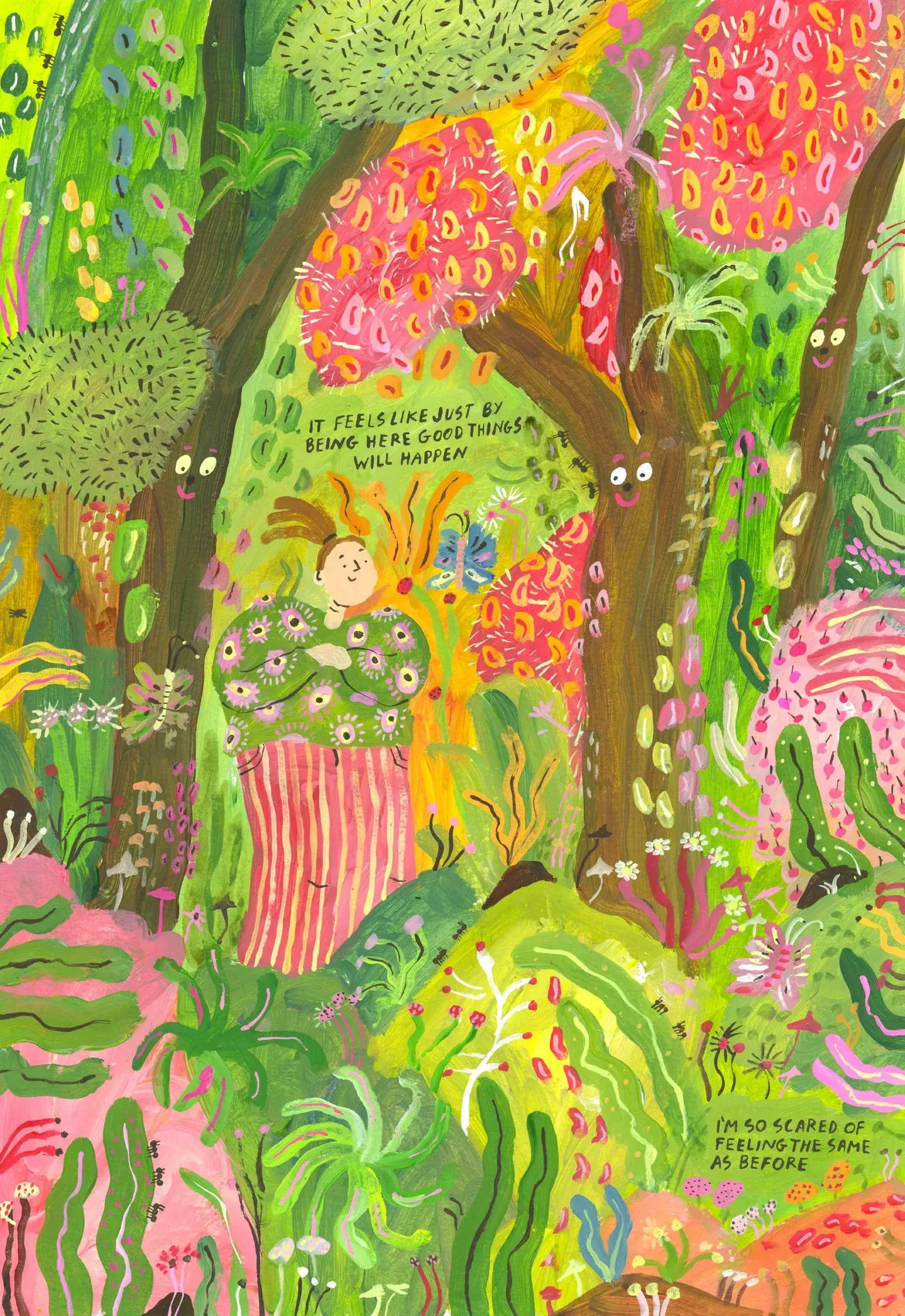
The trip itself holds incompatible things. Thomas remembers the intensity of the Andes, insect noise, birds, plants and flowers. She says the bright colour in the later drawings was an attempt to document the feeling of being surrounded by so much life.1
Grief does not replace that beauty. It arrives with it.
Looking back at the finished project, Thomas says she was struck by gratitude and joy sitting directly beside fear, darkness and grief.1 Comics let her keep that adjacency instead of rewriting it as a tidy emotional progression.
Cut, don't clean
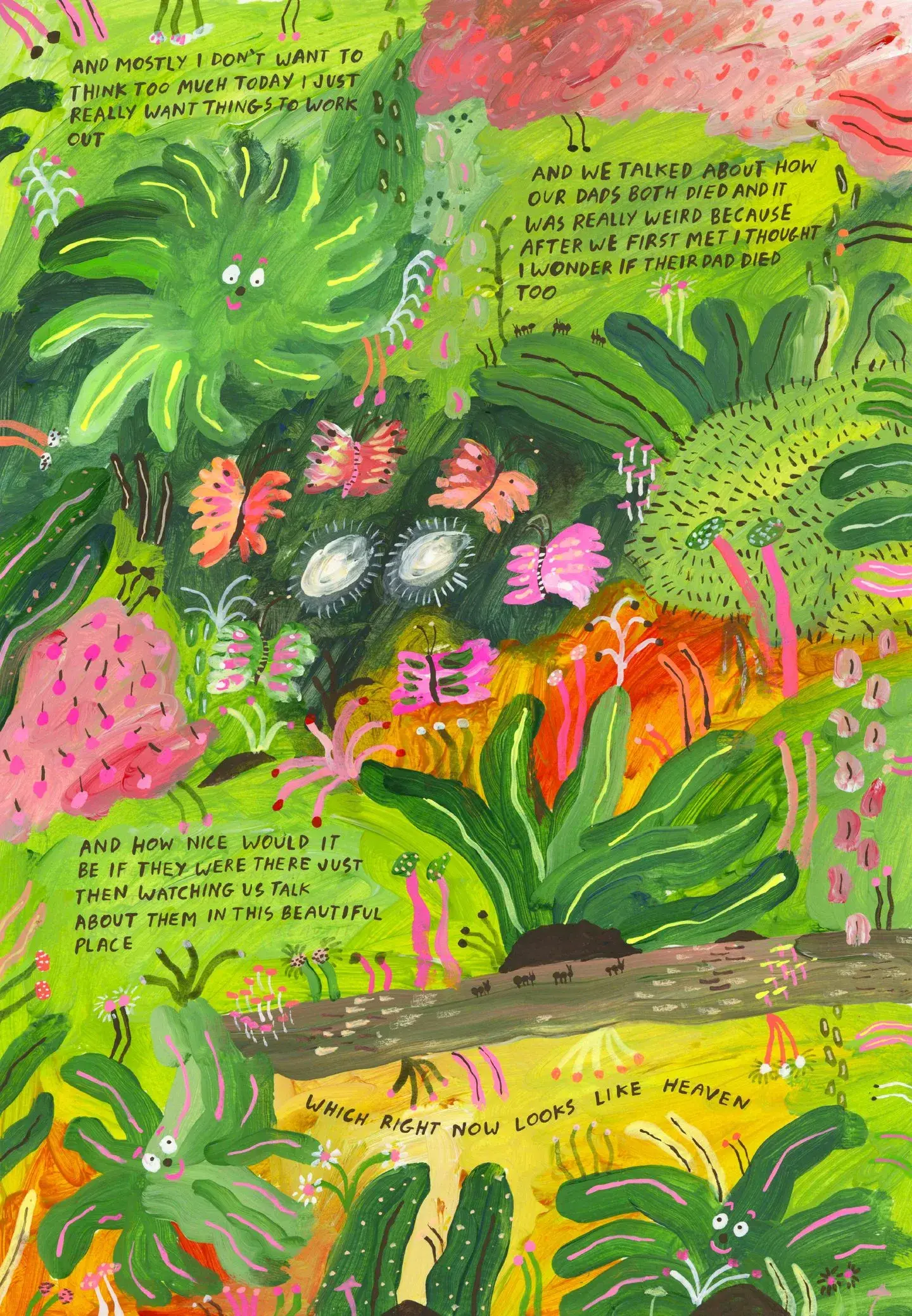
The next operation matters: Thomas takes snippets of text directly from the diary and writes them into the images.1
This is not full transcription. Selection has happened.
Once a diary becomes fragments, an artist can place two moments together that were separated in the notebook, enlarge a tiny sensation, remove a transition, or make a sentence sit against an image that does not literally illustrate it.
That cut is part of how graphic narrative works. Annemarie Jutel describes segmented stories that ask readers to bridge both the spaces between panels and the words and images within each panel.3 Neil Cohn likewise shows page layout guiding the reading path; spatial arrangement contributes to sequence.4
Two tools appear: cutting and coexistence on the page.
A sentence can end at the edge of a panel. The next image is already sitting in peripheral vision before the eye properly reaches it. A gutter separates two states without sending either very far away.
Thomas uses this capacity without presenting it as a theory. Her observation is simpler: in the finished project, bright and dark moments seem to amplify one another.1
Two timelines
A well-edited autobiographical work can make the source material look tidier than it ever was. Coherence in the finished object leaks backward into our idea of the experience.
The dates resist that reading. Her father died roughly two years before the 2023 trip, so this was not an immediate flight after bereavement. It was simply her first solo trip since his death.1
The comics then began in the weeks after she returned.1 There are at least three times in play: the older loss, the present-tense trip and the studio revisiting the diary afterward.
The drawing therefore arrives after the fact. It does not record the trip like a camera; it revisits it from the studio.
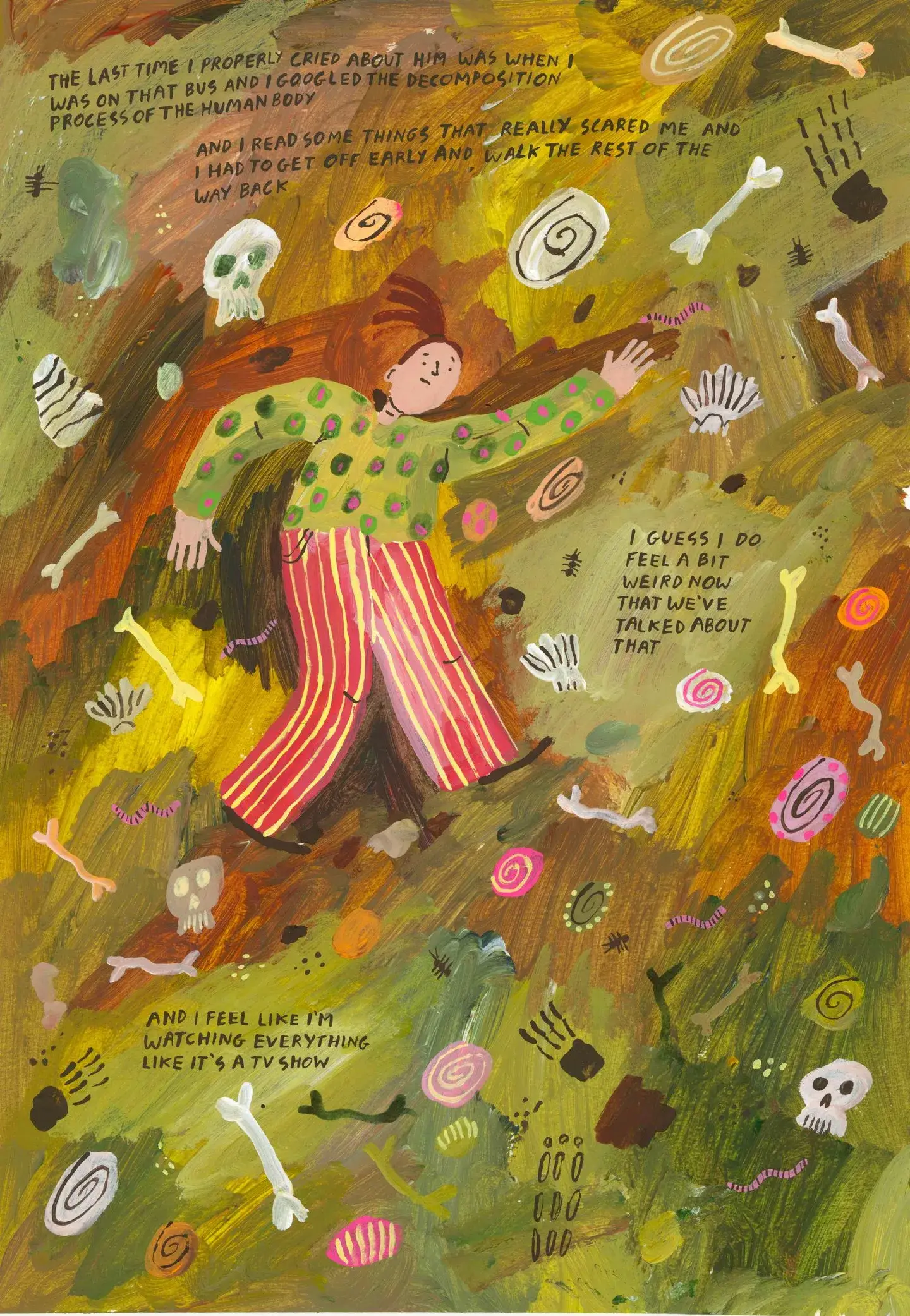
That distance also makes room for observation to meet imagination. Thomas cites magical realism and Isabel Allende's The House of the Spirits. One image shows her buried underground among skulls and fossils. She says drawing and writing about frightening things helps make them less frightening for her.1
There is no need to inflate that testimony into therapy. Thomas is describing her own use of drawing; these sources tell us nothing about what the same method would do for somebody else.
Research on graphic memoir offers a more modest formal explanation. Amelia DeFalco notes that words, images, temporalities and perspectives can be layered without collapsing into one synthesis; graphic memoir can preserve ambiguity and even conflicting attitudes.5
That is exactly what Picking up a Toad can do. The project does not have to decide whether the trip was happy or sad before telling it.
Grief isn't the plot
The colours can mislead a quick reading. These pages are full of green, pink and living forms. Thomas says those colours came from the intensity of the Colombian landscape, not from a strategy of disguising grief under cheerful illustration.1
The reverse is equally important. Grief does not turn every plant, insect or animal into a death symbol.
The series keeps both registers alive.
Comics have already carried experiences of loss, including research work on perinatal bereavement and its aftermath.6 Thomas is not inventing the form as a place to talk about death.
Thomas's specific move is elsewhere: she keeps the ordinary travel material. The toad, plants, fear, beauty, memories and death stay inside the same visual world.
A reusable method
What transfers from Picking up a Toad is less the palette than the editing move.
1. Capture before understanding. The diary records experience with imperfect syntax and repetition. It does not need to know what story it is preparing.
2. Work from a second situation. Thomas does not draw every recorded moment as it happens. Returning home creates distance between note and image.1
3. Select fragments instead of summarising days. A surviving sentence becomes its own unit. The rest may disappear.
4. Compose through adjacency. Comics can place fragments next to one another even when they serve different emotional functions.
5. Refuse the fake ending. A coherent artwork does not require claiming that the experience itself resolved neatly.
Thomas says grief is still difficult to talk about, even though making the comics helped her put into words things she had previously struggled to express.1
That line is useful precisely because it leaves the story open.
The comic did not turn the diary into evidence that a stage was complete. It gave its fragments a different geography.