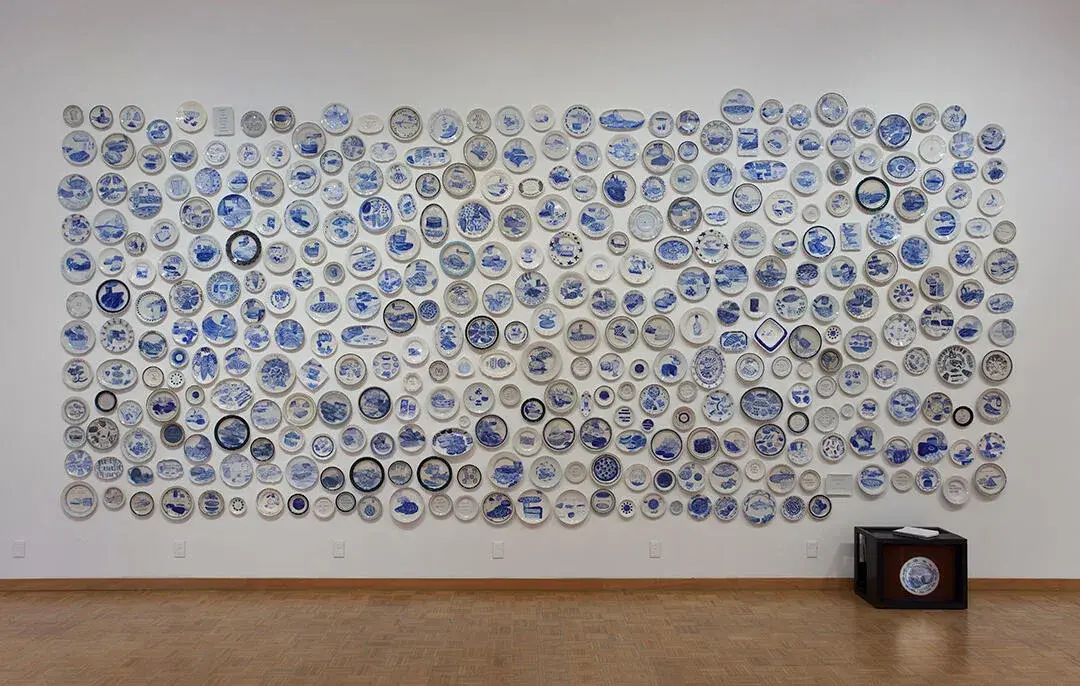
A Julie Green plate does not display the name of the person who was executed.
It gives you a state, a date and a meal: six tacos, six glazed doughnuts and a Cherry Coke, a pizza, a birthday cake, or sometimes no choice at all.1
Green repeated that protocol for twenty-two years, and The Last Supper, begun in 1999, entered the Crystal Bridges Museum of American Art collection as a work of 1,000 plates with four replacements.3
The number is striking, but everything Green chose not to add may be the more interesting decision.
Without names
Green gathered last-meal requests from prisons, books and newspapers, then arranged the plates alphabetically by state and chronologically within each state. The installation supplied the date, state and meal request, but not the prisoner's name.1
For an archive, the choice is unusual: a conventional record would normally demand more fields such as name, age, case, jurisdiction, sentence, appeals and execution details. Green almost does the opposite, removing the most obvious identifier while one small detail of ordinary life remains.
A meal alone can establish neither innocence nor guilt, summarise a crime nor reconstruct a legal case; it simply puts something back into the image that capital punishment can make abstract: a person still had hunger, preferences, habits and family memories.
Green put the aim plainly: “For me, a final meal request humanizes death row.” The menus, they added, could hint at region, economic background or family history.1 The project does not claim that a menu contains an entire person. It works through the disproportion between an ordinary detail and an irreversible act of the state.
Cobalt blue
The constraint is material as well as documentary: Green worked on second-hand ceramic plates, where food was painted with cobalt-blue mineral pigment and the pieces were fired again in a kiln.6 In the project's statement, Green specifies a firing temperature of 1,400 degrees Fahrenheit and credits Toni Acock and Sandy Houtman for that stage.1
The result immediately recalls blue-and-white tableware, while Green described painting as their primary medium and ceramics as an inversion of historical Greek pottery: the plate already exists, while the painting takes over the surface.2
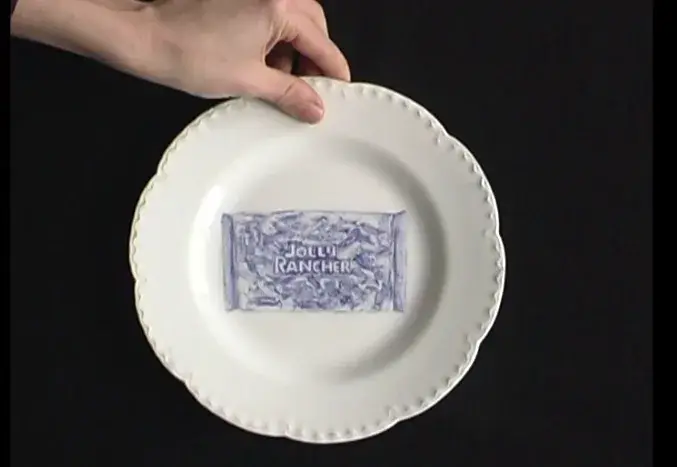
This visual economy avoids an obvious trap because one thousand separately styled works could have become one thousand displays of technique; Green keeps the grammar stable instead: found plate, white ground, cobalt, fire.
Variation comes from the meals and shapes of the dishes, not from a permanently changing style.
A harsher rule made those material accidents permanent: Green wrote that a plate was not redone after firing and, in a 2021 statement, mentioned one “very bad polish sausage” kept among the 895 plates made at that point.2
Twenty-two years
Repetition changes the scale of the work.7 An exhibition contained 152 plates in 2002, the 2013 catalogue collected 500, and a Bellevue Arts Museum presentation showed 800 in 2021.5 Green devoted roughly half of each studio year to the series and planned to add fifty plates per year until capital punishment was abolished or the work reached one thousand pieces.1
Cancer changed the exit condition, so Green decided to finish at one thousand plates in 2021, shortly before their death.5 Crystal Bridges now holds the work, dated 1999-2021, and lists about 1,200 square feet for a complete installation.3
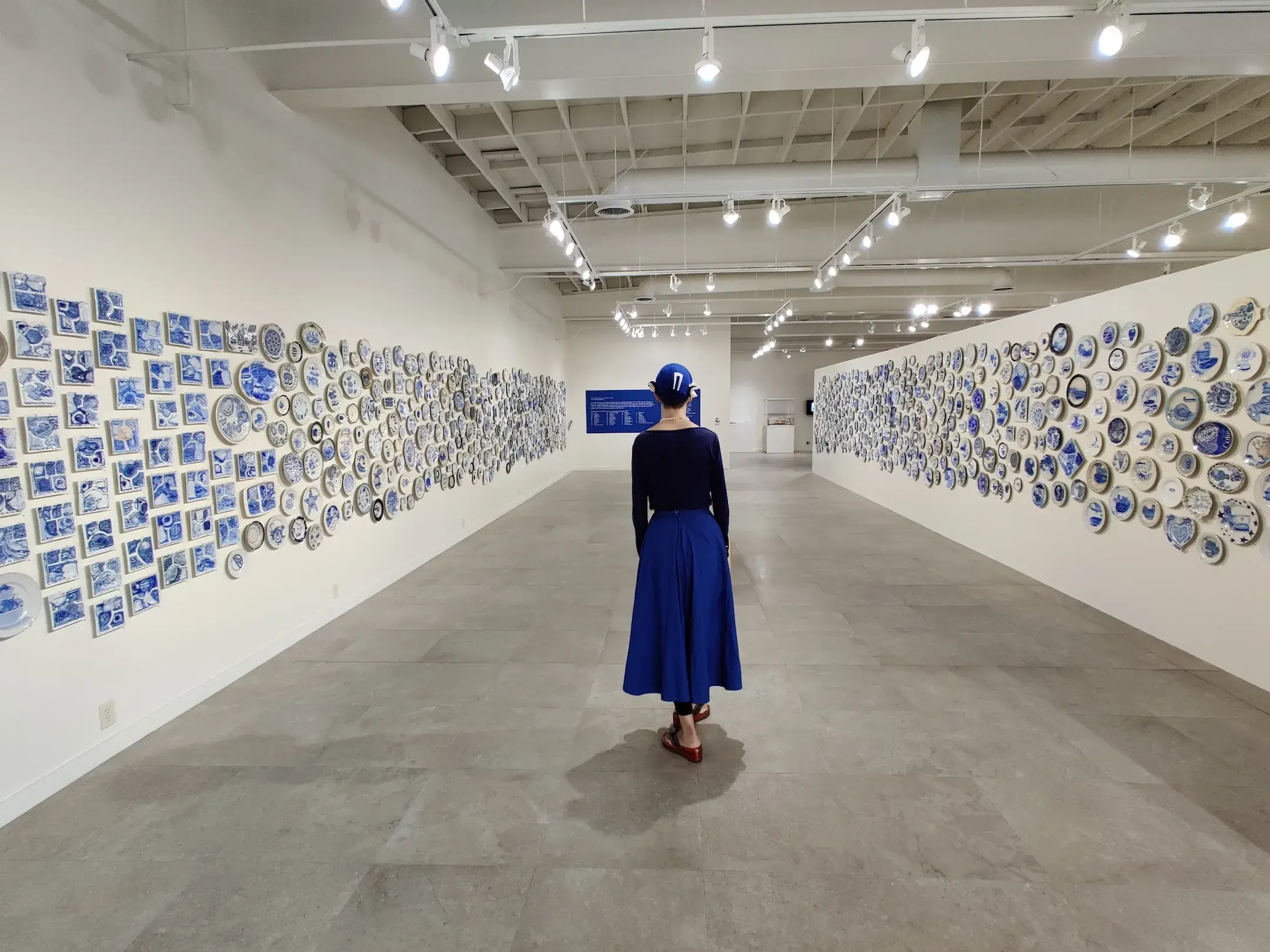
At that scale, the project changes character: each plate remains legible alone, while a thousand together produce the sense of a system.
Boise Art Museum, which showed all available plates from late 2024 through January 2026, organised its guide across six walls running from plates 1 to 1,001.4 The unit remains domestic even as the accumulation becomes architectural.
What is missing
The method has blind spots too: a last meal can be carefully documented, poorly documented or prohibited. Texas ended special last meals in 2011 after a large request went uneaten; Green represented a standard prison menu when no choice was offered.1 The archive therefore depends on prison policy and on what institutions chose to make public.
The protocol also removes a great deal of context on purpose, a visually powerful choice that becomes misleading if the plates are mistaken for legal case files rather than artworks built from selected records.
Green did not pretend the response was comfortable; Smithsonian notes criticism from people who thought the work was too sympathetic toward people convicted of serious crimes, while others accused the artist of profiting from capital punishment. Green said the project was not for profit and returned to the shared human ritual of eating.5
The series cannot settle the death-penalty debate, but it makes that debate harder to compress into a number; Green's own question after two decades was still, “Why do we have this tradition of final meals?”1
The underlying issue has not disappeared: Amnesty International recorded 47 executions in the US in 2025, while at the end of that year 23 states had abolished the death penalty for all crimes.8
One rule works
For a maker, the transferable part of The Last Supper is not “make an activist artwork with a thousand objects”, which would be a remarkably lazy conclusion.
It is this: an archive becomes readable when its transformation rule stays stable long enough for differences to speak.
Green starts with repetitive administrative information, selects a few public fields, passes every record through the same physical format and preserves the differences between cases, repeating the procedure for twenty-two years.
The same logic could be applied to repaired objects, field notes, receipts, broken components, workshop gestures or manufacturing failures. The useful question concerns what to preserve, what to remove and which rule can remain unchanged long enough for the series to reveal something a single object never could.
For Julie Green, that rule fits on a plate, and its force arrives with the thousandth repetition.