Frank Kunert's photographs usually start with something almost believable: a running track leads into a staircase, a small room sits under an overpass, and a facade holds together for a moment before one detail makes the address impossible to live in and leaves the whole building suspect.35
The final object is a photograph, so the label surreal photography is fair enough, only a little late. By the time Kunert uses the camera, the main deception has already been made by hand.
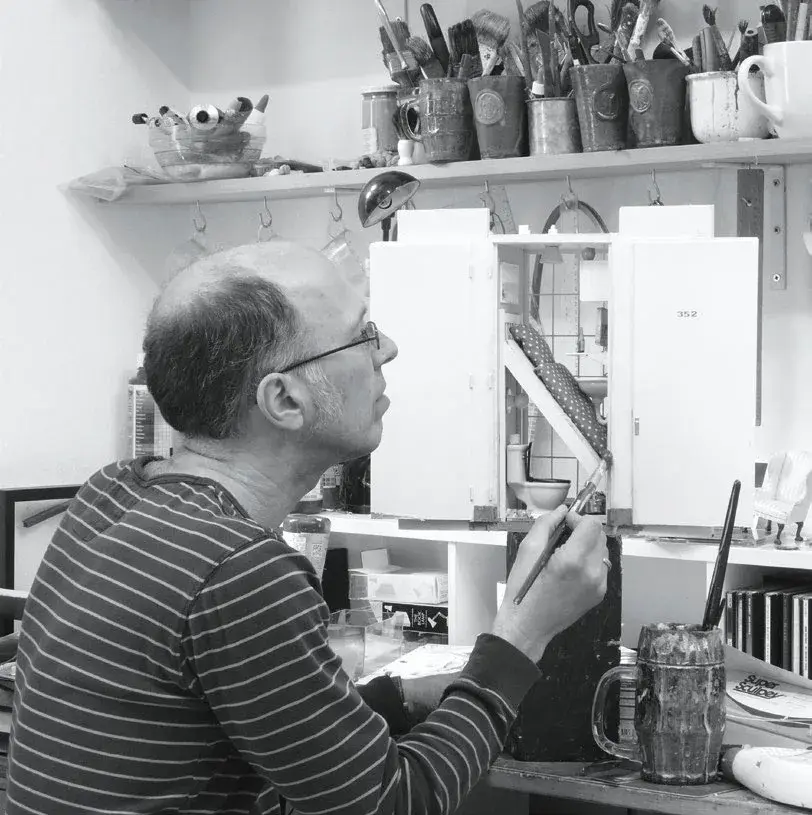
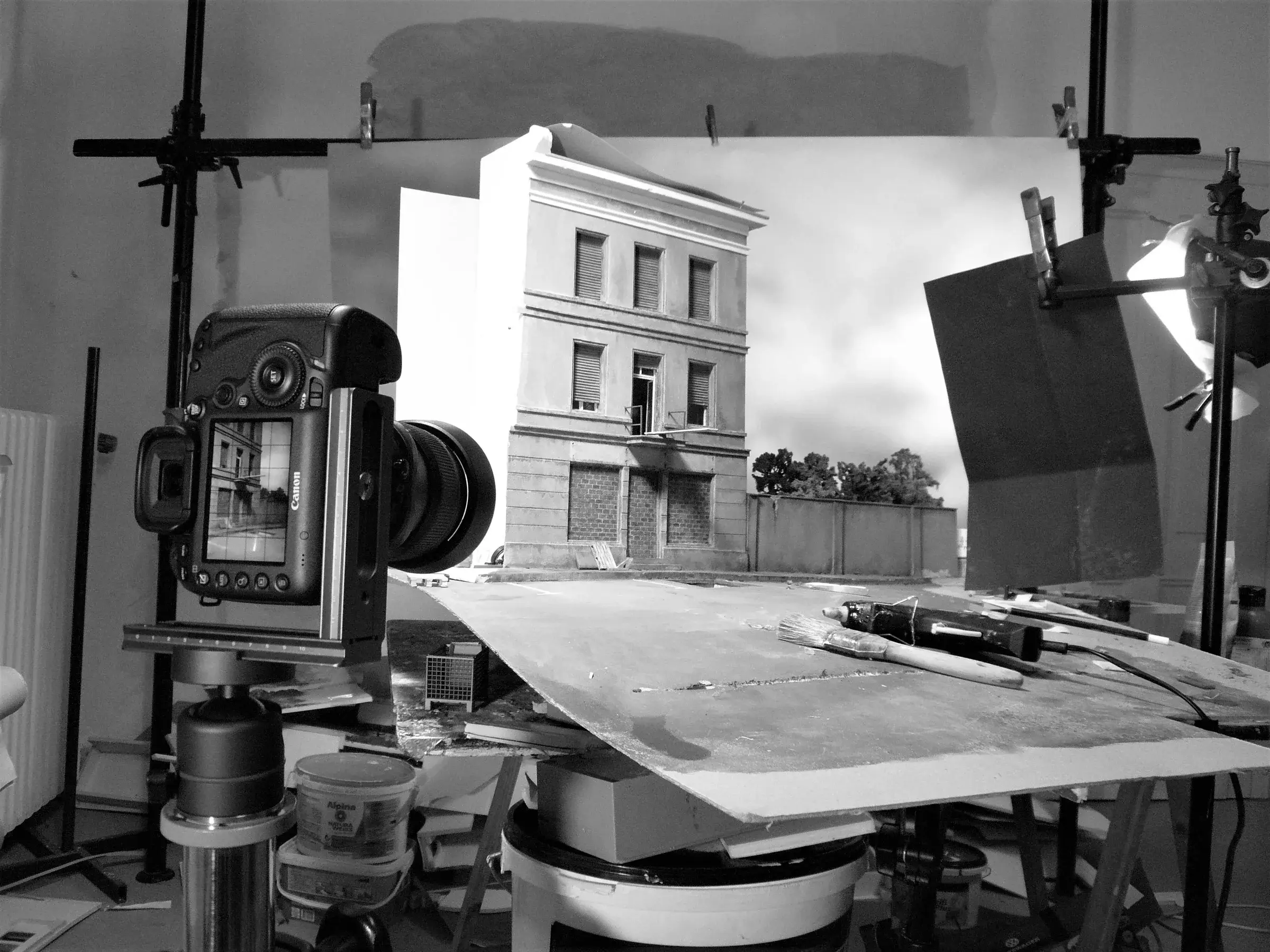
His work and biography page explains the part a quick look through the images can miss: lightweight foam boards are cut, glued, painted and varnished, and floors are laid, windows installed, furniture made, curtains hung, tiles fixed, trees planted, and walls and backdrops painted.1 The optical trick begins on the table, before it becomes an image file.
Table first
Kunert was born in 1963 in Frankfurt am Main, trained as a photographer, and says he has kept a strong attachment to studio work.1 This matters: rather than renders trying to look photographic, these are photographs made by someone who has moved the studio inside a model.
His site gives the scale of the works as 1:12 to 1:43, where ordinary materials can change jobs while keeping some of their old shape.1 A household-cleaner cap can pass as a trash can, salt can read as snow, cotton can turn into cloud or steam, and a doily can become a curtain.1
The miniature format works by loosening an object's usual identity through scale. Kunert gave WIRED a clear version of this freedom in 2018: "I realized how fascinating it is to shrink the world and play with perceptions," he said, since the reduced world let him make scenes that could not exist in the same way at full size.3
In a 2025 interview with Hatje Cantz, Kunert says ideas first enter a sketchbook, sometimes for months or years, before he feels ready to realise them in three dimensions.2 Even at this stage, he does not always know exactly what the scene will become, since the final composition and the atmosphere produced by light settle during the making, closer to bench work than to the execution of a finished plan.2
Seen from there, the model stops being a support object for the photograph and becomes the place where the idea gets precise enough to be photographed.
Worn realism
The scenes work because they do not declare their impossibility too early, which is harder than it sounds when the whole image may depend on one controlled architectural mistake.
Kunert told Hatje Cantz that when he began making small scenes in the 1990s, he populated them with clay figures. As the backdrops became more realistic, he realised they could speak for themselves, and the people gradually disappeared.2
This absence is both a fabrication decision and a narrative one. A figure would risk exposing the model too fast, while a tired facade, a glass left on a table or a wall with the right patina suggests something quieter, as if use has just passed through.
Kunert actively looks for those traces of ageing, and he even says he can feel irritated when a familiar old house is renovated and loses its patina.2 In the miniatures, that wear is rebuilt rather than found: paint accumulates, drips, flakes, and construction errors are accepted because they create detours in the process.1
Realism, in that sense, does more than show miniature virtuosity; it buys time by postponing the instant when the eye understands that the scene is wrong.
WIRED describes that delay neatly: many photographs first resemble ordinary domestic scenes, then one detail breaks the contract, from a cradle mounted on a motorcycle to an upright piano shaped like a dumpster.3
Nobody, everywhere
The other important choice is the lack of bodies, although the rooms do not feel empty.
Kunert says people are physically absent, but their traces remain: a glass on a table, rubbish left behind, a scene apparently waiting to be reoccupied.2 He describes the photographs as stage sets onto which viewers can project their own thoughts and fantasies.2
Here, the making and the subject meet, because a conventional model can show a house while Kunert builds the aftermath of an absurd human decision: an unusable balcony, a room too narrow to inhabit, a door that promises too much, or a public space whose logic has slipped.45
The humour depends on precision. The deviation feels sharper, and sometimes nastier, when the set around it remains ordinary enough to pass for a useful room, a public facility or a tired bit of city.
designboom describes the mechanism as a kind of editable architecture: at full scale, a building has to negotiate gravity, access, construction and use. Reduced, it can keep the appearance of those rules while bending them.6 This may be the cleanest practical definition of Kunert's method: shrink the world, move one rule by a few millimetres, and the purpose of the rule suddenly becomes visible.
Slow on purpose
The work is also interesting for its refusal of efficiency, while avoiding the pose of a manifesto.
Kunert is not anti-digital. He says he has photographed exclusively digitally for several years, even though the basis of the work remains analogue.2 In the same interview, he acknowledges that his method may not look very efficient in a period of rapid AI development, and says this is exactly what attracts him: building with his hands, pausing, looking closely, and letting the process produce impulses he did not have at the start.2
That can sound like a romantic defence of handwork, although the point is more practical than nostalgic. The slow bench gives him chances to notice, correct and complicate the scene before the camera fixes it.2
Slowness composes as much as it fabricates, giving the scene time to gather the details that make it legible. A surface that is too clean would look fake, lighting that is too theatrical would destroy the banality, and a joke that announces itself too loudly would kill the double take.
Kunert is therefore building less a miniature than a trap for perception, and the photograph does not simply document this trap. It closes it.
For IRZ, that is the useful part: the spectacular object, the final image, depends on a chain of small material decisions. Before anyone sees impossible architecture, someone has to lay the tiles, dirty the wall, and wait until the light finally says where the joke is.