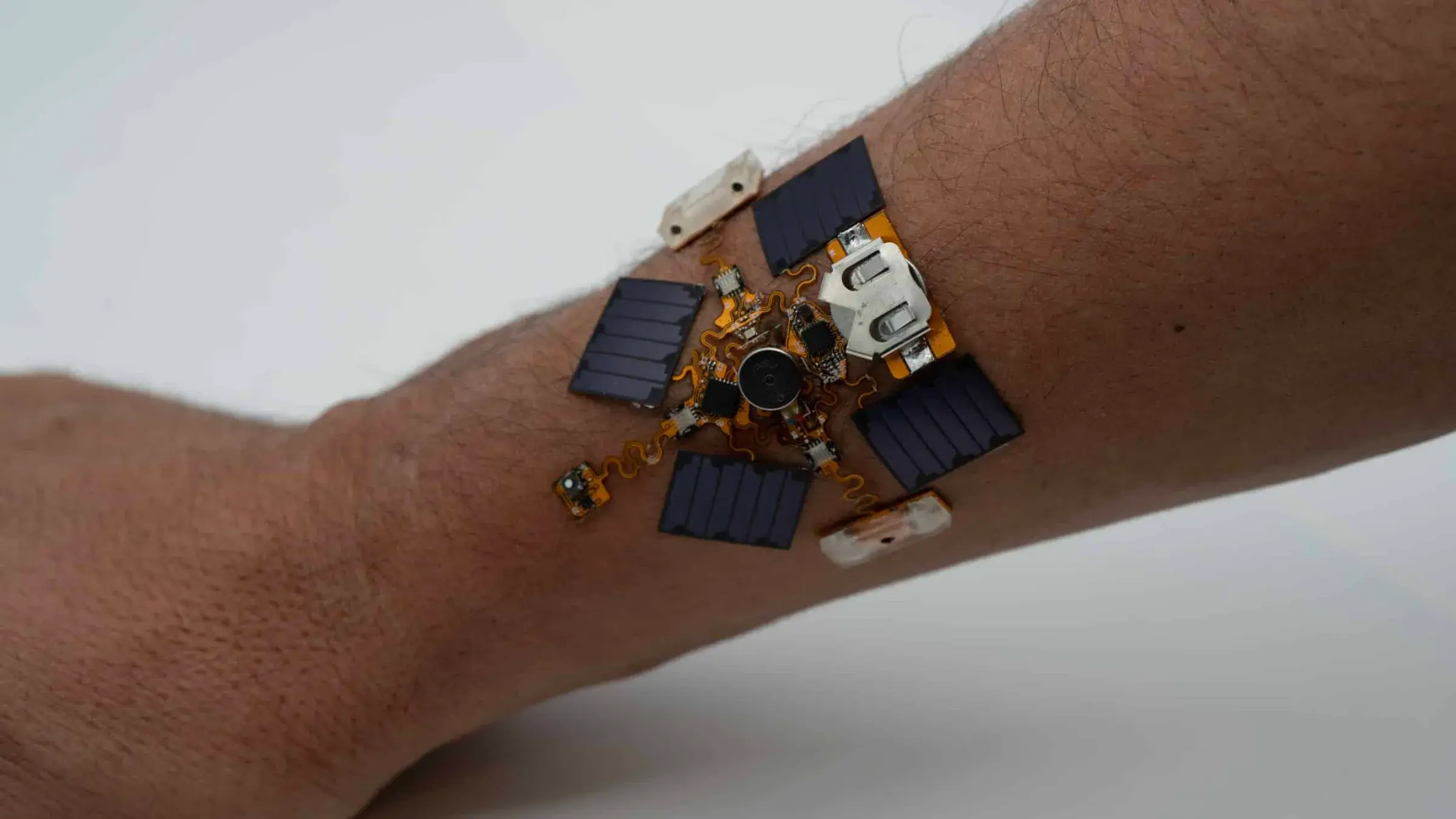
A sensor that detects a toxic gas and pings your phone already exists. The weak link sits at the other end of that chain: nobody checks their screen every thirty seconds, least of all wherever the air or water has just turned suspicious. A team at North Carolina State University went after the last mile instead. Their patch delivers a warning as vibration, against the skin, the moment detection happens.1
The work was published on July 24, 2026 in Device, a Cell Press journal.2 And it does not stop with humans: the same logic bolts onto a quadruped robot, which reroutes after “feeling” a chemical hazard.
Inside the patch
The object fits in a square slightly smaller than a driver's license. Inside sits a microcontroller acting as the brain, a small battery, sensors watching six environmental hazards, and a tiny actuator, the haptic motor that buzzes against the skin.1
The outer face adds an array of thin-film photovoltaic cells, harvesting solar power while the patch is worn.1 Three families of contaminants are in scope: gases, aerosols and waterborne pollutants such as heavy metals.12
On the manufacturing side, the team stresses an unglamorous but decisive point: the patch and its robotic sibling are built almost entirely from off-the-shelf components, with very few custom-engineered elements. The sensor array is also modular, so it can be swapped depending on the application.1
A chemical Morse code
A generic buzz would not cut it. Each detected hazard triggers its own “haptic sequence”, a distinct vibration pattern, which means you can theoretically tell a gas from contaminated water without looking at anything.1
That left a problem of human physics: a small motor pressed against skin is barely noticeable. So the researchers placed textured surfaces between motor and skin, a miniature pattern of bumps.
“By changing the size and spacing of those bumps, we could control how the vibration is perceived against your skin,” explains Oluwatobi Ojuade, PhD student and co-author. The goal: a sensation that grabs attention instead of feeling like a faint buzz you would learn to ignore.1
This detail reveals what the project really is. The patch does not merely detect; it communicates. Like any code, the tactile language must be learned by the wearer, and nothing yet proves six patterns stay legible mid-panic or through a jacket sleeve. Still, a portable chemical Morse code is a very concrete idea.
Sunlight as a reserve
In proof-of-concept testing, the device detected the targeted substances and immediately fired the haptic response. More importantly, energy harvesting extended battery life; combined with the low power draw of the sensors, it allows roughly 24 hours of operation.1
Twenty-four hours is no smartphone record. It is, however, a serious argument for off-grid use: a disaster zone cut from electricity, an isolated worksite, terrain you cannot leave to recharge anything. A poison detector that depends on a wall socket loses much of its value precisely where it would matter most.3
The robot's skin
During development, the team wondered whether the concept could serve robots too. Hence the “e-skin”: the sensor patch sits on top of a piezoelectric layer. When the sensor detects a hazard and triggers the vibration, that vibration presses on the piezoelectric material, producing an electrical signal the robot can read.1
In testing, this e-skin let quadrupedal robots detect chemical hazards and alter their routes to avoid them. The paper's abstract highlights the key detail: the robot decodes the temporal structure of the tactile codes, with no wireless communication involved.2
In a burning warehouse, a collapsed tunnel or anywhere radio networks fail, a sensor that transmits by contact rather than antenna deserves attention. First author Erim Uzunoğlu even owns up to a literary lineage: the team was partly chasing a real-life version of Dune's poison snooper, the novel's portable toxin detector.3
Not in your pocket yet
All of this remains a proof of concept, and the authors do not pretend otherwise.1 Several questions decide whether this object ever protects anyone:
real-world selectivity of the sensors against messy chemical mixtures, the false-positive rate daily use would tolerate, how the device survives days of wear and sweat, and whether a stressed human can actually tell six vibration patterns apart. None of those answers appear in the press release, and the full paper sits behind a paywall.2
There is also a paradox New Atlas points out with some glee: to detect anything, the sensor must be exposed to the danger. Sending your robot to check the patio before you step out suddenly becomes tempting, e-skin and all.3
The transferable part of the project goes beyond the gadget anyway. Most of our alerts land on a screen, a device you must pull out, unlock and consult. Here, information reaches the body directly, at the point of contact with the risk. For a treatment plant worker as much as for a response robot, that may be the real innovation: an alert that never asks to be looked at.