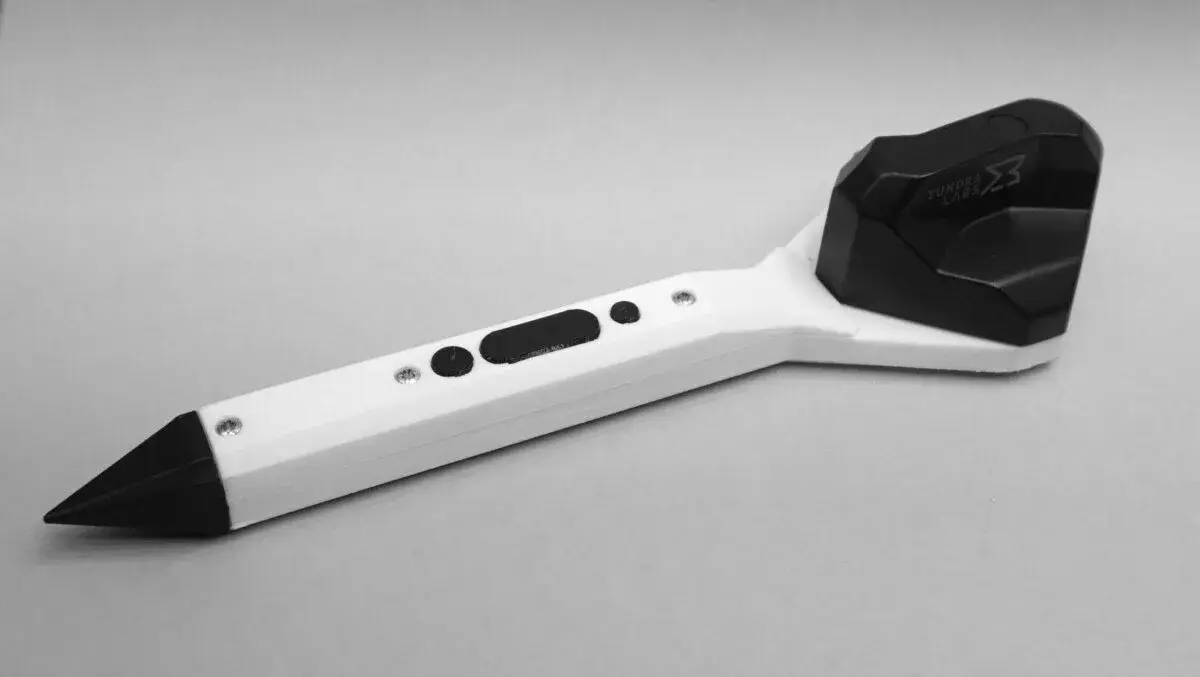
The original pitch promised a DIY 6-DoF spatial stylus for $155, while the primary project tells a more interesting story once its bill of materials and tracking dependencies are read together.
Krisjanis Rijnieks's Lighthouse Stylus has a dated, itemised bill of materials showing that, on April 5, 2026, the stylus itself totalled €151.28 before shipping,3 with €115.95 of that amount paying for one component, the proprietary Tundra Tracker from the SteamVR ecosystem.
Everything else is comparatively small in the project's summary, with €15.90 in 3D-printing material, €5.27 for five PCBs, €12.33 in electronic components and €1.83 in mechanical hardware.3 The resulting paradox fits in one hand.
Lighthouse Stylus is certified open-source hardware, with mechanical parts, PCBs, software and documentation released under open licences.2 Yet roughly 77% of the stylus cost sits in the one part the project cannot open.
Rather than hiding that dependency, the project documents it clearly, which makes the device useful for thinking about what “replicable” actually means in research hardware.
An incomplete €151
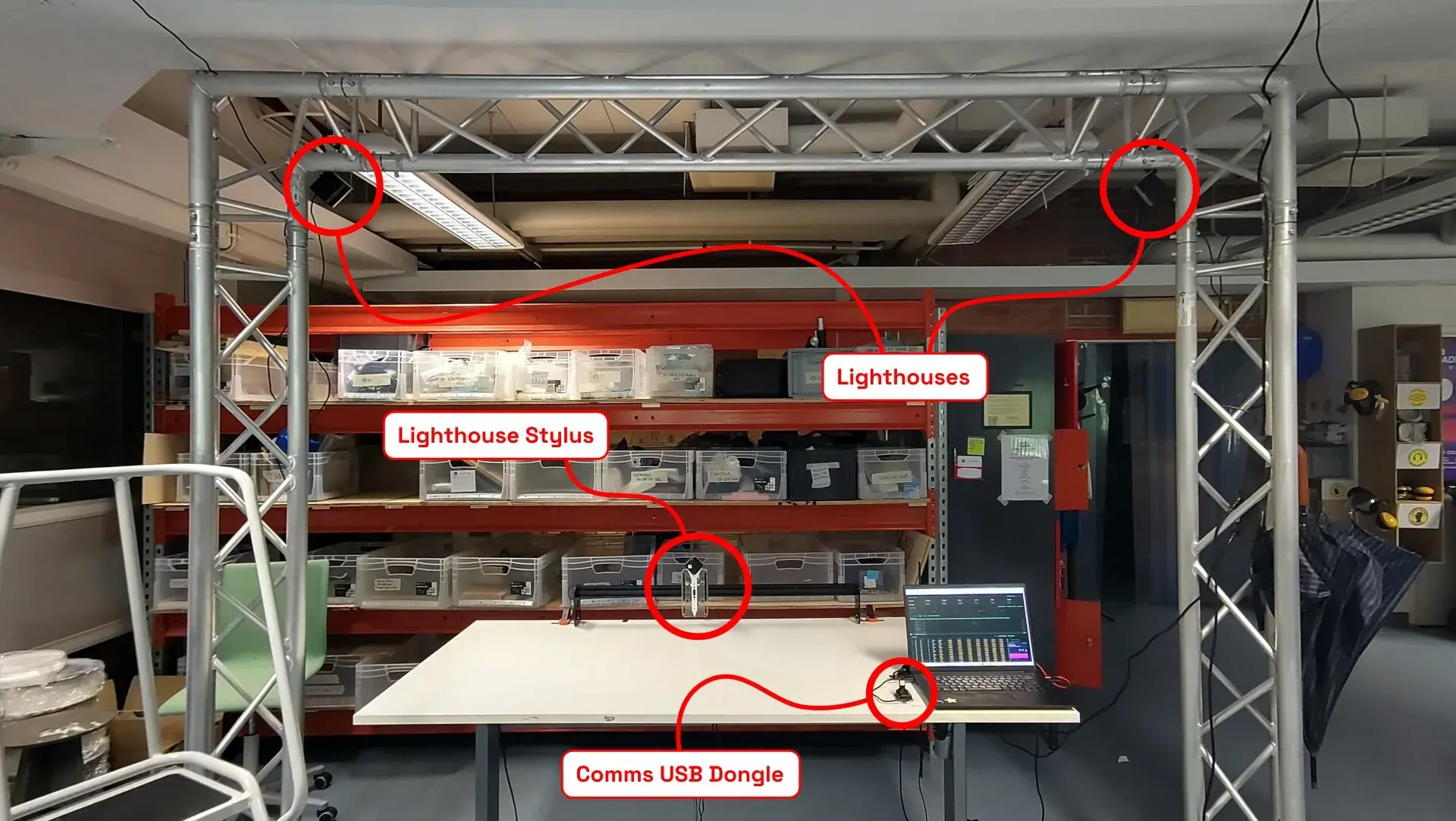
The BOM does something unusually useful by stating what the total leaves out: shipping is excluded, and the calculation assumes access to the Valve Lighthouse tracking infrastructure. Without a base station, the device cannot provide its intended tracking. The project's own table puts the total at €310.26 with one base station and €469.26 with two.3
One station is enough for basic use, according to the documentation. Two or more improve coverage when they use different channels and are positioned to reduce occlusion by the user's body.4
The build also assumes access to an equipped workshop: a 3D printer, PCB milling machine, xTool F2 Ultra MOPA 60 W laser, soldering station, microscope and hand tools all appear in the tooling list.3
€151.28 therefore describes the parts and consumables for another unit inside an already equipped environment, rather than the price of entering the technology from an empty desk.
That distinction applies to a great deal of open hardware, because a BOM often answers “what does the next copy cost?” while readers hear “what does access to this capability cost?”, two questions that can be separated by hundreds or thousands of euros of infrastructure.
A closed core
The Tundra Tracker provides the stylus's localisation rather than serving as a minor convenience bolted onto the enclosure.
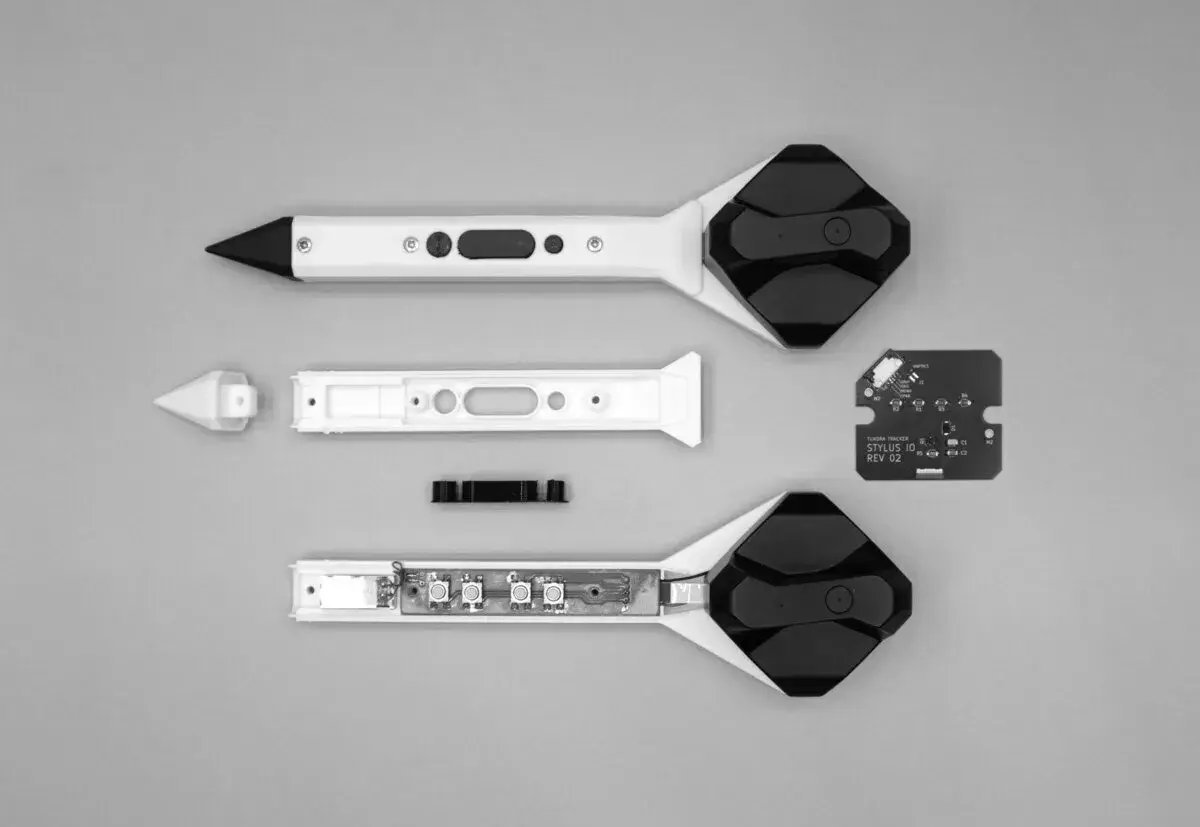
Lighthouse Stylus operates in the Valve Lighthouse ecosystem and retrieves tracker pose through SteamVR/OpenVR.14 Around that tracker, the project adds a printed enclosure, four buttons, an optional haptic actuator, two PCBs and software that exposes pose data to a browser application.
Rijnieks is explicit in the repository: everything under the project's control is open except the Tundra Tracker.2
The expansion interface used by the Bridge PCB is publicly documented, so that part can be reproduced without privileged access,2 although building the project as documented still requires buying the tracker itself.
The openness therefore stops at a clearly marked hardware boundary for a pragmatic reason: designing a complete, reliable 6-DoF tracker compatible with Lighthouse stations would turn a stylus project into a tracking-system project, whereas buying that function leaves Rijnieks free to develop the research object that was actually missing, a replicable, documented spatial tip for projection-based CAD/CAM interfaces.15
Tracking six axes
Six degrees of freedom means three positions, X, Y and Z, plus three rotations, and for a spatial stylus those extra axes are functional rather than mathematical decoration. The tip can touch a table, move above a surface, point towards an object or orient a virtual tool. An application can use tip position and body orientation at the same time.
The repository already includes a Three.js application with ruler and freehand tools. Stylus events arrive over WebSocket after SteamVR pose data is read, with trigger, menu, grip and touchpad inputs exposed to the application.4
The architecture separates three layers, with SteamVR supplying tracking, middleware turning it into a software stream and the application deciding what a gesture means, so interface research can change without rebuilding localisation every time. Replicability therefore extends beyond printing the plastic because another laboratory can follow the chain into the interaction code itself.
Precise, then drifting
“Sub-millimetre” needs a qualifier, because the current project README reports a tip-position per-frame noise floor of about 0.2 mm with two or more base stations,2 a figure that is excellent for detecting small movement and producing stable visual interaction but says nothing by itself about long-term absolute position.
The same document reports 1.5–2 mm/m of length-dependent scale error and, more importantly, 12–24 mm of slow session drift for a fixed reported point.2
The project's own conclusion is appropriately narrow: the stylus suits spatial interaction and relative measurement rather than absolute metrology.2
Perhaps the most educational part of the project is that a device can be extremely quiet over short intervals and still lose its reference over a long session, making a statement such as “<1 mm accuracy” misleading unless the metric and time scale are named.
For drawing a contour, selecting a point or steering a projected interface, local stability may dominate. For recording an absolute multi-metre dimension and expecting it to remain valid later, session drift becomes a serious problem.
Another route
D-POINT, released a few years earlier by Jcparkyn, attacks a similar need with a very different system,6 using a stylus that carries eight ArUco markers and an IMU. A webcam detects the markers, OpenCV estimates pose, and an Extended Kalman Filter combines vision and inertial data to reduce latency and improve fast-motion tracking.6
That design avoids Lighthouse base stations and a proprietary tracker at the cost of solving marker detection, rolling-shutter correction, camera calibration, pose estimation and inertial fusion itself, while Lighthouse Stylus makes the opposite trade by buying a mature tracking layer and opening what sits around it.
Neither approach is simply “more open” or “cheaper” in every context: D-POINT moves more complexity into software and camera setup, whereas Lighthouse Stylus moves more cost into proprietary VR infrastructure while offering a documented research device around a tracking ecosystem that already exists.
The sensible choice depends on what a laboratory already owns and what part of the problem it actually wants to study.
The hidden workshop
Replication reveals a second dependency, less obvious than the Tundra Tracker, in the form of the Fab Lab infrastructure needed to use the FreeCAD sources, STEP files, PrusaSlicer settings, KiCad designs, production files, software and assembly procedures the project publishes.2 That is far beyond a research prototype photographed for a paper and then left to fossilise on somebody's shelf.
Following the recipe still requires machines because the enclosure combines PLA and TPE while two PCBs have to be produced and populated. The documented build uses equipment including a Roland monoFab SRM-20 PCB mill and a MOPA laser for production steps.3
Here, replicable means something more useful for research than “anyone can build it in a kitchen”: a laboratory or Fab Lab with a reasonably standardised set of tools can reconstruct the system from published files.
Open by layers
Lighthouse Stylus ends up offering a fairly healthy definition of open hardware.
The project openly documents the Tundra Tracker exception while releasing what it can actually license, mechanics and electronics under CERN-OHL-P-2.0, software under MIT, and documentation and media under CC BY 4.0.2
That makes it possible to know exactly what can be changed and what still has to be purchased.
The model is less pure than a system whose every component can be reproduced from open plans, but it is usable now.
For a laboratory, that compromise may be more valuable than incomplete theoretical openness: a researcher can build the device today, change its form, PCB, buttons or interface, then compare results with another laboratory following the same documentation.
The more useful advance is that cost, dependencies, source files, error modes and limitations can finally be read together instead of reducing the project to a “$155 stylus” headline.
A research tool becomes much more useful when we know which parts we can reproduce, which parts we still have to buy, and which measurements we should never ask it to make.