In Kamioka, in the mountains of Gifu Prefecture, part of the track maintenance crew is hired from the tourist pool. They pay 3,000 yen for the day to dig ballast, pull fastening spikes by hand, slide a fresh sleeper under a rail lifted with a jack, then sign their sleeper with a marker1112. A local development NPO runs the operation. And the line they maintain has not seen a train since December 2006.
What these one-day volunteers keep alive is the terrain of a second invention: electric-assist bikes fixed directly onto the rails. Two mountain bikes on a metal frame, a rear tire resting on polished steel, and nearly twenty years after the line closed, the old mining rails still carry people13.
The freight left
The Kamioka Railway was a mining line first. About 19.9 kilometers between Inotani, on the JR Takayama Line, and Okuhida-Onsenguchi, in a mining country that once ran horse-drawn tramways in the mid-Meiji era2. Sixty percent of the route ran through tunnels and over bridges, enough for locals to call it "the subway of Okuhida"2.
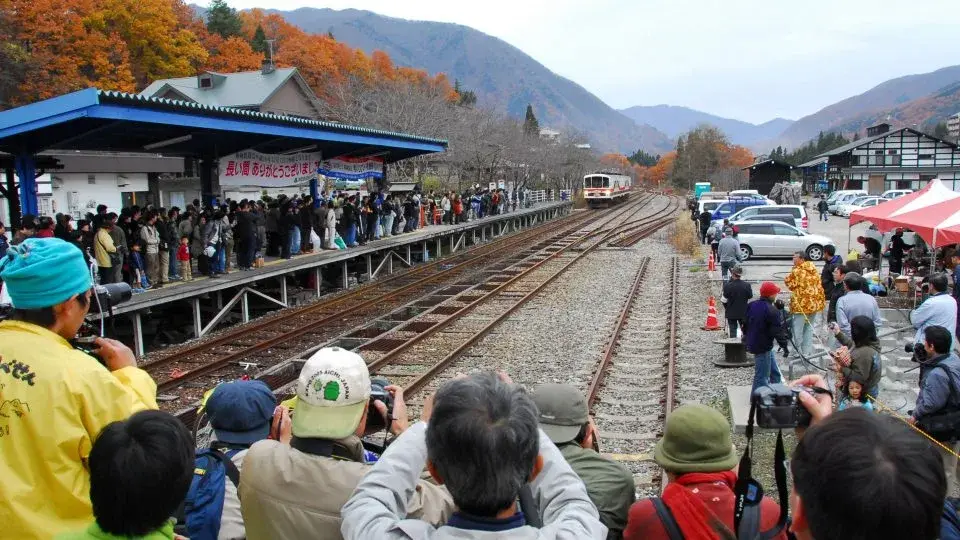
Opened under Japanese National Railways in 1966, transferred in 1984 to a third-sector regional company, the line lived on zinc: freight from the Kamioka mine accounted for roughly 80 percent of its revenue23. When the mine switched its transport to trucks in October 2004, about a hundred passengers a day were left5. The abandonment decision came in mid-2005; the last train ran on November 30, 200645.
A local ironworks
After the closure, residents gathered around the line's former support association refused to watch the rails go to scrap. Their idea fits in a sentence: keep the railway assets "in their original form" by running locally built vehicles on them2. A town ironworks drew up the blueprints and iterated until the current rail bike existed (the project's own history page credits the making spirit of mining towns)2.
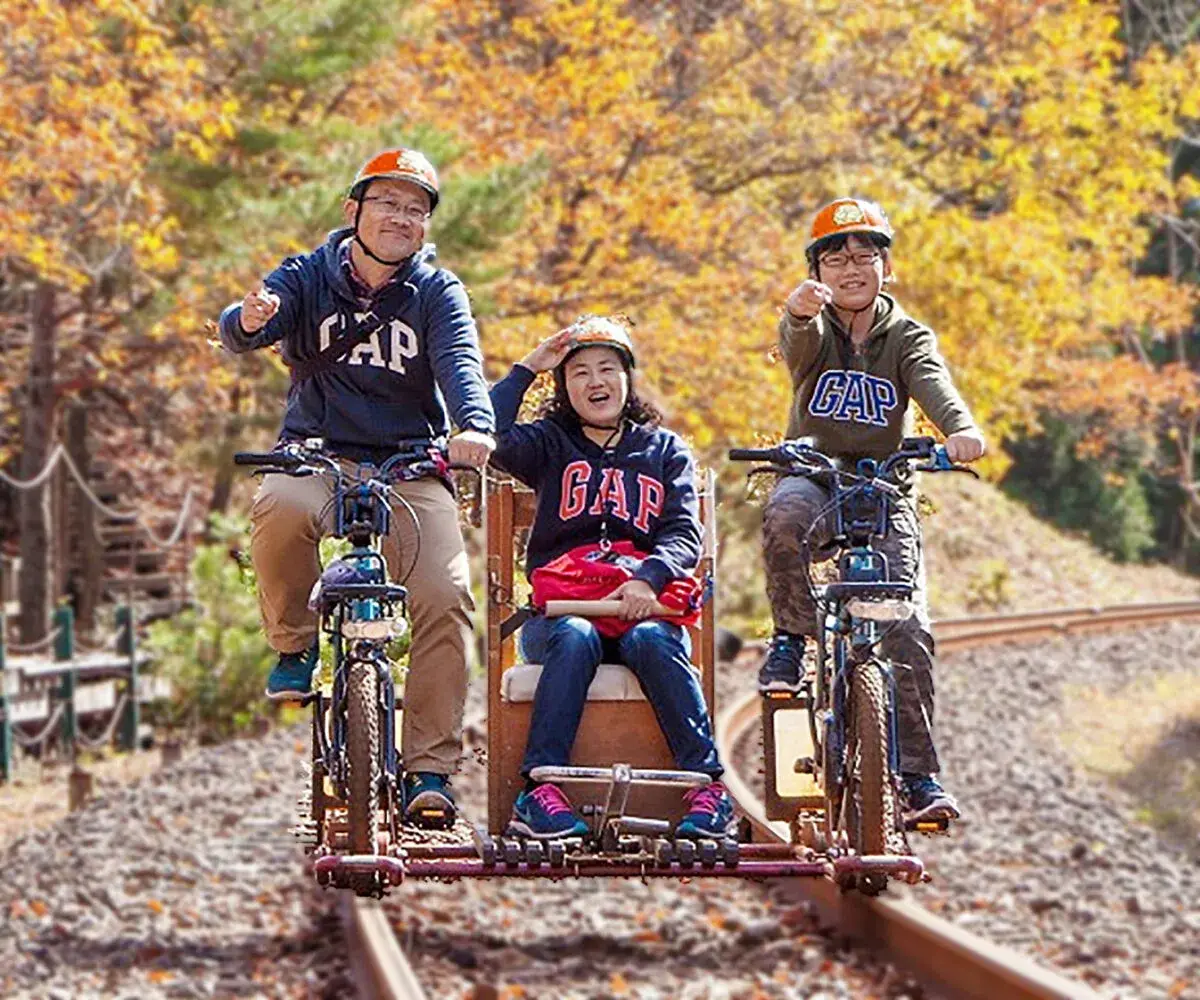
The mechanism is deliberately simple. Two mountain bikes are bolted onto a metal frame; guide rollers ride on top of both rails, and the rear tire of each bike sits directly on the running surface, which turns the pedals into the drivetrain6. The whole fleet got electric assist7. The project moved from the volunteer association to a local development NPO, ran year-round from fiscal 2012 with a winter pause for snow, and a second stretch opened along the gorge in 2018210.
More than 100,000 people pedaled the line in eight years of operation, over 40,000 rides a year before COVID3.
Designed for two rails
The current fleet reads like a list of constraints, each solved once7.
The base vehicle pairs two riding positions with a central wooden bench: two mandatory pedalers, measured at least 145 centimeters tall, one passenger between them, with a child seat or dog cage as an option7. For people with no pedaling partner, the NPO developed a sidecar rig balanced for a solo rider, funded by a grant from the local credit union. Groups of four get a giant tandem whose own site warns about the downside: the long wheelbase makes every curve a workout, plan to sweat. And those who only want the view ride a wooden trailer pulled by a staff motorcycle, for 1,200 yen7.
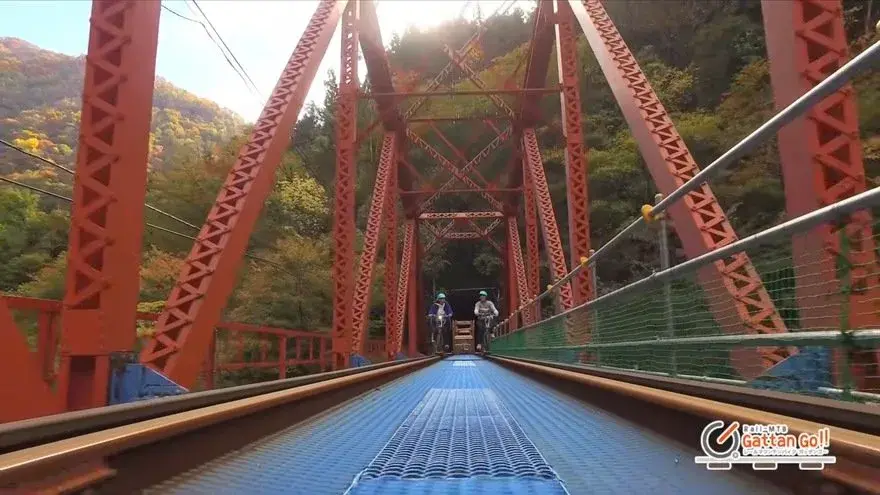
Two courses share this fleet. The town course runs about 2.9 km one way between the former Okuhida-Onsenguchi and Kamioka-Kozanmae stations, fifty minutes to an hour round trip, briefing and break included7. The canyon course, the demanding one, links the former Urushiyama station to Futatsuya tunnel: 3.3 km one way through tunnels and bridges, including the red truss bridge above the second Takahara river58. Departures go out in small groups with guides at the front and rear, and at the turnaround everyone dismounts while the vehicles are pivoted910. One operating rule is unusual enough to appear in the sales conditions: if a bear is spotted on the track, every later departure of the day is cancelled8.
The tourist's hammer
One problem remains, invisible on photos: a track with no operator does not preserve itself. Sleepers rot, spikes rust, and no railway company has this work on its schedule anymore.
The NPO's answer is an annual workshop, the makuragi kokankai, literally the "sleeper exchange gathering". The principle: charge amateurs to do the real maintenance work, by hand, supervised by the staff. You meet at the station, ride a rail bike to the section being treated, then run through the full track-layer sequence: dig the ballast around the tired sleeper, pull the spikes, lift the rail with a jack, remove the old piece, insert the new one, drill fresh holes, hammer the spikes back in, check the gauge11. Last step, not standard railway practice: everyone writes their name on their sleeper11.
The 2022 edition, the thirteenth, brought together 37 participants from four different prefectures, Gifu but also Nagano, Toyama and Shizuoka13. The seventeenth ran on June 7, 2026 with about thirty spots, day, bike rental, bento and insurance included12. In November, the workshop will cross the tunnel for the first time and replace sleepers on the canyon course14.
A transmissible gesture
Kamioka compares poorly to spectacular rail-to-trail conversions. Here, nobody paved anything or pulled the rails out: the preserved value is the rail itself, with its physical constraints. The vehicle design follows from them entirely: no steering, no balance to find for the middle passenger, an imposed width, known gradients. It is the same reasoning as the Colombian motobalinas covered earlier by Core77, motorcycles adapted to run on disused tracks: you do not design a vehicle, you answer an infrastructure1.
The other transferable part is the funding of maintenance. A local NPO has neither a railway operator's track budget nor a planner's grants. The annual workshop turns a cost line into a product: participants pay to perform the maintenance, leave with a skill, and the track stays usable for another twelve months. The 2026 program repeats the formula: a guided walk off the rails on the old mining paths with the LOST LINE PROJECT, a night ride during the NPO festival, and therefore the first sleeper workshop on the gorge course1415.
The limits are real. The model runs on a short, seasonal linear asset, closed in winter for snow, dependent on volunteers, good weather and the absence of bears on the track810. It says nothing about preserving high-speed lines, and nothing about commercial profitability either: the stated balance sheet fits in prices from 3,000 to 8,000 yen per vehicle and a list of local development awards, including a special 2012 Japan Railway Award for "revived rails"27.
But for anyone who makes or maintains things, Kamioka leaves two clean ideas. First, an orphan infrastructure survives if someone designs objects to its measure, rather than the other way around. Second, the maintenance gesture can become the experience itself: exactly what separates an exhibited heritage from a living one. The next sleeper fitted in the gorge will probably carry a name in marker: the name of someone who paid to sweat.