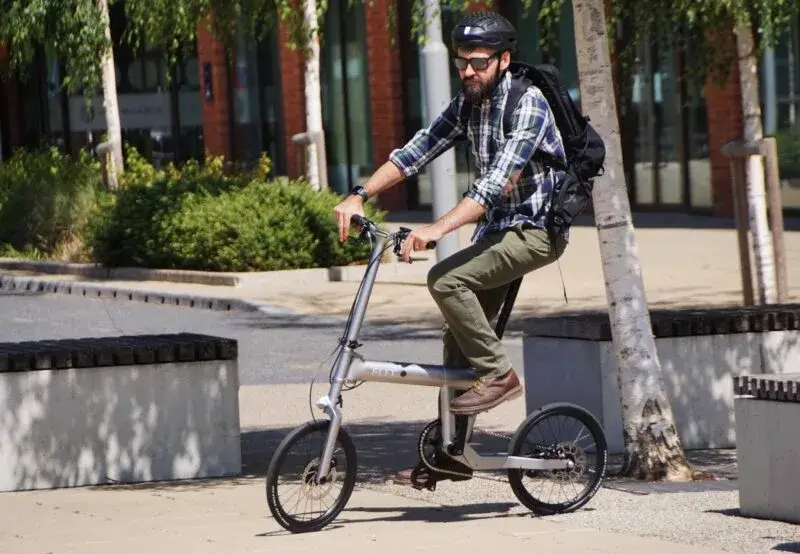
For decades, the recipe for a premium folding bike has had two essential steps: engineer a clever hinge, pick your metal, then light the welding torch. When FLIT, the Cambridge maker of folding electric bikes, designed its new M2i, the team threw the torch overboard.
Instead of welds, the anodised 6061 aluminium frame is assembled with structural bonding — a technique borrowed from aerospace and supercars. The result is a single-speed folding e-bike that weighs 13.3 kg and undercuts Brompton on both weight and price.12
The gesture sounds almost naive. In fact it is a textbook example of the trade-offs that appear as soon as you try to make a tube thin, light and precise. And it raises a question marketing would rather not answer: can a glued bike be repaired?
The breaking heat
The problem is not welding itself. It is what heat does to a thin aluminium tube.
When you weld aluminium, the intense heat permanently changes the metal's crystal structure. The area around the weld bead weakens and distorts — historically one of the most common failure points on a bicycle frame.1 On an ordinary full-size frame you live with that compromise. On a small folding frame, where parts must lock together with tight tolerances, a few tenths of a millimetre of distortion is enough to make the hinges open and close badly.3
Bonding takes a different route. When the two parts of a structural epoxy are mixed, the resulting polymer chains form a cross-linked network that locks into the microscopic imperfections of the anodised surface — without ever heating the metal. The aluminium keeps 100% of its factory strength: no warping, no heat-affected zone.1
Where the grams are
When chasing the lowest weight, the industry has long looked at titanium. Titanium has a great strength-to-weight ratio. But it is more than 60% denser than aluminium.1 So you can spec aluminium tubes with wider diameters and thicker walls with no weight penalty.
On an electric bike, where the top tube has to house a 230 Wh battery pack, those wider, inherently stiffer tubes hold up better than narrow titanium piping.12 The same logic applies to machining: FLIT can mill nested male-to-female sleeve joints with a 1 mm tolerance. Milling titanium requires slow, specialised, expensive CNC work.1
That is the smartest part of the choice. Bonding is not just a trick to cut weight: it is a production strategy that lets you use an easy-to-machine material, then assemble it cold. In a titanium frame, the same structure would take far more machining time and a much heavier price tag.
Alignment kept
A folding frame is a precision machine. Folding depends on the alignment of the pivot points: if they do not land exactly where they should, the hinge binds or the latch wears out.
Welding, with its thermal distortion, is the enemy of that alignment. Bonding assembles machined parts at low temperature, preserving millimetre alignment across the whole structure.3 It is the same argument made by contemporary glued bike frames: LOCTITE and Faction Bike Studio replaced welding with bonding on mountain-bike frames to keep precise pivot locations and take out weight.5
On the road, that precision translates into a bike that feels mechanically truer — wheels aligned, hinges that shut with the same feel every time. That is a sensory argument, but it rests on a measurable physical property of the process.
Shear, not peel
This is where the mechanics matter, because it's where bonding shows its real nature.
When a rider stamps on the pedals, the forces pull along the overlapping tubes. That is shear stress. Adhesives are vulnerable to peeling forces, but extraordinarily strong against shear: they spread the load over a large area rather than a single thin weld bead.1
Industrial adhesives also show significantly lower stress concentration factors than welds or mechanical fasteners, which allows thinner, lighter materials.8 In other words, bonding is not a fragile fallback: well designed, it is more uniform than a welded joint.
But there is a catch, and it is decisive. A bond is only as good as its surface preparation. Joint quality depends on cleanliness, degreasing and the state of the surface at the interface. It is the most common failure point in bonded structures: a trace of oil, a release agent, a surface still carrying contamination, and adhesion drops.8 FLIT leans on an anodised surface to manage this, but does not publish the full protocol or the exact adhesive it uses.
The pothole test
Convincing a city commuter to trust the safety of a frame to a glue joint requires more than theory. So FLIT put the frame through two rounds of validation.
In the lab, the frame was locked into a rig where pneumatic pistons hammer thousands of newtons into the joints. To pass, the bonded structure had to survive up to half a million continuous stress cycles with no micro-fracture appearing in the chemical bond.1
In the real world, engineers deliberately rode overloaded prototypes over the worst city roads they could find in Cambridge, slamming the bikes into steep kerbs and deep potholes. That first pothole test bent a rear swingarm slightly. The most telling detail: the bonded joint itself stayed perfectly intact. The engineers concluded the chemical bond was sound, but that the metal swingarm needed redesigning and its strength doubling.1
That is a rare example of transparency. Many brands would publish a video of a bike riding over potholes without mentioning what they had to fix along the way. Here the partial failure of the assembly is documented, and the conclusion is exactly what you want from a good process: the joint held — it was the part around it that needed reinforcing.
Tried in 1972
The most striking part, though, is that gluing a bike is nothing new. The history of structural bonding in cycling is long, and it has already known its golden age.
As early as 1972, the Italian brand ALAN was assembling "screwed and glued" aluminium frames that raced in competition. In France, Vitus developed a bonded-alloy assembly process at the end of the 1970s with backing from Péchiney and US adhesive specialist 3M. The Vitus 979 Duralinox, launched in the early 1980s, became one of the most widespread racing frames of its era, with over 130,000 produced.7
In the US, Trek introduced its first aluminium frame, the Model 2000, in 1985, built with aerospace epoxy before it moved on to carbon. The tests of the time showed bonded joints had better fatigue life than welded joints.6 It is an argument you find almost word for word in FLIT's communications today.
The reason the technique eventually retreated is not a mechanical secret. When welding processes became more reliable, they displaced bonding through cost and speed: no more cast lugs, no more precision fitting, no more bonding steps slowing production.6 Bonding became a memory, kept alive mostly in carbon — where you have no choice, because you cannot weld carbon fibre.
And repair?
This is where the question gets uncomfortable, and where IRZ's take diverges from the press release.
A welded frame that breaks can usually be re-welded. A bonded frame cannot: repairing a failed joint means dismantling the bond, cleaning the surface, and re-bonding under the right conditions — specialised workshop work, not a quick weld. Tube-to-tube frames built that way offer exactly the advantage of replacing one damaged tube without scrapping the whole frame; but that only holds if the joints are repairable, which is far from guaranteed for a bond buried inside the structure.4
History confirms the caution. The bonded frames of the 1970s and 80s were solid, yet competition teams replaced them every season, and some riders said Vitus frames "got soft" with the kilometres.7 A 1991 patent on bonded bike frames already flagged the risks of water ingress at the interface and corrosion, and proposed adding a mechanical joint for safety.9 Modern adhesives have come a long way, but surface preparation and long-term ageing remain the two unknowns the manufacturer does not document publicly.
For FLIT, that trade-off is explicit: a three-year frame warranty, limited production in Cambridge. For the buyer, it is a fact to know before committing: you are not just buying a light bike, you are buying a repair philosophy that is less established than the welded bike's.
Three conditions met
The FLIT M2i is neither the first glued bike nor the last. It is interesting because it brings together the three conditions that make bonding credible today.
First, choosing aluminium over titanium turns bonding into a production strategy, not a gimmick. Second, the alignment precision demanded by a folding frame is precisely the ground where welding is penalised. Third, the validation process is documented, down to the initial swingarm failure.
The contrast with Brompton gives a sense of the bet: the FLIT weighs half a kilo less than the welded, titanium Brompton Electric T-line and costs almost half as much (£2,999 versus £5,799).1 Where Brompton has to save weight on stripped-back components, FLIT can afford premium gear: Hope hydraulic brakes, Goodyear tyres, a fizik saddle.12
In the end, the real lesson of the M2i is not "glue replaces welding." It is that the way you assemble tubes is a manufacturing decision that matters as much as the choice of material — and that a nearly forgotten technique can return when a problem becomes precise enough. The next time you see a "glued" bike, you will know it is neither a novelty nor a shortcut: it is an answer to constraints that welding could not meet.