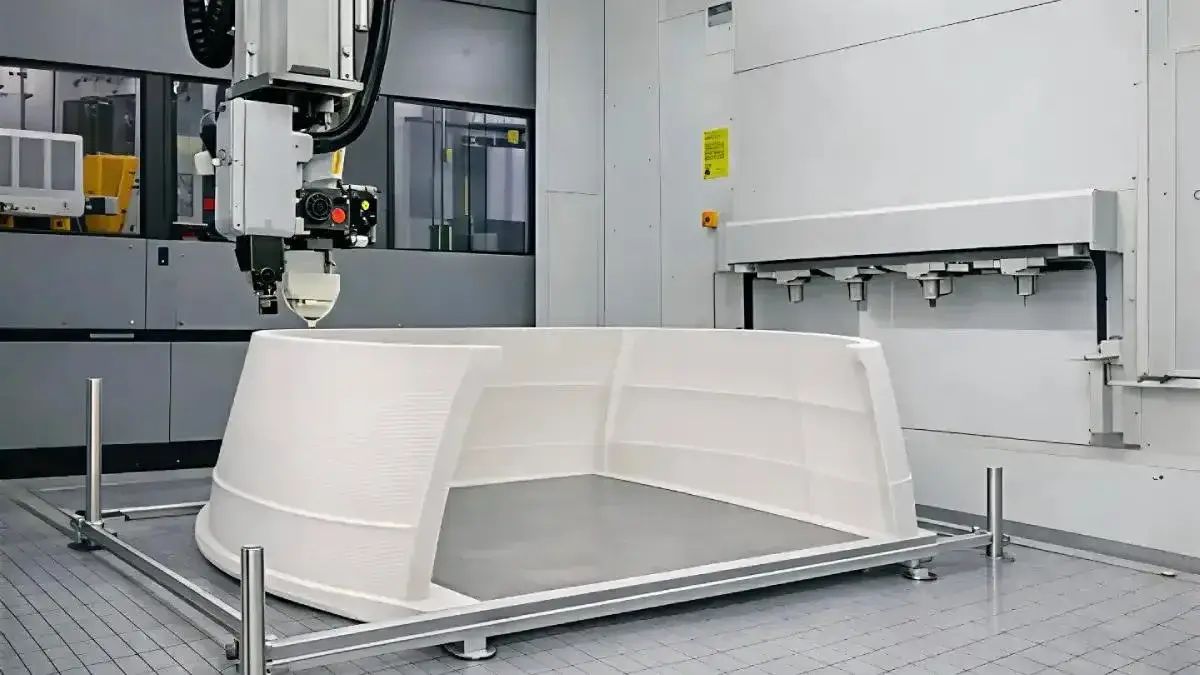
The easy photograph from 3D-FiberTrain is a large nozzle laying thermoplastic into the shape of a train nose. HÖRMANN Vehicle Engineering calls the manufacturing route “tool-free.” Follow the component down the line, though, and a milling machine appears.1
It belongs there. After extrusion and continuous-fibre placement, automated milling brings dimensions and surface quality back where they need to be. The project never removed tools from the factory. It is trying to remove one very specific tool: the dedicated mold tied to the component geometry.13
That makes the project less magical and much more useful. A printer replacing an entire workshop would make a wonderful headline. A reusable chain that still uses several machines but no longer needs a full-size mold for every geometry makes a stronger case for low-volume rail production.
The part moves
The first station uses large-format granule extrusion to put down the bulk thermoplastic geometry directly from a digital model.1 There is no need to manufacture a full-size negative first. HVE and Fraunhofer point especially to small and medium runs, where the fixed cost of such a mold would be spread across relatively few components.23
The printed body is not expected to carry every load efficiently by itself. The second station lays continuous-fibre tape along load paths. Reinforcement becomes local rather than uniform.1 Fraunhofer says structural optimization reduced the number of tapes to the mechanically necessary minimum.4
Then the component reaches machining. Extrusion accepts the layer surface and tolerances needed to build a large shape quickly; the cutter removes material where tighter dimensions and a better finish are required.1
Each station deliberately leaves work for the next one.
Six hours
A HVE one-pager shown at TRAKO in 2025 documents a front panel measuring 1,326 × 530 × 16 mm and weighing 9.8 kg. The listed material is Listolan 060 XL polycarbonate blend with 20% glass fibre.5
For that panel, HVE gives a 275 °C nozzle, a printing speed of 2,600 mm/min and a six-hour print time.5 The same page states compliance with the EN45545 fire-safety standard.
Six hours is not the time from CAD file to train-ready component. It is the published print time. Tape placement, machining, handling and inspection keep their own clocks.
The consortium later built two full-scale demonstrators around Siemens Mobility's Velaro MultiSystem, operated as the ICE 3neo Class 408: a front skirt and a nose section.14 HVE notes that the reference train operates at up to 320 km/h.1
Before part one
The economic argument starts before a conventional composite part exists.
Large rail exterior skins are commonly made using thermoset composite processes such as hand lay-up or vacuum infusion. Their geometry comes from a mold. That mold has its own design, material, machining, storage and sometimes rework when the component changes.1
Across a long, stable production run, the expense can be amortized. Across tens of parts or a growing family of variants, it becomes more visible in every unit. 3D-FiberTrain tries to replace that geometry-specific investment with production equipment that can accept a different digital shape without first rebuilding the full-size negative.23
Changing the part is still not free. Engineering, simulation, testing and validation may all have to run again. The practical difference is narrower: the file can change without automatically forcing a new mold to exist first.
In 2025 HVE displayed three project figures: 15% lower component-related cost, 20% lower component-related production time and 30% lower carbon footprint.5 They are HVE's published project numbers, not an independent universal benchmark. The 2026 completion release is more qualitative, citing lower costs, shorter production times, lower carbon footprint and greater flexibility, particularly for small and medium runs.1
Fire complicates
Scale is not the most rail-specific difficulty in the project. Fraunhofer spends more time discussing the material.
The glass-fibre-reinforced polycarbonate was selected and modified to meet stringent rail fire-protection requirements.4 The flame-retardant system, in turn, makes printing behaviour more difficult. At this scale, warping or delamination discovered late wastes a great deal of material and machine time.
Researchers therefore used process simulations beforehand to predict thermally induced distortion and delamination.4 This is the less visible engineering behind the large printed shell: making a fire-compatible material printable, then keeping the geometry under control as it cools.
Continuous fibres address mechanical load afterwards, while milling handles the places where raw extrusion does not deliver enough precision. The photographed component is the result of all those compromises, not merely a big printer.
Recyclable, not recycled
HVE describes the chain as entirely thermoplastic and recyclable.1 That changes the material family compared with conventional thermoset composite routes.
The published project does not, however, show an old rail component being ground up and turned directly into a new nose. Fraunhofer lists the direct processing of recyclates as future work.4
So “recyclable” is the defensible word. “Closed-loop recycled” would claim a step the partners have not yet documented.
The sequence makes sense: first prove the manufacturing chain, then work on feedstock from recyclates, its quality control and the performance needed to close the material loop.
Still a demo
The same caution applies to the train. The skirt and nose are demonstrators produced by the research project.14 HVE does not say that Deutsche Bahn is now operating a fleet of ICE 3neo trains with series-produced printed noses.
A full-scale demonstrator already brings together dimensions, fire behaviour, reinforcement, thermal distortion, machining and structural validation. It is far beyond a scale model. It is still a different problem from repeating the process for many certified vehicles.
Series production must hold properties, tolerances and inspection criteria part after part, while maintaining the claimed economic case at daily production cadence. HVE sees small and medium volumes as the most promising territory.1
The cutter stays
The milling machine that seems to contradict “tool-free” is the best way to understand the project.
3D-FiberTrain gains nothing by forcing the printer to do every job. Extrusion makes volume, tape carries selected loads, milling supplies precision. That division of labour is ordinary manufacturing practice; the unusual move happens elsewhere.
The removed tool is the one that belongs to only one geometry: the mold. The other machines stay because they can work on the next variant too.