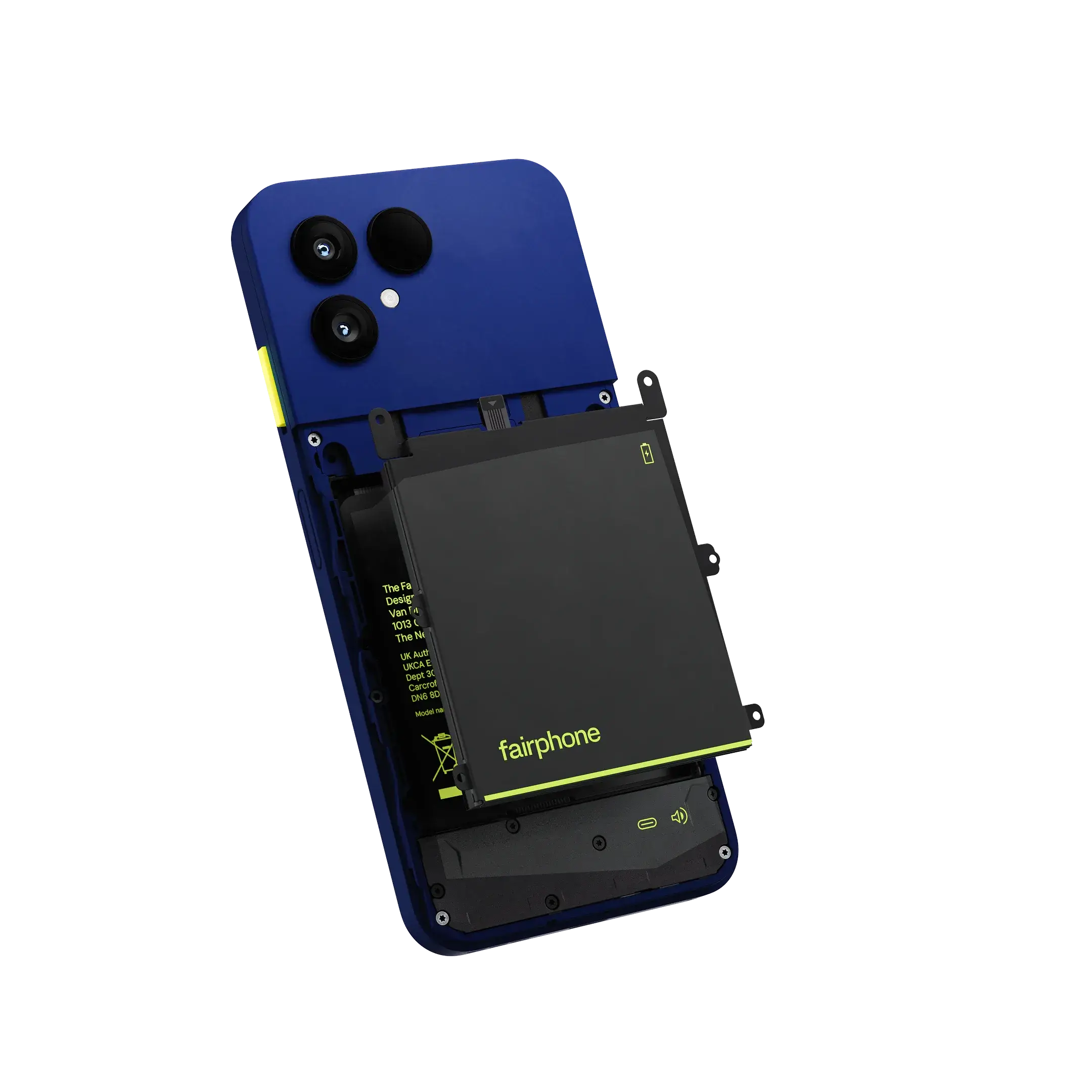
The Fairphone (Gen. 6+) has something unusual for a 2026 smartphone: remove its back, take a T5 Torx screwdriver and you can replace a large share of what will eventually wear out. Fairphone counts 12 user-replaceable parts and says the battery, display, USB-C port and rear cover can each be swapped in under five minutes.1 iFixit gives the Fairphone 6 a 10/10 repairability score, noting adhesive-free battery and screen work and a modular charging port.8
Then the phone crosses the Atlantic.
Fairphone announced its first official direct US launch on August 18, opening a dedicated American shop and listing the Gen. 6+ at $649.99 with Android 16, 12 GB of RAM and a Snapdragon 7s Gen 4.13 That is where a useful contradiction appears: the phone is unusually open when it is lying on a workbench, while access to a mobile network still depends on doors its owner cannot unscrew or replace.
Fairphone lists AT&T and T-Mobile as supported. Verizon, by contrast, is marked “incompatible / not whitelisted,” along with carriers using Verizon's network.4
Not the first
Saying Fairphone has “finally arrived in the United States” already needs a correction.
Before this direct launch, Fairphone had an American route through Murena. Fairphone's own support page explains that devices including the Gen. 6 were offered in the US through that partner with /e/OS, with warranty and support questions handled by Murena.5 An American customer could therefore buy a Fairphone before August 2026.
What changed this year is narrower and more meaningful: Fairphone opened its own US channel and presents the Gen. 6+ launch as the moment the brand becomes officially available in the country.3 The phone now arrives through Fairphone's own store with Android 16 and Fairphone's software stack, published US warranty terms and support tied directly to that sales channel.16
That is less dramatic than “finally available,” but more useful for understanding a product launch. Shipping an object into a country is only part of the work. Software, warranty, spare parts, service and compatibility with local infrastructure all have to follow it.
Same radio
The oddest detail is that the European and US technical pages for the Gen. 6+ publish the same radio bands.
Both list 5G n1/2/3/5/7/8/20/28/38/40/41/66/71/77/78 and the same LTE bands, with no mmWave support.12 Neither spec sheet describes a US modem with a different band set from the European phone.
Yet the American compatibility page does not say “every network using these frequencies will work.” Its matrix is much more concrete: AT&T is supported for BYOD, T-Mobile is supported, and Verizon is incompatible / not whitelisted.4
The wording matters. It does not prove why Verizon has not whitelisted the model, or how much of the limitation is technical, commercial or procedural. It establishes only that a list of compatible frequencies is not enough to describe whether a phone works on an American carrier.
The whitelist
This contrast suggests a second definition of openness.
The first is mechanical. Fairphone documents a removable 4415 mAh battery, a modular USB-C port, a replaceable screen and spare parts promised until 2033.1 The model is easy to understand: when something fails, an owner can often identify the module, order another one and return the device to service without replacing the whole phone.
The second kind of openness is institutional. It lives outside the chassis in accepted-device databases, carrier profiles, BYOD procedures, eSIM support, firmware and network qualification. A screwdriver has no leverage there.
Fairphone's compatibility page makes that visible through another detail: on T-Mobile, eSIM is not supported, and Fairphone tells users to use the Nano-SIM slot.4 The phone nevertheless contains a 5G eSIM according to its specifications.1 The component exists; practical use still depends on the device-carrier pair.
The distinction applies well beyond phones. A connected product can be physically modular, documented and repairable while still depending on a permission layer located somewhere outside the object.
Twelve parts
Reducing the Gen. 6+ to its Verizon limitation would miss what Fairphone is doing differently from most of the smartphone market.
The device keeps 12 user-replaceable parts. Fairphone specifically lists the battery, screen, USB-C port and rear cover among components that can be changed quickly; iFixit highlights adhesive-free common battery and screen repairs, a modular charge port, and the availability of repair guides and parts.18
Fairphone promises spare parts until 2033, six major Android upgrades through 2032 and software support until 2033.1 The US standard warranty lasts two years, with a commercial extension that can take the handset to five years under the published conditions, excluding the battery; the battery follows a different duration.6
Those dates matter as much as the screwdriver. A phone designed to come apart becomes much less useful if replacement screens disappear two years later or security updates stop while the hardware still works.
Two firmwares
The American launch even produced a brief software fork.
In a note published on August 25, Fairphone says the US Gen. 6+ had already received 16.104.0 as its first US-launch update while European devices were then receiving build 16.100. Fairphone adds that EU and US devices should receive the same updates going forward.7
That should not be exaggerated into evidence of permanent fragmentation; Fairphone explicitly says the branches are meant to converge. The short split instead shows the invisible work behind a new market. The chassis can be the same while a commercial variant still needs to be qualified, tested in its new environment and then folded back into a common maintenance line.
Repairability does not remove that work. It changes the question. Once a user can open the phone, it becomes easier to see what remains closed after the screws are out.
The real launch
The American Gen. 6+ is therefore more interesting as a story about a repairable product entering a non-modular market than as a story about a repairable smartphone finally reaching US soil.
The phone lets an owner replace a battery or USB-C port. Fairphone sells the parts. iFixit confirms that common repairs are straightforward. Software support is promised for years.18 That already returns a meaningful amount of control to the owner.
Buying it directly in the US does not remove the control layers sitting above the hardware. A network can still decline to support the model. An eSIM function can depend on the carrier. A launch can briefly need a market-specific firmware branch before returning to the common line.
Core77 spotted the useful symbol in seeing Fairphone officially enter the United States.9 The more instructive part begins one step later: an object can become more open without the ecosystem around it opening at the same speed.
On the workbench, the Gen. 6+ comes apart with a T5 Torx. On Verizon, the same phone reaches a door with no screws.