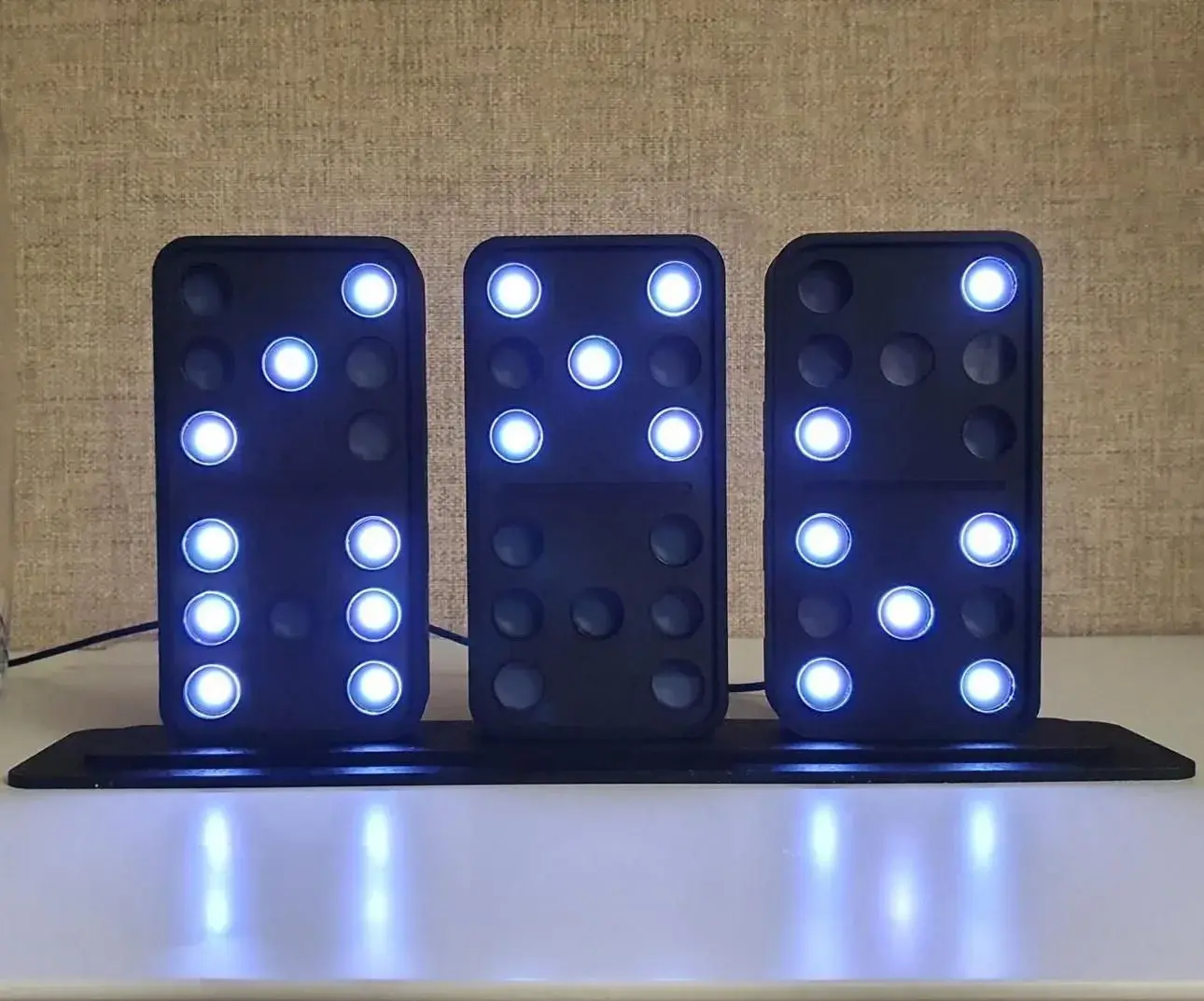
In December 2010, the design consultancy Carbon Design Group unveiled a clock that displays time with dots physically flipping between black and white. Each dot turns on a purpose-built coil actuator, and the motion was tuned to suggest "the feel of falling", like a domino dropping.2 Sixteen years later the same object has resurfaced as a tabletop build, flagged this week by Adafruit, stripped down by a maker to what a normal workshop and an Arduino can do: dots that no longer flip, they light up.16
The reduction is the best part of the story. The copy loses the gesture, keeps the code, and the genuinely expensive part of the original vanishes in one move.
The pip code
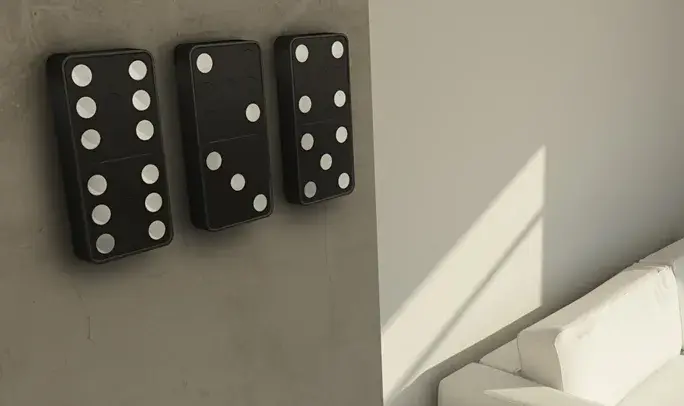
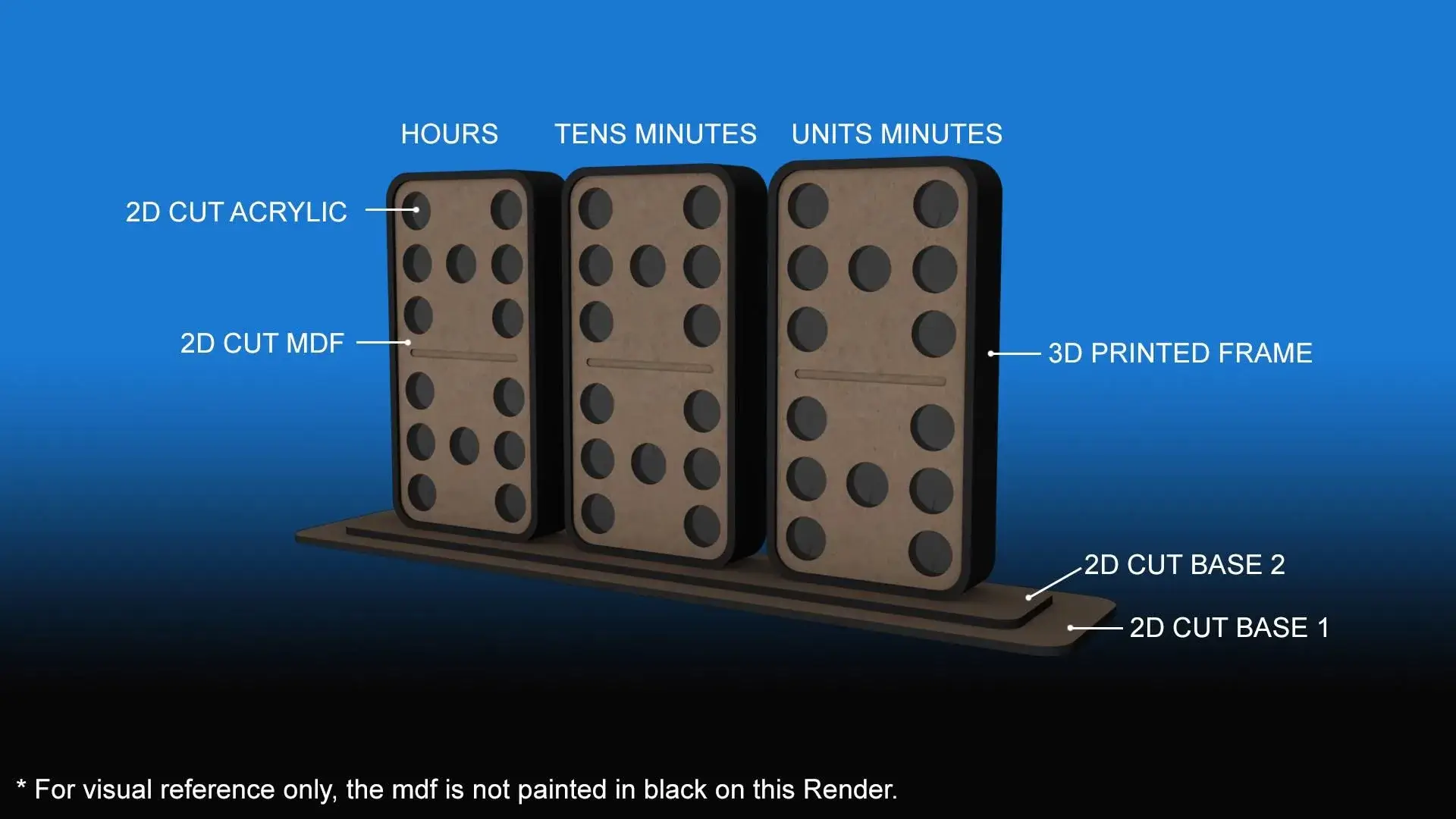
A domino carries two halves of zero to six pips, twelve at most per tile. That range maps exactly onto the hours of a half-day, and Carbon used it as-is: three oversized dominoes, the first for the hour, the second for the tens of minutes, the third for the units. The 2010 press photo shows 10:59: four and six pips on the first tile, three and two on the next, four and five on the last.2
Joe Sullivan, the project's industrial designer, summed up the idea in two steps. The dot-counting scheme developed for dominoes and dice is immediately recognizable, so it reads with no learning curve. And the shift in context, a game object turned wall object, does the rest.2 The clock began as an internal "Passion Project", time granted to the team to explore without client constraints, and the three tiles talked over wireless, standing free or hung on a wall.2 Public sources stop at the prototype and the first unit planned for the studio's walls in early 2011; no commercial release shows up in what remains accessible.2
The Davis coil
On paper, the display is the easy problem. The hard part is rotating up to twelve dots per tile, slowly, silently, thousands of times a day, without draining batteries.2 Mechanical engineer Eric Davis answered with a dedicated actuator his colleagues nicknamed the "Davis coil": what he calls a single-poled motor, where the magnet and the iron travel around the coil, opposite the way motors are usually built.2
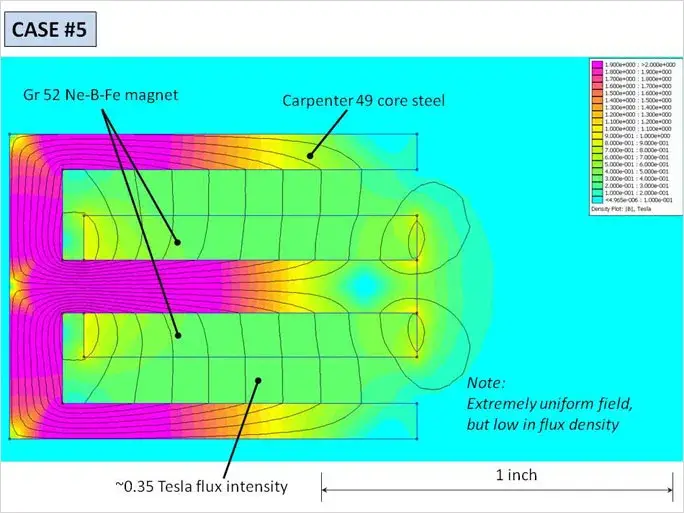
Periodic documents show the method. Davis ran a series of magnetic flux studies to refine the geometry; one of them, published at the time, targets roughly 0.35 tesla with a neodymium magnet and a Carpenter 49 steel core across an inch of width.3 Energy is only spent initiating the flip: between minute changes, every dot rests in its black or white state at zero cost.2 Dampening grease keeps the motion quiet, and digital prototyping killed an earlier idea of linking mechanisms in rows, judged too "visually loud" when many dots flip at once.3
What stopped flipping
The tabletop version, documented on Instructables by maker Kotheson, keeps the display code and throws away the mechanism.1 In place of the coils: 42 addressable WS2812B LEDs, one per possible dot position. The intro text owns the trade plainly: coil motors are "if not complicated, tedious and a bit expensive", so Neopixels take over.1
What the reduction removes is precise. Motion, to start: no more flip, none of the falling feel that drove all of the 2010 engineering. Autonomy too: the original aimed at untethered tiles and only paid for energy during transitions; the copy runs on a 5-volt feed and pays for as long as the dots glow.12 The gain resembles the loss, though: dots can take any color at all, and nobody needs to design an actuator to build the thing.1
The 2010 worry, a "loud" mechanism flipping several dots together, dissolves here by surrender: nothing moves at all. Between two minutes, the clock waits.1
MDF, acrylic, 42 LEDs
The build sticks to basic materials. Each domino stacks a 3D-printed PLA frame with four 3 mm MDF layers; white acrylic discs glued to the third layer form the base of each dot, and two layers of translucent smoked acrylic diffuse the light from the LEDs glued behind them.1 Everything gets a matte black paint job before assembly on laser-cut bases, with cable channels planned at the cutting stage.1
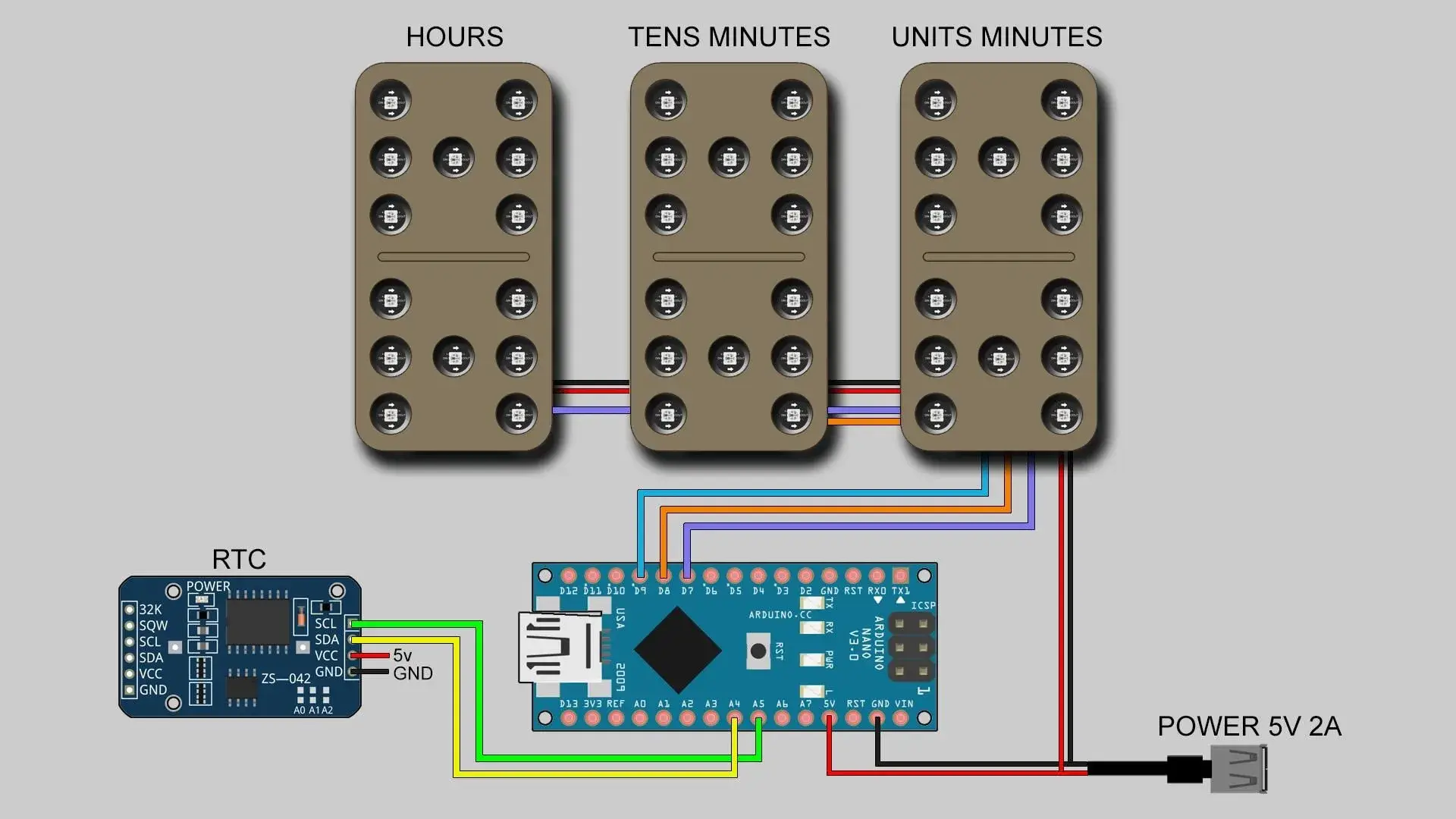
The 42 LEDs split into 14 per tile, seven per half, enough to compose any pattern from zero to six pips. At the busiest full minute, 12 hour dots, 5 tens and 9 units, 26 LEDs burn at once. The brain fits on an Arduino Nano, a DS1307 real-time clock module on the I2C bus and three data pins, one per domino; power arrives directly at 5 volts, 2 A.1 Setting the time involves a firmware ritual: uncomment one line to read the computer's clock, upload, comment it again, upload once more.1
The files question deserves honesty. The step-by-step is published under a CC BY-NC-SA license, but the STLs, DXFs and code go through Kotheson Studio's Etsy shop rather than the project page.1 The object has existed under different terms: in November 2020, Arduino Blog and Hackster covered the same build, under the handle Kothe, with an intro text identical word for word and the same photos, and pointed to the code and CAD files directly in the write-up.45 The current page reads as a republication, with the documentation free and the files distributed through a shop. At least one person besides the author has already rebuilt it and posted the result on the project page.1
What carries over
Three pieces of this story transfer as-is. The display code, for a start: dominoes or dice are enough to show time with no digits and no hands, and any LED strip can carry it. The acrylic stack next: a white disc at the back, translucent smoked acrylic in front of the LED, and the dot gets its clean halo without exotic diffusion. Then the reduction method itself, probably the most interesting of the three: identify the mechanism that costs the most, here the actuator, and replace it with information driven by code.13
The energy bill inverts along the way. Davis's coil only consumed at the instant of turning; the LED pays for the entire minute it glows. The original was expensive to engineer and nearly free to run. The tabletop version settles for cut-sheet materials and a cable.
What MDF cannot rebuild is the fall. On the original, every minute dropped like a domino. Here, it lights up.