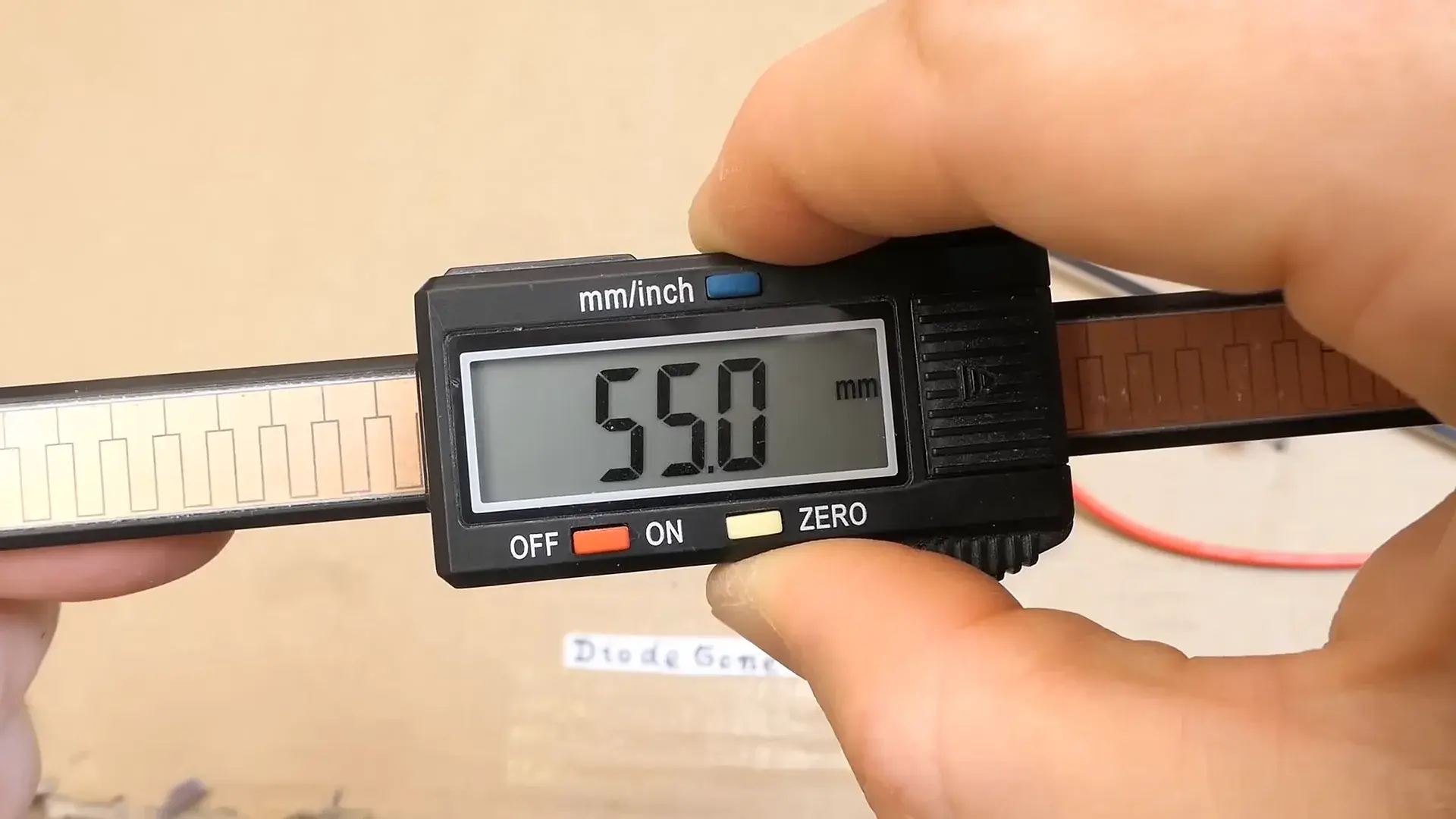
Most makers end up with a cheap digital caliper somewhere. DiodeGoneWild tears one down to see what actually makes it measure.12
All the electronics live in the carriage that slides along the ruler. Under the scale sticker, the ruler hides an etched copper strip made of repeating T-shaped sections. Facing it, the carriage PCB carries capacitive sensing plates.1 As the carriage slides, the measured capacitance varies in proportion to the displacement, and that variation gives the relative position. Zeroing is left to the user, through the ZERO button.
The most useful detail is not the measuring principle; it is the battery. The caliper has no real off switch. Moving the carriage switches the display on, so the unit draws power constantly, even in storage.1 That is why these tools are always dead exactly when you need them.
Understanding the object shifts the relationship slightly. It is not a mysterious precision instrument; it is a copper ruler and a wandering capacitor. Knowing that does not make the measurement more reliable, but it makes the failures less magical.